Autonomously piloted boats might sound weird to inveterate boaters who value the sense of independence and control that skippering brings. But key players in the marine industry, believing that self-driving boats will spur participation and sales, have enthusiastically pursued this technology.
I have been aboard and witnessed over the past six years the robotic behaviors of a number of these concept boats. In two cases, prototypes suffered malfunctions during demos that led to crunched fiberglass—obviously not ready for prime time. Yet, from what I experienced at the IBEX boatbuilder trade show in October of last year in Tampa, Florida, autonomous boats are now swiftly approaching consumer availability. Let’s compare two of the latest examples.
Simrad AutoCaptain
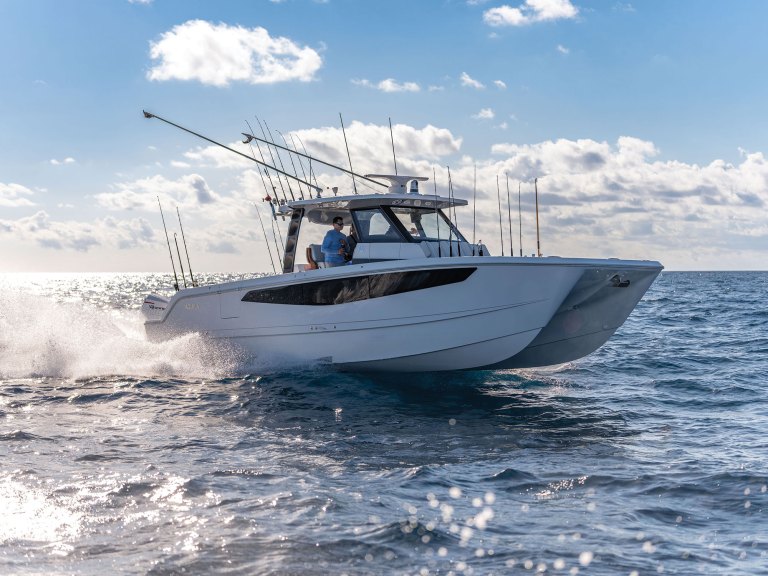
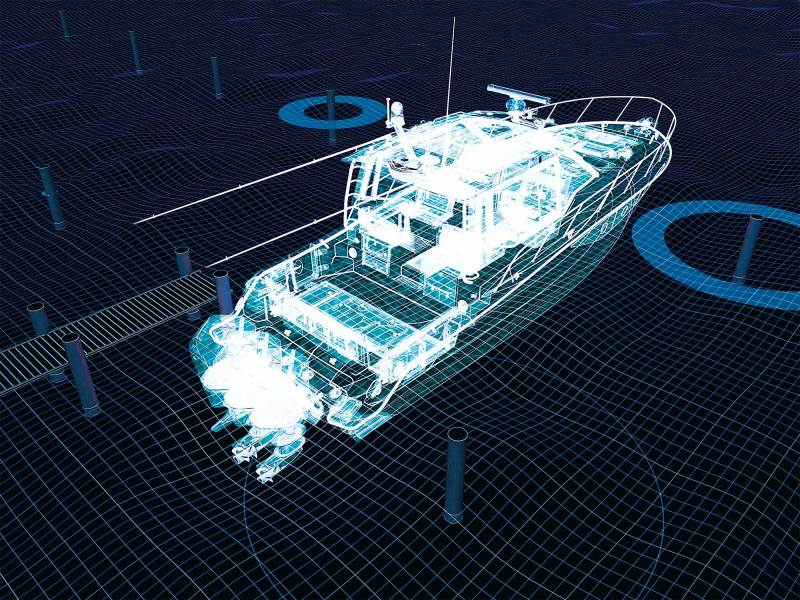
The Simrad AutoCaptain autonomous-boating system features full auto-docking capabilities, including docking, undocking, and short-distance maneuvers. Developed in collaboration with Simrad’s sister-brands Mercury Marine and Boston Whaler in the Brunswick family, the system I tested was integrated into a Boston Whaler 405 Conquest with triple Mercury 600 hp outboards with joystick piloting.
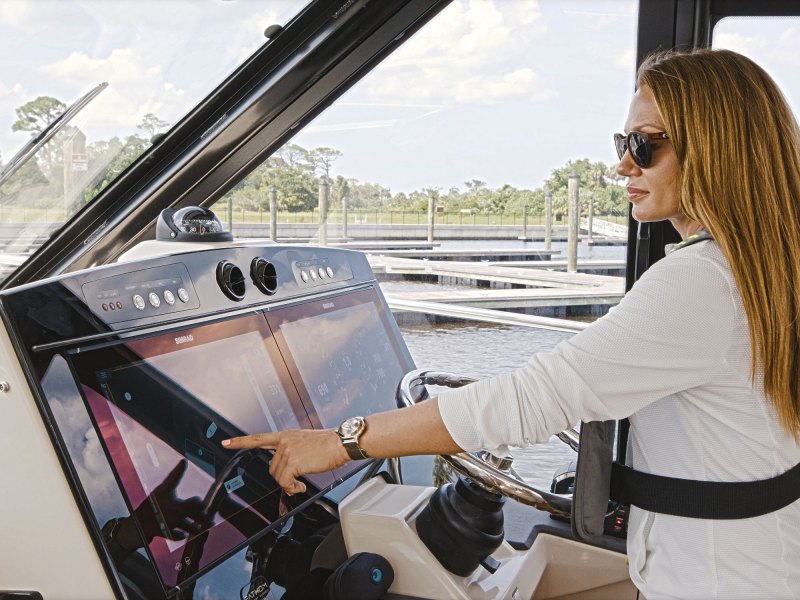
AutoCaptain is controlled with a Simrad touchscreen display that’s networked with an electronic brain/interface that reads sensors and controls propulsion and steering. Using the display, you simply drag the boat icon to the desired location then activate the docking or departure sequence. You can also make on-screen adjustments. Once the boat reaches the dock, AutoCaptain uses joystick piloting to remain on station.
To help guide its actions, AutoCaptain uses six depth-perceiving cameras. Activating by hand any other control such as steering, joystick or throttle immediately disables AutoCaptain.
The system automatically adjusts to counteract wind, current, and nearby obstacles. While some systems rely on GPS and require returning to a previously mapped location, AutoCaptain is designed to work anywhere—not just where the boat has been before, according to Simrad.
AutoCaptain worked well, but it took more time than I imagined it would to undock and dock. It moved deliberately, but slowly as sensor readings were carefully analyzed by the system’s electronic brain to ensure each move it made was ultimately safe. So sure are Simrad and Mercury of AutoCaptain that they were scheduled to offer the system as an option on new Boston Whaler boats shortly after my demo. To find out more, visit simrad-yachting/autocaptain.
Read Next: The World’s First Self-Docking Boat
Avikus Neuboat Control
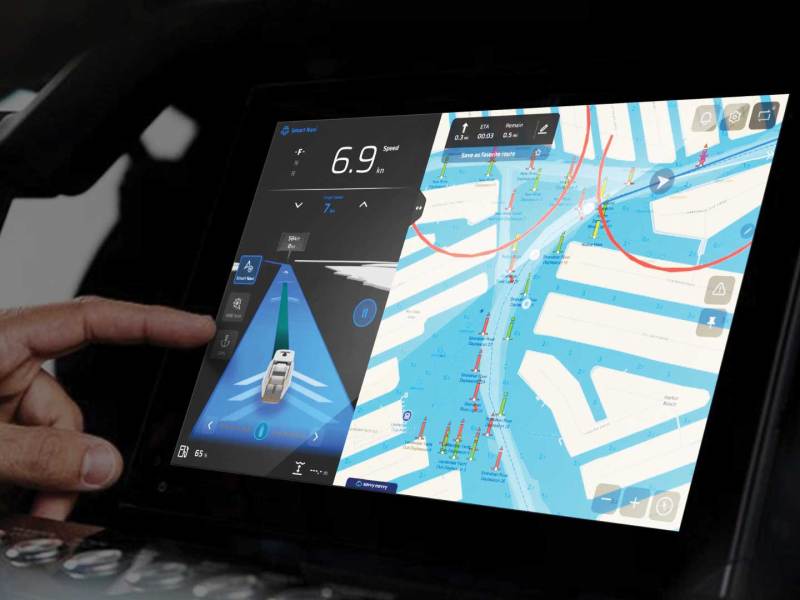
Docked just yards away from the AutoCaptain demo boat at IBEX was the Avikus semi-autonomous Neuboat Control demo vessel. Unlike AutoCaptain that benefits from integrating products from within the Brunswick family of brands, Neuboat Control assembles disparate brands. In the case of my demo, it was a Scout 330 LXF with twin 350 hp outboards from Honda Marine, which has signed on as a development partner for this system.
Avikus can tap into a huge technology base developed by its parent company, HD Hyundai and its Autonomous Navigation Technology subsidiary that serves the commercial shipping industry. Hyundai Automotive and its cruise-control technology contributes also to the Neuboat Control. The system can be controlled from virtually any multifunction device networked with the electronic brain.
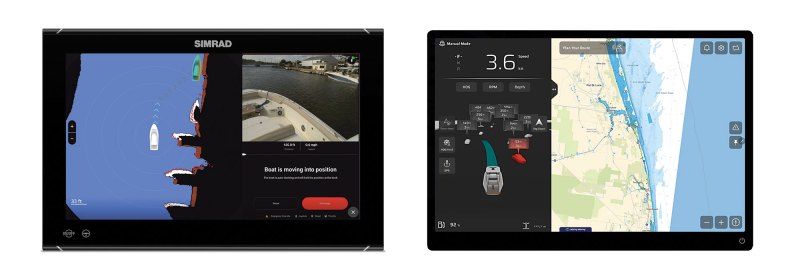
Unlike AutoCaptain, Neuboat Control offers both auto-docking, known as “Dock 2,” and semi-auto-navigation, known as “Navi with Control.” Sensors include a network of six machine cameras, lidar (laser indicating distance and ranging), marine radar and GPS. AIS is scheduled to be integrated in future systems.
In the navigation mode, the system was able to “see” and change course and speed when it sensed a potential collision with any vessel or other hazard. The cameras can detect objects up to 400 meters away, with a 200-meter detection range for the lidar, and 600-meter range for the marine radar. Maximum speed in Navi mode is 10 knots, so don’t expect to race autonomously across the water.
The impression of Dock 2 left me feeling like the Neuboat Control system exhibited more confidence and speed (in relative terms) than AutoCaptain during the demo of its departure and return to the dock. On the other hand, it’s almost certain that AutoCaptain will be available on new boats before Neuboat Control is offered as an option. That said, neither of these systems will be cheap. To learn more, visit avikus.us.