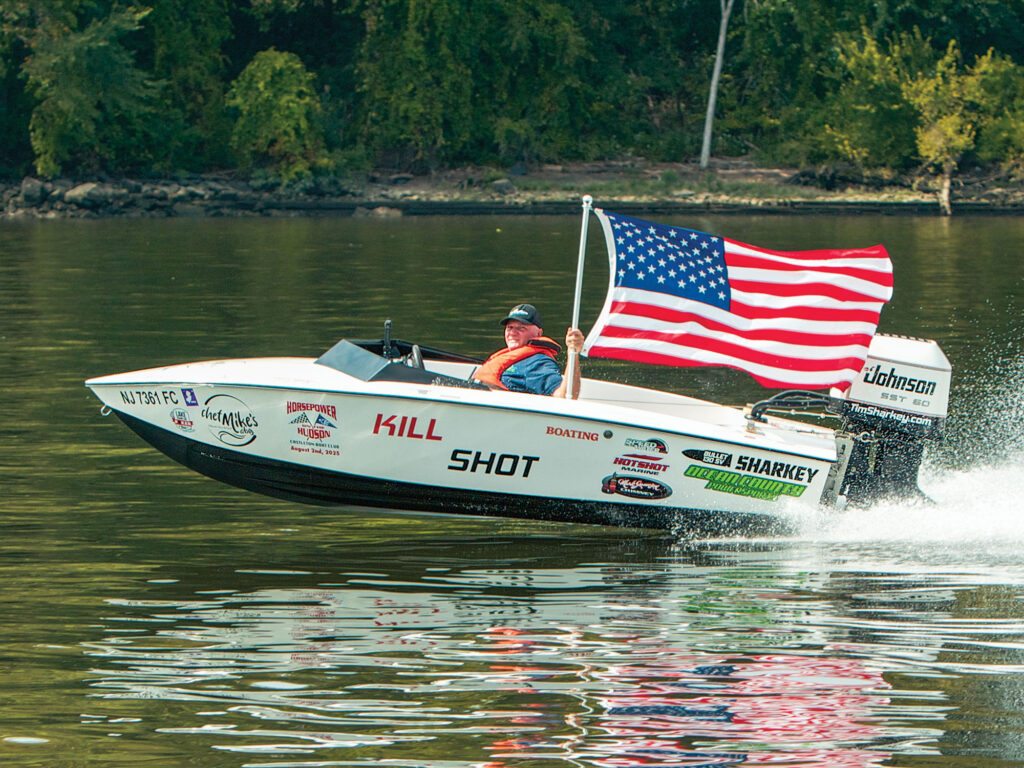
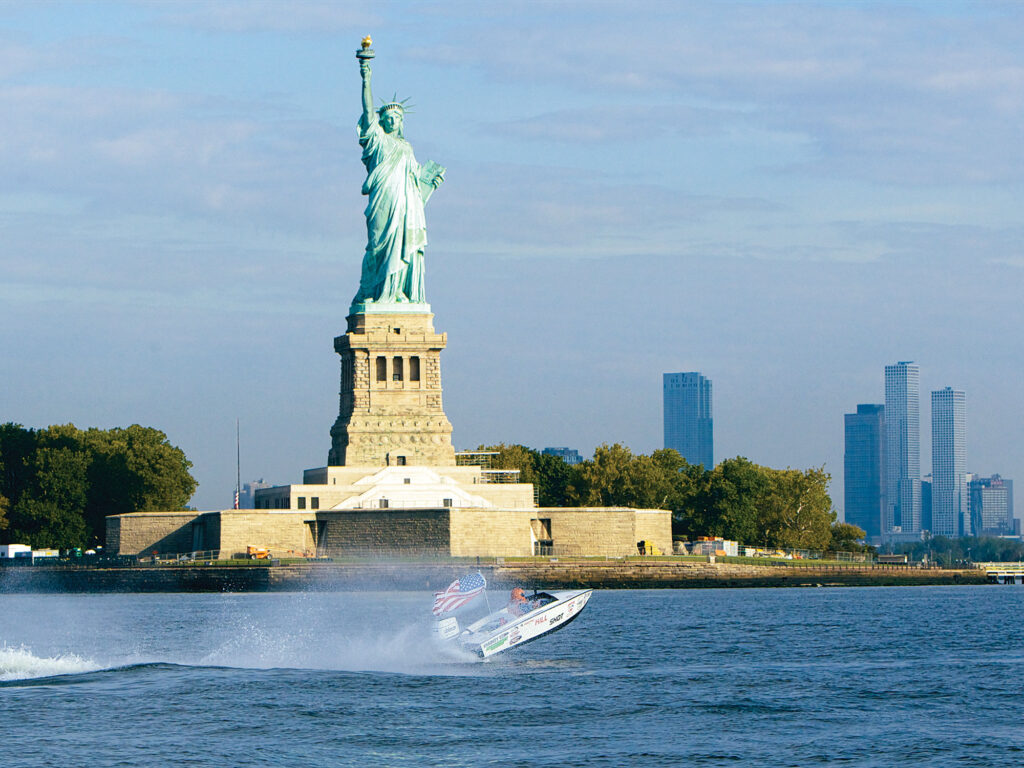
The sun had already risen to the east over Governor’s Island and Brooklyn, as Tim Sharkey launched the 13-foot Bullet that he first built and then restored himself. From Liberty State Park, he idled into the surprisingly calm waters around the Statue of Liberty. The day started crisp and sunny, a perfect fall day to enjoy time on the water. But Sharkey was not there to sight-see. In a matter of moments, he would hammer the throttle and the vintage Johnson SST 60 outboard—rebuilt by Boating contributor John Tiger—would propel him up the Hudson River, undertaking a 145-mile endurance run from New York City to Albany. Why? To honor deceased racing legend, Joe Sgro, to run an historic racing route, and to prove that with the right classic boat and engine, he could do it too.
Powerful Legacy
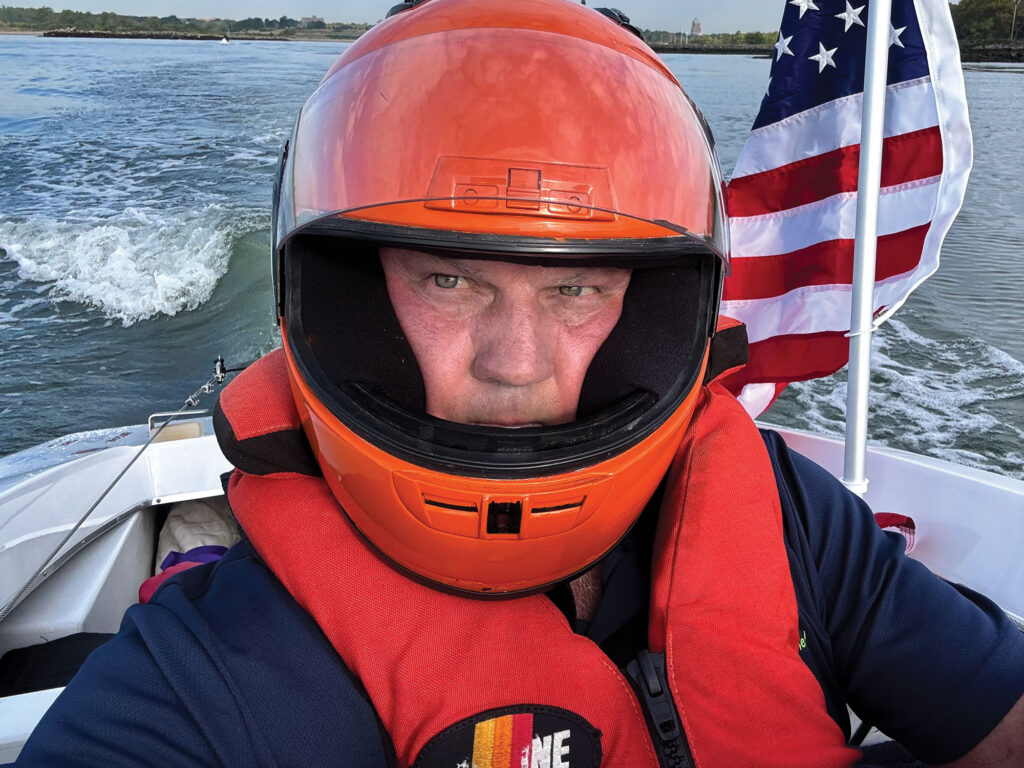
Sharkey, a New Jersey native, has been in the performance-boat scene for decades, including working for Bullet Boats in Wall Township, New Jersey, starting in 1985. He helped build several of the speedsters while also enjoying powerboat racing before branching into performance-boat photography, where he developed a legendary career as a shooter. In fact, doing shoots of poker runs that started in New York Harbor and ended upriver in Kingston, New York, first gave him the idea of doing a Hudson endurance run. His research led him to discover that sanctioned performance-boat racing on the Hudson dated all the way back to the 1920s. Indeed, back to the 1800s, the Hudson served as a proving ground for steamboats, and even ice yachts, that raced each other. They also raced against the trains that paralleled the river.
The tradition continued for many years. “I found a YouTube video of a race from 1949 that featured 316 entries from 18 different states, all with outboard power,” Sharkey recalled. “It was like the Indianapolis 500 back then.”
So, with a legacy deeply rooted in performance boating and a love of racing old Bullets, Sharkey kept the idea in his mind. The dream started to become a reality the day he found a 1985 Bullet SV 130, hull No. 23 in fact, available for auction on eBay. He bid for the boat, which he helped build back in the day, and started the refurbishing process to make the run. Only this time, he’d go farther up river, to the USS Slater, a World War II battleship that now serves as a museum on the water in Albany.
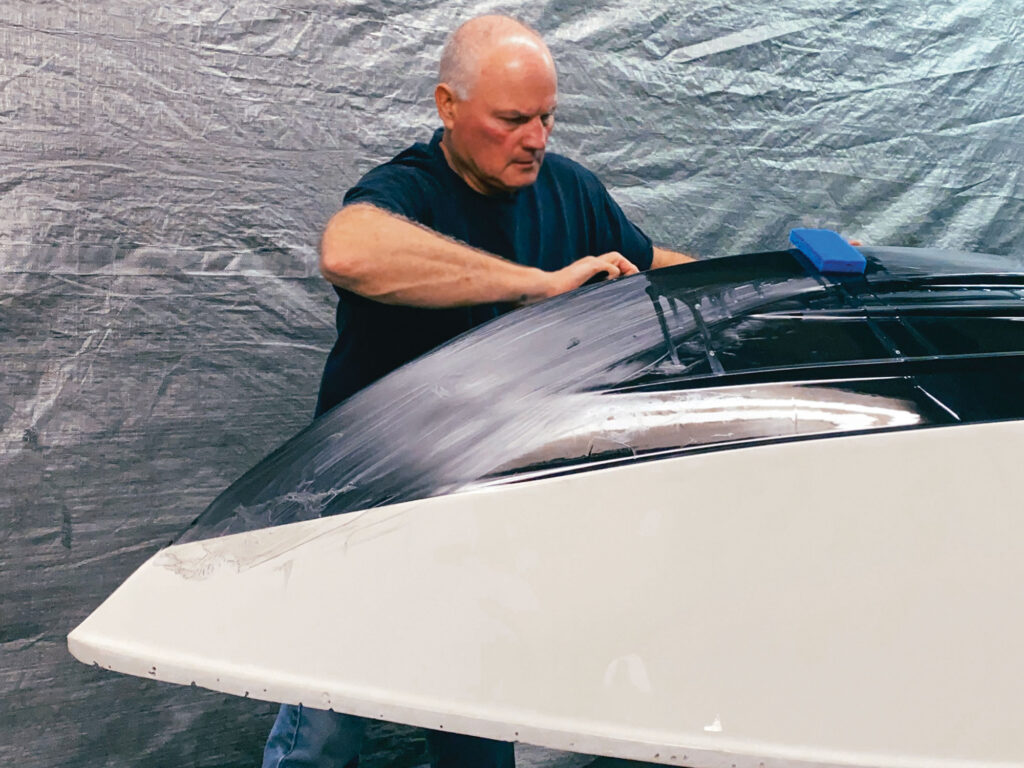
Reloading the Bullet
The Bullet SV 130 was designed as a sports boat meant to run with a 25 hp outboard. But Sharkey wanted more oomph. “I rebuilt it to handle anything I would want,” he said.
He started by adding U-channel hollow fiberglass stringers for increased strength while not adding excessive weight. He also added three additional bulkheads and bolstered the transom. “I built the hell out of it to handle rough water,” Sharkey explained. The Hudson often develops a brutally rough chop.
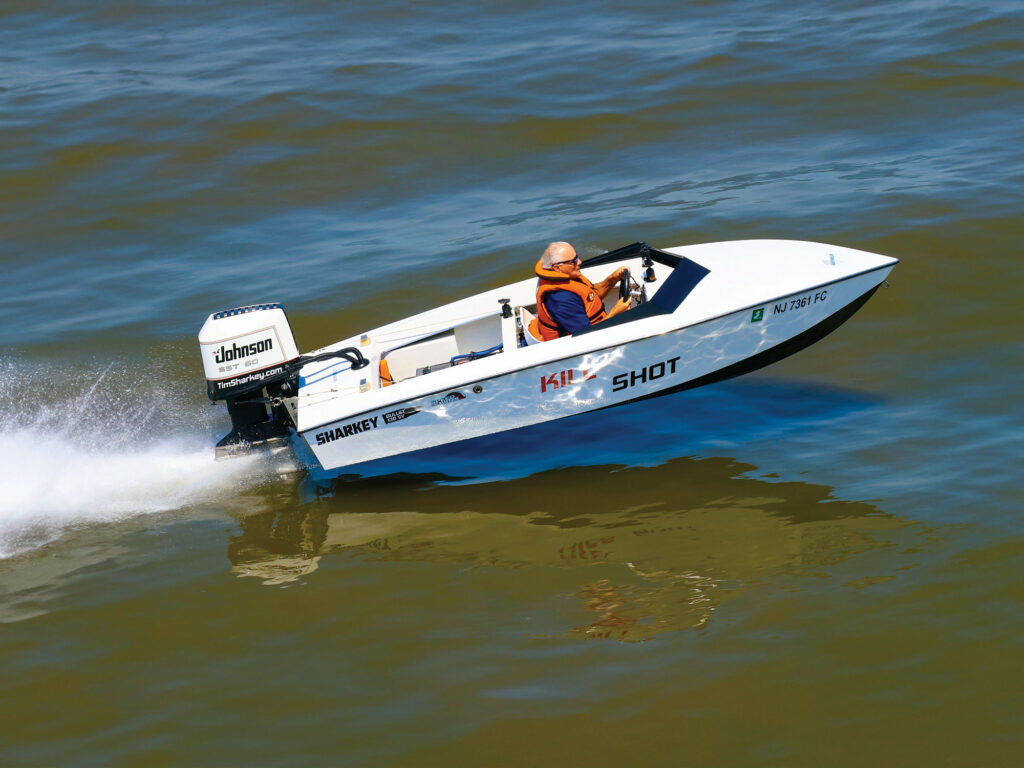
In addition, Sharkey built an entirely new deck of carbon fiber and Kevlar, expanding the width of the cockpit to allow side-by-side seating. He named this Bullet Kill Shot.
From there, Sharkey experimented with a few different engines before deciding on the old-school two-stroke Johnson SST60 outboard, originally built in 1989. To get the engine into prime shape for the run, Sharkey turned to outboard guru John Tiger of Tiger Outboards in Virginia Beach, Virginia—a frequent contributor to Boating who is also an expert at restoring classic outboard engines. After Tiger replaced the powerhead with the last one he could find available, he restored the engine to a lower unit capable of pushing the SV 130 to speeds in the 60-plus-mph range.
After three years of planning and refurbishing, Sharkey announced in January 2025 that he would attempt the run, lining up over a dozen sponsors and setting up a support team to complete the mission, as well as dedicating his efforts to the memory of the late Joe Sgro of Outerlimits Offshore Powerboats, one of his offshore mentors. Now all he had to do was run it.
Running Up River
With the refurbished Johnson, Sharkey initially expected to make the 145-mile run in three to three and a half hours while averaging 50 mph. He enlisted the help of Eric Reilly and Shane Mahieu to follow him in a 32-foot Sunsation center-console. Sharkey’s daughter, April, joined the support crew to help capture video. Kill Shot has a 22-gallon fuel capacity, so Sharkey stowed two five-gallon fuel jugs on the Sunsation in case he needed to refuel on the water.
At 8:42 a.m. on September 13, 2025, while idling in front of the Statue of Liberty, Sharkey gave the signal and hit the throttles and pointed upriver, blasting past Ellis Island and the southern tip of Manhattan, known as the Battery.
The waters of the lower Hudson are often riled with confused seas from the constant traffic of commuter ferries and commercial barges, as well as wind and tidal currents, but on this Saturday morning, the river proved surprisingly calm.
“I was expecting it to be much rougher, but it was a surprisingly easy ride all the way north past the George Washington Bridge,” Sharkey said. The calm seas, fair winds and fall sun continued upriver past the Tappan Zee Bridge and West Point, and it seemed as if the run would be as smooth as cruising on a local lake. With such great conditions, Sharkey was able to push the Bullet to a top speed of 57 mph. At that speed, he had a chance to make Albany before lunch.
Read Next: How to Ready a Racing Outboard
To that point, Sharkey’s biggest fear was striking floating debris or hitting a deadhead that could destroy the prop or even take out the engine’s lower unit. “That’s the biggest concern on that river,” Sharkey said. “You never know what’s floating downriver, especially with an outgoing tide.”
The smooth running continued all the way to Kingston, New York, about halfway up the river,when Sharkey pulled into Kingston Harbor to top off the fuel tank. But when he stopped, the Sunsation was nowhere to be found. Turns out that they, in fact, did hit some unseen debris and had to stop to ensure there was no damage. Fortunately, the support boat survived intact and delivered the five-gallon jugs to Sharkey. Onward to Albany.
Toughing It Out
When Sharkey restarted his run, though, everything changed.
“All of a sudden, the river bottlenecked and the wind direction changed directly against the current. The next thing you know, it was roller after roller after roller,” Sharkey said.
Fortunately, Sharkey had built his boat to handle rough conditions, but he still had to ease back on the throttles so that he didn’t personally take a beating. Driving for hours at high speeds can be physically demanding, especially since the Bullet’s classic cable-and-pulley steering system, with a drum helm—which Sharkey likes for its responsiveness—means he constantly has to counter the engine’s torque while under way.
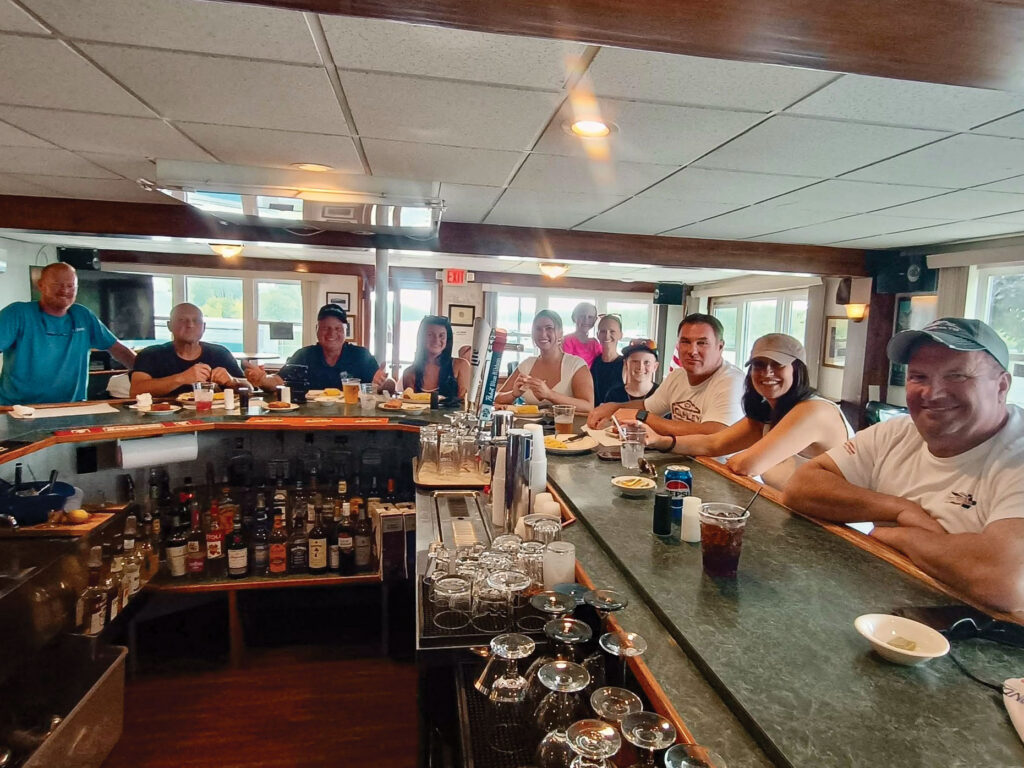
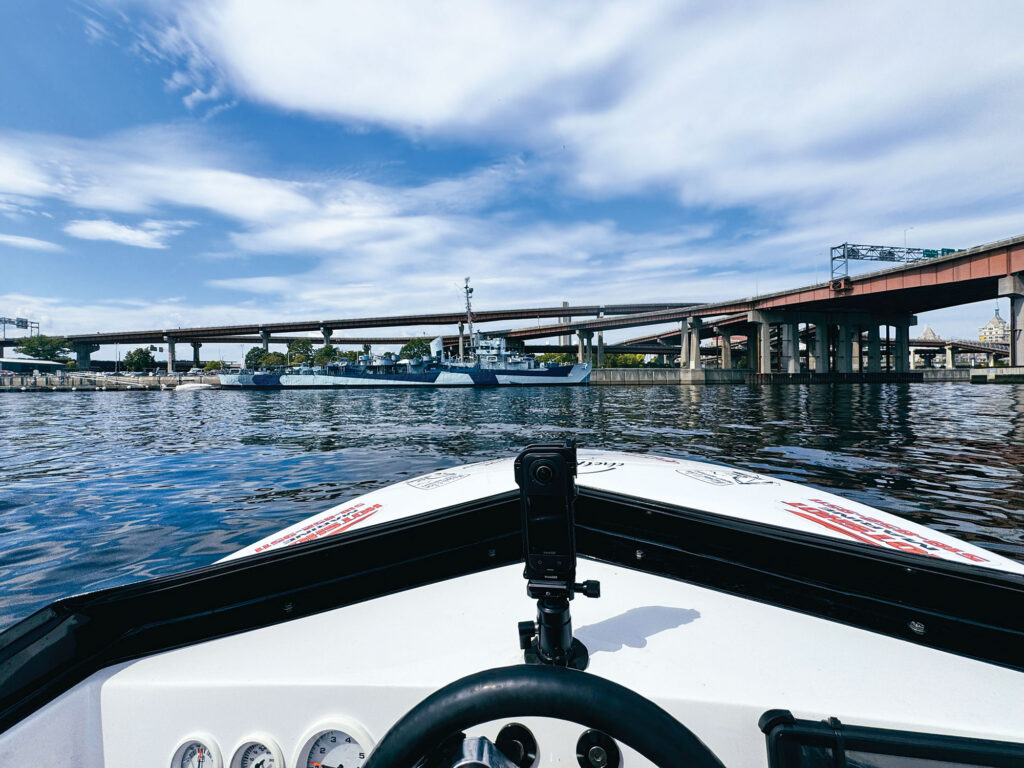
Luckily for Sharkey, the waters calmed again on the way into Albany and he could relax a little bit for the home stretch to the USS Slater. Sure enough, four hours, two minutes and 32 seconds after he took off from the Statue of Liberty, he pulled alongside the Slater in the heart of downtown Albany.
“To see that battleship at the end of the run, that was a great sight,” he said of the jounrey, one that took years in the making and a labor of love to get the boat right.
Overall, Sharkey averaged 36 mph on the run, and while his arms were tired, the rest of his body felt no worse for wear. He felt good enough to enjoy a steak dinner at the celebratory reception at the nearby Castleton Yacht Club, no doubt basking in the satisfaction that, 40 years after building Bullet SV 130 hull No. 23, he took it on a boating adventure of a lifetime.
Top Wrench
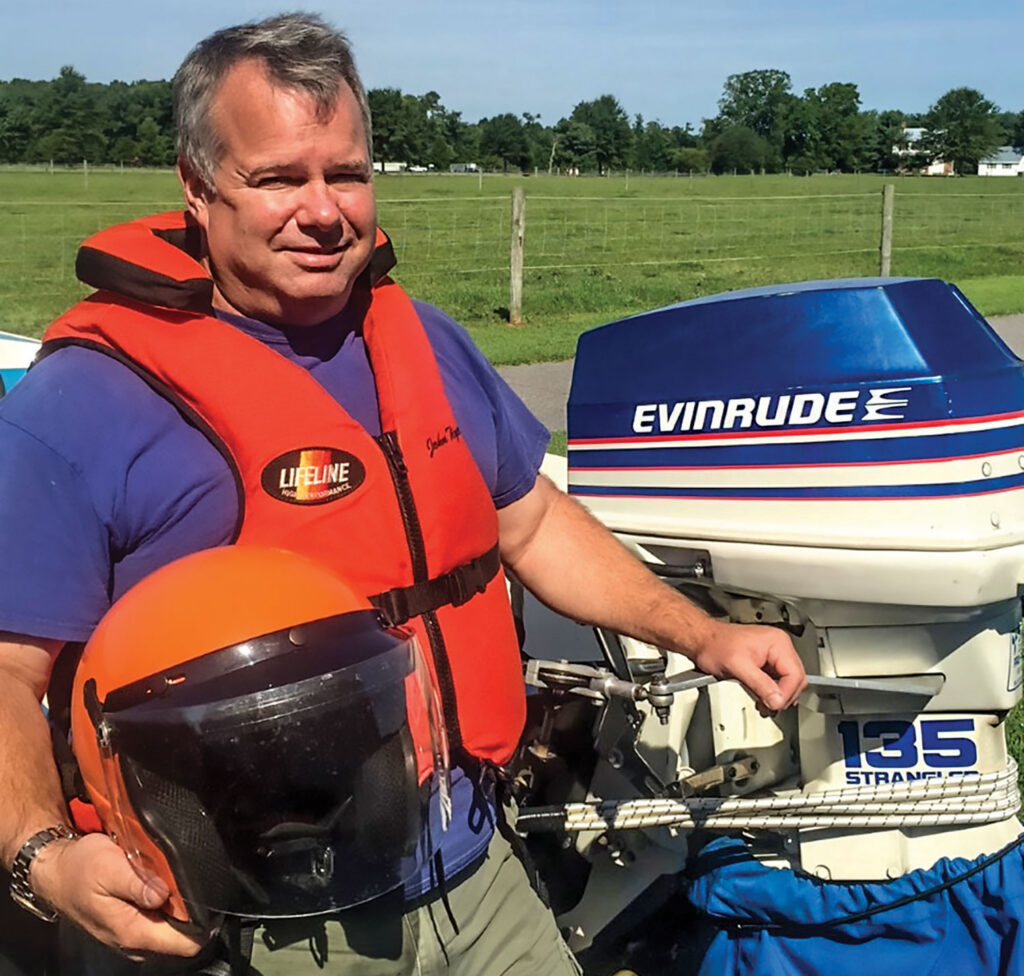
Tim Sharkey tapped Boating contributing editor John Tiger to tear down and rebuild his outboard for this run. Tiger, along with his wife, Laura, owns Tiger Outboards in Virginia Beach, Virginia.
We appreciate—and hope you do too—the technical expertise that Tiger contributes to Boating. He was happy to outline what is required when readying a racing engine and optimizing it for an endurance run. More than a tech and more than a journalist, Tiger has extensive experience actually racing powerboats.
“As the SST-60 is basically a ‘warmed-up’ version of the stock Johnson/Evinrude 70 hp of the day (1989), the engine was rebuilt stock; no modifications were made. The block was cleaned, cylinders measured for correct size and checked for taper and out-of-round conditions, then honed. Pistons, rings, bearings, gaskets and seals were all replaced with new parts. Fiber reeds were replaced with new reeds. Carburetors were ultrasonically cleaned and rebuilt with new parts.”
“The powerhead was then meticulously assembled according to the factory service manual. The exhaust housing/midsection was disassembled, cleaned and shimmed to remove any excess play and movement, to help Sharkey maintain boat control in rough water. The gear case was disassembled, inspected for wear, and resealed, with a new water-pump assembly installed.”
“After reassembly, the engine was started and run for approximately 45 minutes of break-in time on an engine stand before delivery back to Sharkey.” —Kevin Falvey