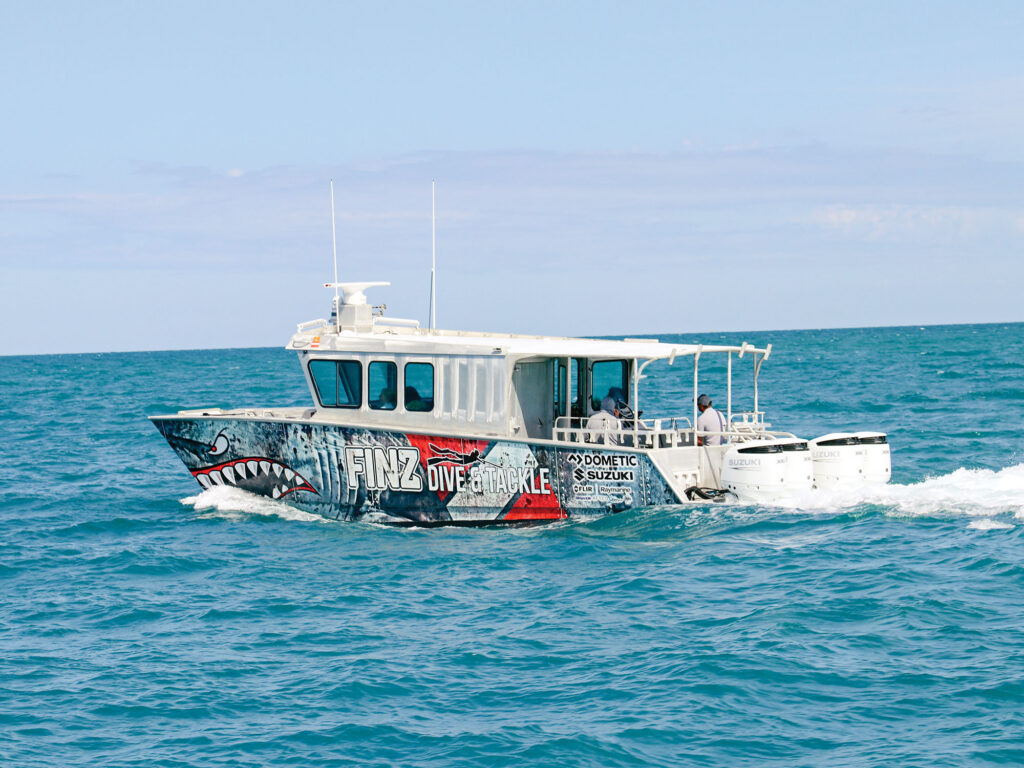
If boats had personalities, Capt. Robert Trosset’s 35-foot custom aluminum catamaran, Park Shark, would be a problem child. Whether tied up in Oceans Edge Marina in Key West, Florida, or making one of its routine 140-mile-roundtrip diving excursions to Dry Tortugas National Park, this boat was literally built to break the rules of hull design, stabilization, and providing electrical power.
One of the biggest rules this boat ignores is the conventional wisdom that you can’t install a gyroscopic stabilizer off-center. Trosset, who runs Finz Dive & Tackle in Key West, decided to ignore all this, and worked with a custom boatbuilder, Razorhead, in Iberia, Louisiana, to design a new flagship for his growing fleet. When I asked Trosset why he chose such a big, custom aluminum catamaran, he didn’t sugarcoat the answer. “I wanted what I wanted, and this was the only builder who didn’t call me crazy.”
Specifically, he wanted a huge interior cabin to accommodate six passengers in air-conditioned comfort, a full-stand up head, rack storage for 28 SCUBA tanks and a “landing craft” front ramp for storming the beaches of Forida’s Dry Tortugas and Fort Jefferson in D-Day style. He also wanted to provide customers with a new level of speed and comfort in all kinds of weather, making the 70-plus-mile run to Dry Tortugas National Park, doing multiple dives, spending time ashore exploring Fort Jefferson, and getting back to Key West the same evening. Lastly, the longtime captain wanted to do it all without the maintenance, weight, noise and carbon-monoxide hazard of an onboard generator.
Fortuitously, as Trosset was planning Park Shark, Dometic was getting ready to launch its DG3 Gyrostabilizer at the 2025 Miami International Boat Show. Dometic won a NMMA Innovation Award at the show and later won a DAME award at METS for its high performance and efficiency. By reaching full operating rpm in 16 minutes (versus an industry average 50 minutes), generating some of its own electrical power to slash energy consumption by 40 percent, eliminating hydraulics in favor of a proprietary Inverted roller screw design for precise dynamic control of the flywheel, and spinning down in less than 20 minutes rather than eight hours, Dometic eliminated many of the potential obstacles to installing and using a gyro aboard a boat like Park Shark.
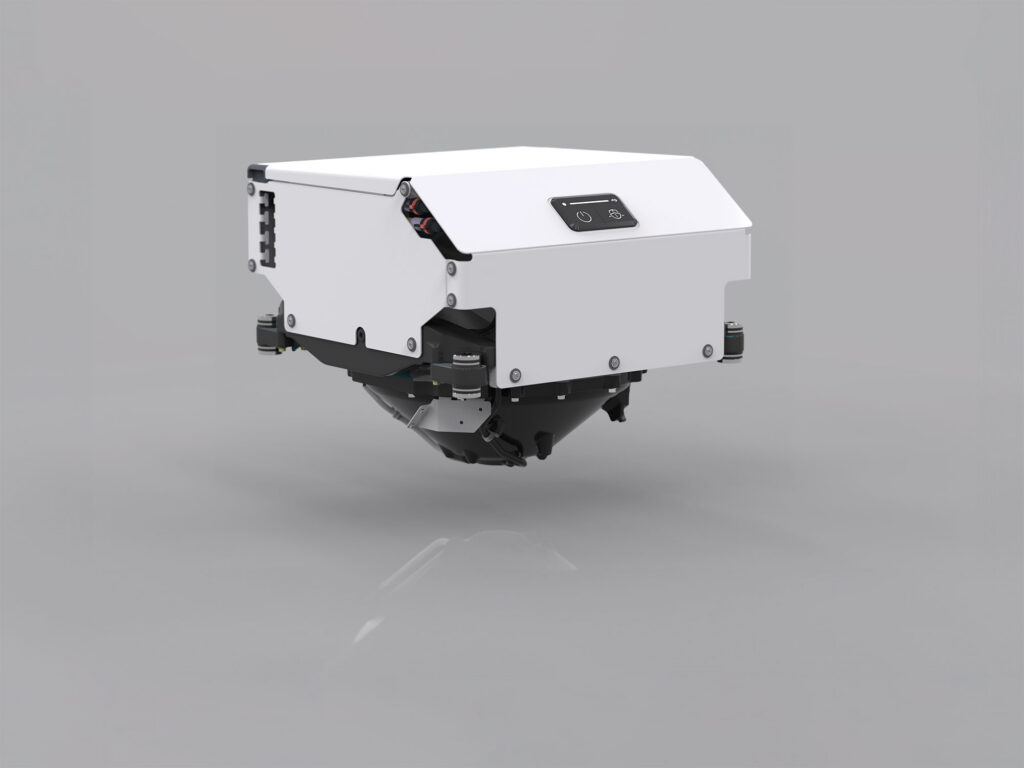
Trosset, a longtime field tester for Dometic, decided to make the DG3 gyro integral to his custom cat. “We talked a lot before the boat ‘went into the mold,’” Trosset said. Engineers from Dometic told Razorhead what was needed for the hull to support the gyro and meet the stress loads, and Razorhead built it to the provided specs. Because of Park Shark’s layout, the DG3 was installed in the starboard hull, well outboard of the vessel’s center line.
This off-center location raised questions. Because it was essentially installed at deck level and running inside an enclosed cabin with the passengers, more sound-deadening was added. Trosset balanced the DG3’s roughly 600 pounds by installing the batteries, power management system, and holding and water tanks on the opposite side, on the port side.
The eccentric installation defied the perception that a gyro must be installed on a boat’s center line to deliver effective roll stabilization—particularly for a boat as heavy and beamy as Park Shark. “The ride difference is even better than I expected,” Trosset said, whose fleet includes other catamarans. “Over 70-plus trips so far, our gyro has been a lifesaver when I’m drifting or anchoring in a beam sea, where the “snap roll” motion associated with twin hulls can make life miserable. It can be particularly bad when the space between the waves and the distance between the sponsons are roughly the same. I turn it on when I arrive at the boat, and it’s ready to go by the time I leave the channel. On the long run out there, it helps us land flat when coming off waves, making the whole ride softer, more comfortable and more fuel efficient. I never turn it off,” Trosset added.
Read Next: Maintenance and Storage Advice for LiFePO4 Systems
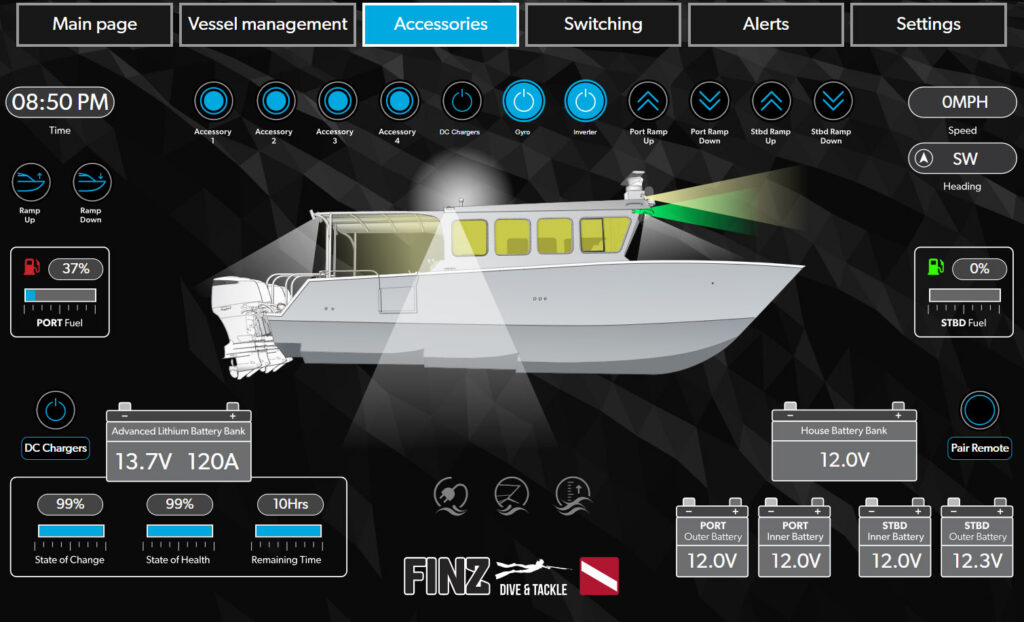
Dometic engineers are equally excited about the system’s performance and potential in this market. “Even though Robert’s boat is 23,000 pounds (finished weight) and we’re installed off to one side, our long-term testing shows he’s getting 85 to 87 percent roll reduction—in an application that’s way beyond the DG3’s specifications,” said Dometic Product Manager, Steve Watson.
Existing power-cat owners with boats up to about 34 feet could also improve their ride with a single DG3, according to Watson, and much larger cats can be accommodated with two units. “It requires two things to retrofit our gyro onto existing catamarans: installation space and support structure. The typical retrofit route includes replacing the leaning post and making modifications to support the floor structure beneath it.”
And if you’re not willing to sacrifice the leaning post to make room for a gyroscopic stabilizer aboard, you may still have options. Park Shark has proven there is more than one way to skin a cat.