
It was back in January, as we explored the Minneapolis Boat Show, when my good friend Chuck Larson stopped in the aisle facing a new pontoon. Chuck tilted his head left, then tilted his head right, and stroked his chin— all signs of contemplation. The man is capable of deep thought.
“OK, Mr. Boating magazine, explain it to me,” Chuck said after a moment. “What’s with the sawed-off bow on all these new boats? I’ve seen those so-called adventure boats—they look like dreadnought battleships from World War I. Now I’m seeing this look on lots of boats, even this pontoon. Did they use a Sawzall to cut off the end of the center tube? Is this function or fashion? Because to my eye, it sure ain’t pretty. Shouldn’t a boat look graceful on the water?”
It took two beers at lunch to explain to Chuck the plumb-stem concept, a design that has real function by extending the waterline length, and thus improving the efficiency of a displacement hull like those old dreadnoughts; the term was derived from “dread nought”—fear nothing. The look is apparently derived from the hull form of foiling sailboats that was adopted for Euro pleasure boats that have invaded the North American market, and now it’s spreading like the measles. If you’ve been around boats for a while, you may have seen other fashion statements pop up on the water. I can think of a few.
The integrated swim platform appeared in the late 1980s, and like the plumb bow, migrated from Europe. In fact, this magazine referred to early examples as “Euro-style” runabouts. A sleek platform molded as part of the deck replaced a traditional horizontal teak platform bolted to the transom of most inboards and sterndrives. The idea migrated to outboard boats where it enables elevated motor installation for enhanced performance and offers a secure, closed transom.
The radar arch, a molded composite basket handle that sprouted from performance boats in the early 1990s, may have had some function— as a place to mount a radar antenna so you could spot those DEA boats— but it became a “sport arch” style point on boats that were never equipped with radar. Should the arch angle forward or aft? Which looks faster? This one faded.
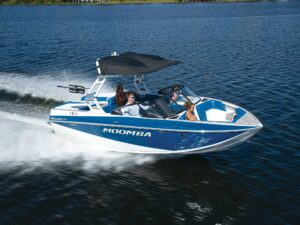
The pickle-fork bow debuted around 2003 on the MasterCraft XStar, a wakeboat penned by Peter Granata of Granata Designs.
Read Next: The Future of Boat Design
“MasterCraft wanted to increase the room in the XStar, and it also wanted to come up with a look that I would describe as sinister, just to appeal to the youthful wakeboarding market,” Granata said in 2003. “The broad bow gives you more space forward and a boarding platform at the peak. And the look is great.” This idea became widely adopted and many of today’s wakeboats still have a vestige of pickle fork. Even the new MasterCraft ProStar ski boat has a pair of little prongs at the bow.
Before we left the show, Chuck and I stopped at a MasterCraft booth to look at the ProStar.
“Now there’s a great new idea!” Chuck said, standing behind the ProStar. “I love the look of this teak swim platform. The perfect combination of fashion and function.”
I’ve noticed bell bottom jeans are back too.