The US Coast Guard requires that you carry a Type IV throwable personal flotation device (PFD) on board any vessel with a length overall of 16 feet or longer. Not only is one required, it must be “immediately available,” meaning it has to be stowed within arm’s reach of the captain and crew, and not buried in the bottom of a compartment. Here are three different styles to choose from to stay compliant and safer.
West Marine Throwable Cushion
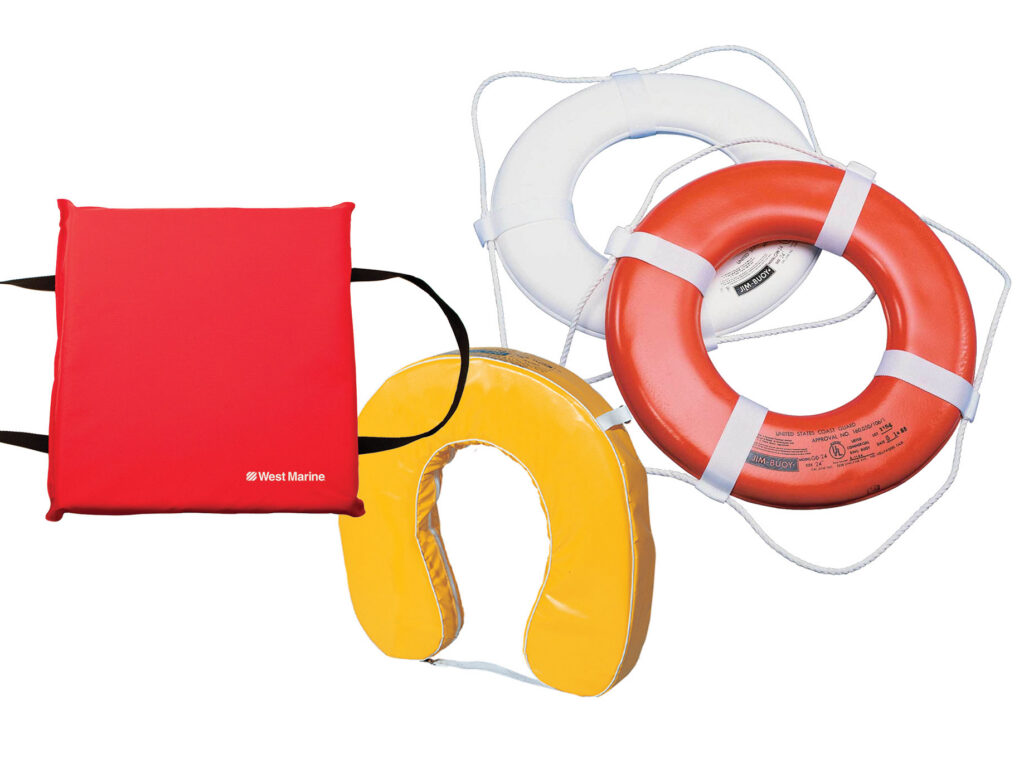
The Throw: The least-expensive option and the easiest to carry, a Type IV-approved cushion (above left) works because often people are already using it on deck as an actual cushion, so it’s easy to grab and throw. Cushions work well in situations where there’s little to no wind and the overboard person is able to put his or her arms through the cushion straps. Many boaters attach 30 feet or so of line to haul in an overboard crewmember after they grab it, though this is not required.
The Woe: Boat cushions are super lightweight and not at all aerodynamic, so they’re hard to throw long distances, and are particularly susceptible to wind. While they will help an overboard person float, they cannot keep them upright.
Price: $19.99; westmarine.com
Jim Buoy Ring Buoy
The Throw: With a hard vinyl coating and a buoyant urethane body, ring buoys (above right) are easier to throw than other Type IV PFDs, especially in windier conditions. They features a grab line, a lightweight rope loosely attached around the buoy’s circumference so that it is easier to retrieve and hold in the water. The donut shape allows for the overboard person to slide their arm through the center hole to make it more secure while awaiting pickup or being hauled back towards the boat.
The Woe: Its rigid body makes a ring buoy harder to stow in a convenient location, particularly on smaller boats with more cramped storage lockers.
Price: $99.99; amazon.com
Read Next: Four Top Inflatable PFDs Tested
Jim Buoy Horseshoe Buoy
The Throw: The main difference between horsehoe (above center) and a ring buoy lies in its shape, obviously an open-ended U rather than a small-diameter circle. Because of the U shape, it is possible for the overboard victim to slide it around their waste or even under their arm pits, depending on the person’s size and body shape.It also has a hard urethane body with a rugged vinyl coating so that it can maintain its effectiveness after long periods of storage without needing to be used.
The Woe: While its weight and rigid body make it easier to throw than a cushion, it’s typically harder to toss than a ring. It’s also harder to stow aboard a small boat due to its odd shape. It’s the most expensive of the three options.
Price: $299 for one with 50-pound-rated buoyancy; amazon.com