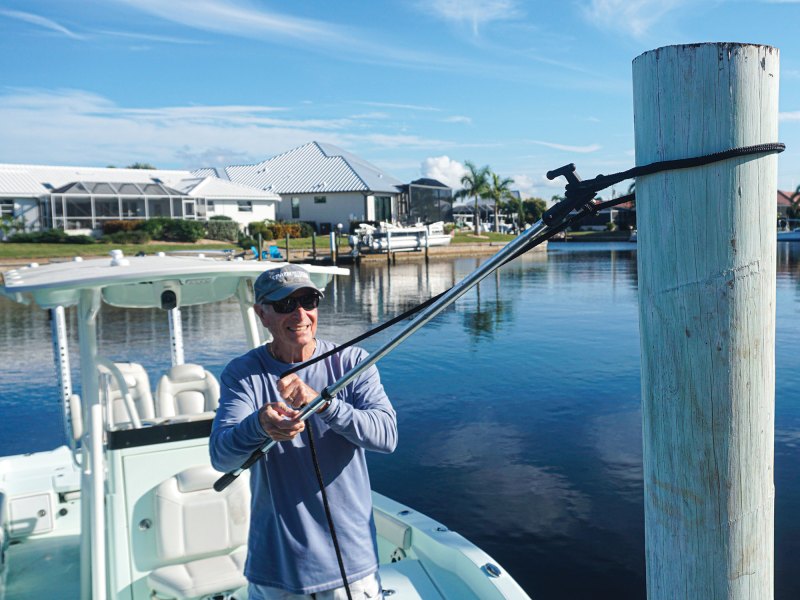
A good boat hook is one of the handiest tools any boat owner can have on board. Reach for your boat hook to fend off a dock or another boat to pull your boat towards a dock or mooring point, to snag a mooring ring or pass lines from a dock or piling, to retrieve objects from the water or even to assist in a man-overboard situation. Plus, a boat hook is great for snagging a cap or hat that blows off into the water. Boat hooks are available in a wide variety of styles, materials and lengths. Here are some tips for selecting the best boat hook for your vessel and situation.
Pole Material
Most boat hooks feature an aluminum pole, which is light enough to control with one hand and resists bending under pressure. A pole made of composite material may be even lighter and has the advantage of being non-conductive, but is usually more expensive than aluminum. A wooden pole with a bronze or stainless-steel working end offers a classic aesthetic, but will be much heavier than aluminum and thus harder to use in some situations. When shopping, check to see if the boat hook is designed to float if dropped into the water, as that’s bound to happen.
Telescoping vs. Fixed Poles
Telescoping boat hooks collapse for easy storage and extend when you need extra reach. The sections may be secured with a twist-lock mechanism or with cam locks, both infinitely adjustable, or with single-position snaps. A fixed-length pole will never jam and may be stronger than an extendable pole, making it a good choice if you have ample stowage and prefer a no-fuss tool. Nobody ever wishes they had a shorter pole, so it’s best to go with the longest pole your boat can accommodate.
Read Next: How to Cleat a Dock Line
The Hook End
A wide variety of shapes and materials are offered for the business end of the boat hook. A basic design has a rounded point for fending off and a hook for snagging a line or a dock cleat. The point should have a non-marring tip. Some designs have multiple shapes, with one intended for lifting and placing a line and another for hooking a line or a dock cleat.
There are also specialized tips (Hook & Moore, for example) and boat-hook accessories (such as the Sea-Dog Mooring Snap and Shurhold Dock-A-Reni) designed specifically to help attach a line to a mooring ring, piling or the eye of a cleat on a high dock.
Look for a boat hook with a removable working end, which makes it possible to replace a damaged working end or fit a brush or other accessory to the pole, turning it into a multi-use device. Shurhold, Star brite and West Marine, for example, all offer a wide range of accessories for their respective extendable boat-hook poles.
A boat hook makes docking safer—an investment that pays off every time you use it.
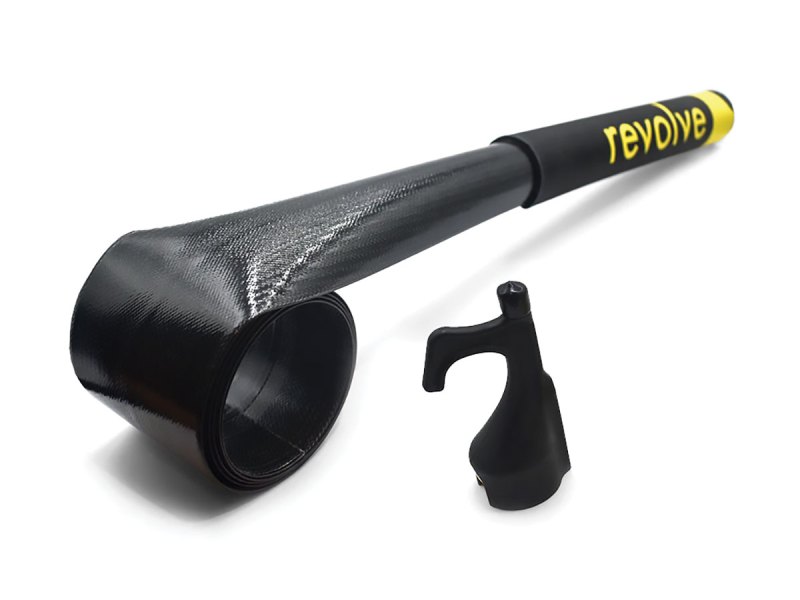
Revolve Tec Boat Hook
The Revolve Tec Boat Hook is the ultimate space-saver. Its lightweight (0.98 pounds) 6-feet-3-inch floating composite pole is split down its length so it can be rolled into a cylinder only 4.5 inches in diameter by 4.75 inches high—the size of a roll of toilet paper. It can be deployed in seconds by flicking your wrist and snapping on the hook end, or attach a brush and other accessories. amazon.com