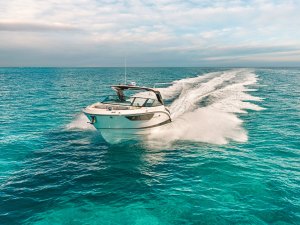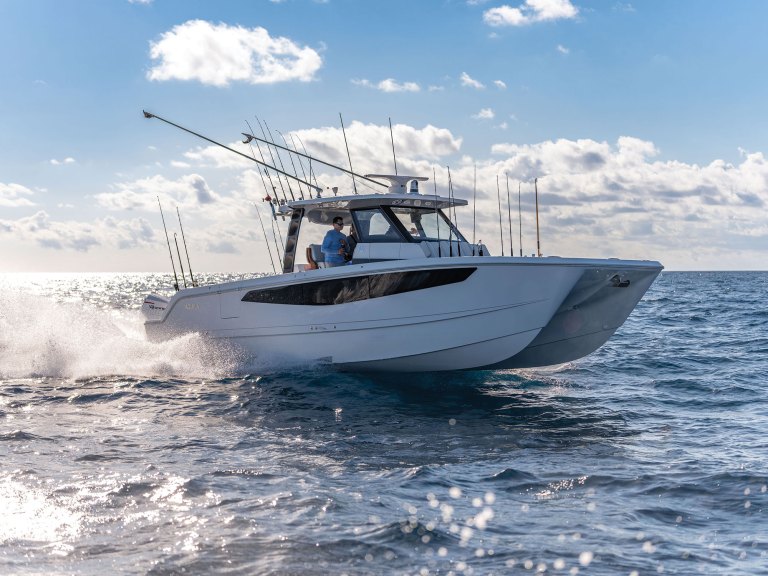
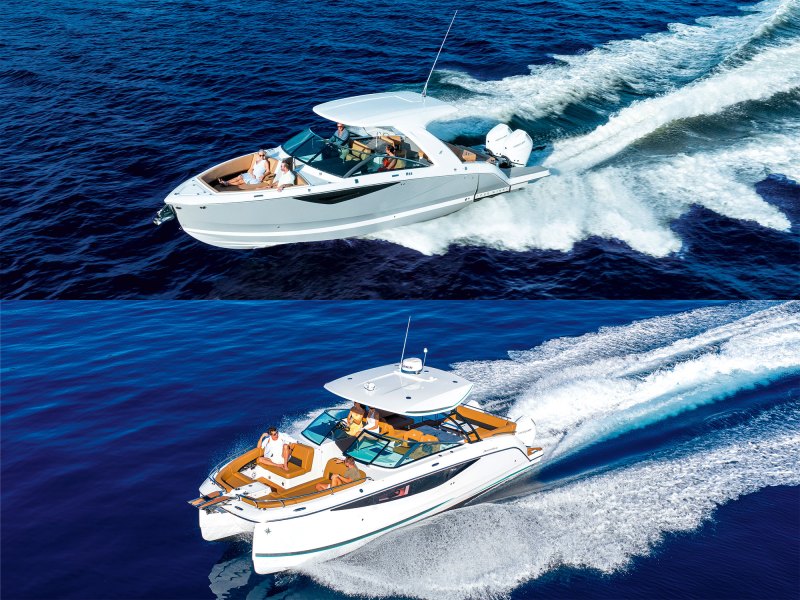
It’s a dilemma that happens all the time. A prospective buyer likes two boats that are about the same size and price. So how do they decide which one to buy? Recently, at a Beneteau press event in Jupiter, Florida, I saw two 33-foot bowrider dayboats with similar prices, but the Four Winns H33 was a monohull, and the Jeanneau TH33 was a catamaran. Because monohulls and cats have different characteristics, one will likely fit certain lifestyles better than the other.
In a situation like this, the best approach is to use a scoring system to rate each one across a variety of categories, then total the scores. I thought these two boats would be a good test of this method because they were simultaneously so similar, yet so wildly different in design. One benefit of approaching the boat-buying experience with such a tactical method is that it reduces the tendency to succumb to impulse, which is always a danger. Like choosing a life partner, picking the right boat means looking at all aspects, including the good, the bad and the ugly.
Keep in mind that not all categories are equally important. Take, for example, fuel capacity and range. For someone who only makes relatively short trips, this is of less concern. But for others, who routinely take longer cruises, fuel capacity and range are a big deal. Use a score sheet to keep track of each category’s decision, assigning a number from one to five, with five being used for a boat that shines in an important category. A score of one would go to either a boat that rates low in that area or is a trait that matters as much as a rodent’s posterior to you. Make a column for each boat, and at the end, add them up. The highest score identifies the best buy—for you.
Design Aesthetics
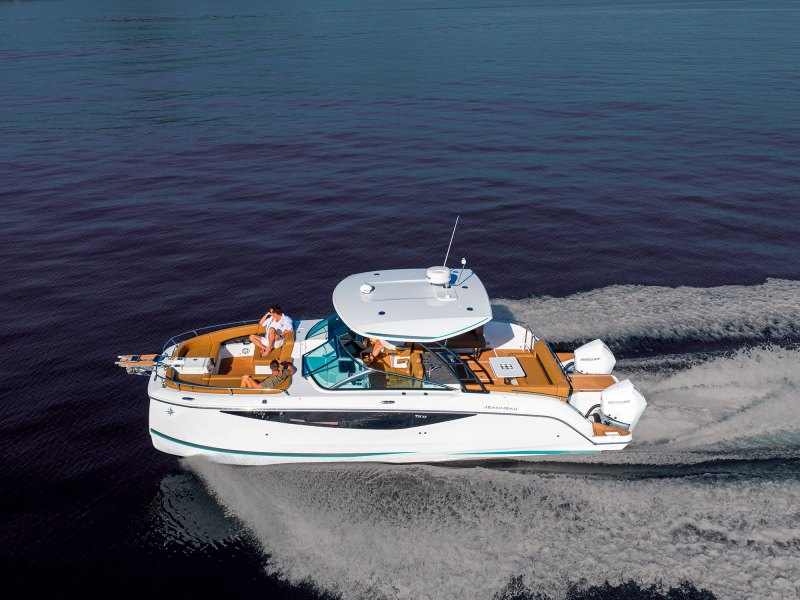
In general, most North American boaters have been lukewarm to power catamarans. While acceptance for big fishing cats has risen in the past few years, thanks to innovative new models from companies such as Freeman, Caymas, World Cat, Invincible and Twin Vee, the popularity of dayboat cats has remained flat. Why? The biggest reason could be that many recreational boaters have a mind’s eye image of what a boat should look like. Because anglers are more willing to go offshore in less-than-ideal conditions, they tend to value traits like seakeeping over aesthetics. So, fishing cats have had greater acceptance. Still, the way a boat looks is important and some just don’t like the way cats look. This category is one of those eye-of-the-beholder things. Score it as you see it.
Performance
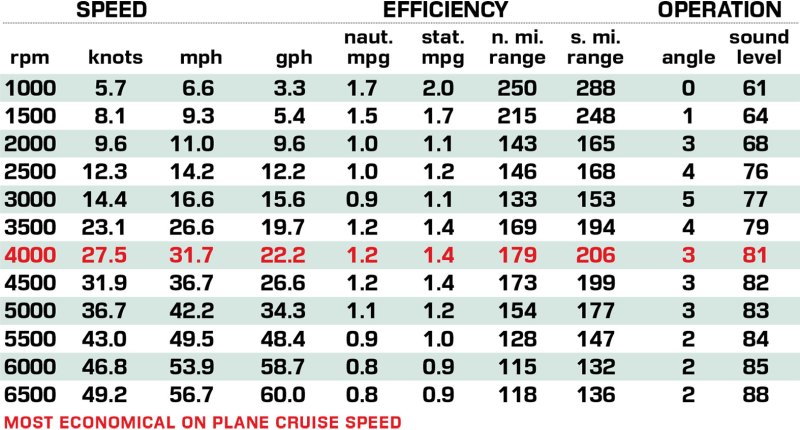
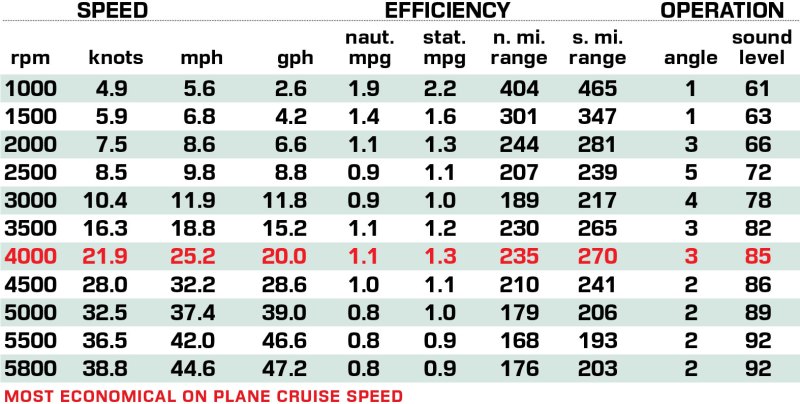
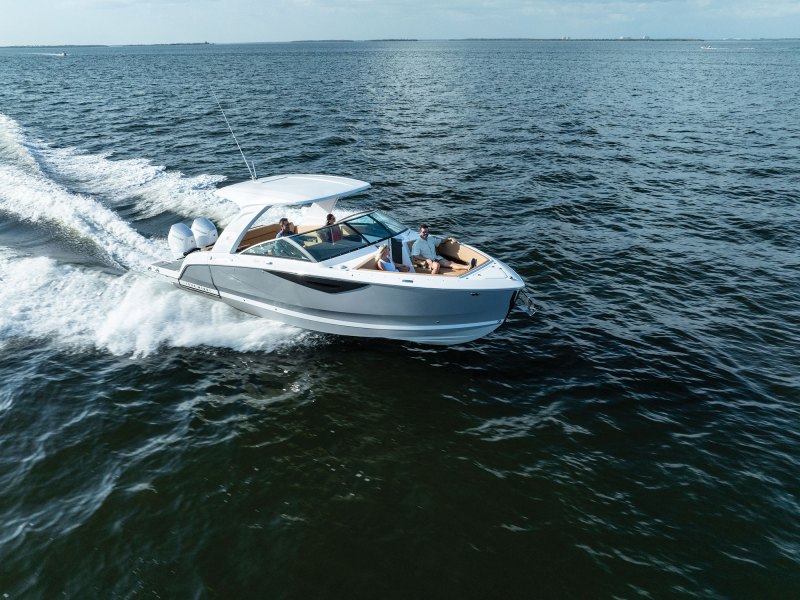
Although some cats are cheetah-fast, thanks to quad-engine packages that can total up to 2,000 hp, the Jeanneau TH33 fulfills a different mission. I tested the TH33 with its max power of twin Mercury V-8 Verado 300s and got a top speed of 44.6 mph. Boating’s Jeff Hemmel tested the H33 with twin Mercury V-10 Verado 400s, which is the max power for that boat, and it reached a top speed of 56.7 mph. It reportedly hits a top speed of 46 mph when powered with the standard twin 300 hp Mercury Verado outboard engine package, according to the Four Winns engineering team. Both boats offer either Mercury or Yamaha as power options (a feature we like because it gives buyers more latitude in selecting a dealer). The Four Winns H33 also offers sterndrive options from MerCruiser and Volvo Penta. Score the win for the Four Winns in this category.
Roominess
The biggest difference between these two boats may be beam width. While the Four Winns H33 has a proportionally wide beam of 10 feet, 6 inches, the TH33 has a 2-foot wider beam that extends all the way forward, translating to a whopping 400 square feet of deck space. This roominess makes this cat feel like a 40-footer. While the hull length of these two boats is 33 feet, the length overall—counting the swim platform—is 34 feet, 5 inches for the cat and 35 feet, 6 inches for the monohull. But the total usable swim platform space is similar, thanks to the huge space between the wide-set outboards on the cat. A big scoring advantage goes to the TH33 here.
Wow Factor
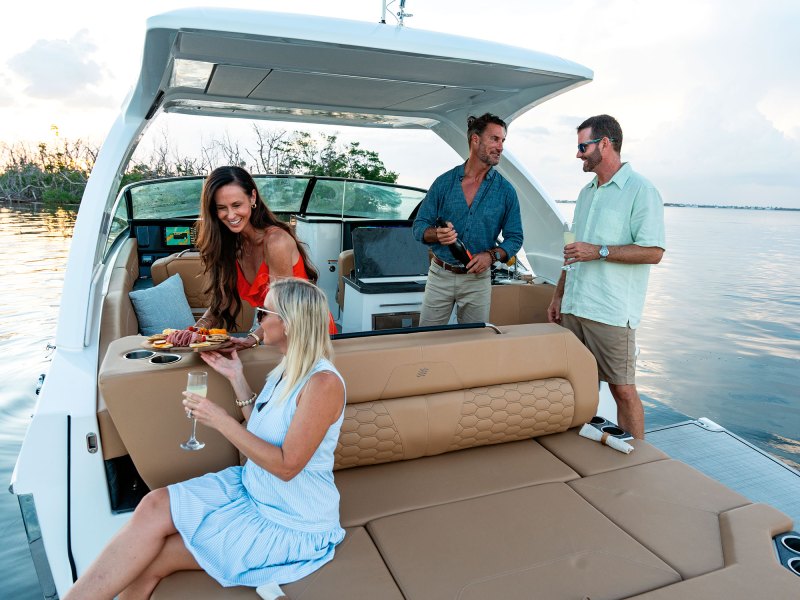
Face it, boaters love it when someone sees our boat and does a double take before giving it a thumbs up. Both of these boats will dazzle guests with plentiful, luxurious seating and upscale surroundings, but the Four Winns scores a bona fide James Bond moment when the owner electronically lowers the twin terraces to add some acreage to the cockpit. The catamaran’s ultra-wide beam creates a yacht-like vibe, which is hard to accomplish for a boat this length. Wow factor is another subjective category, so scores here are your call.
Entertainment Quotient
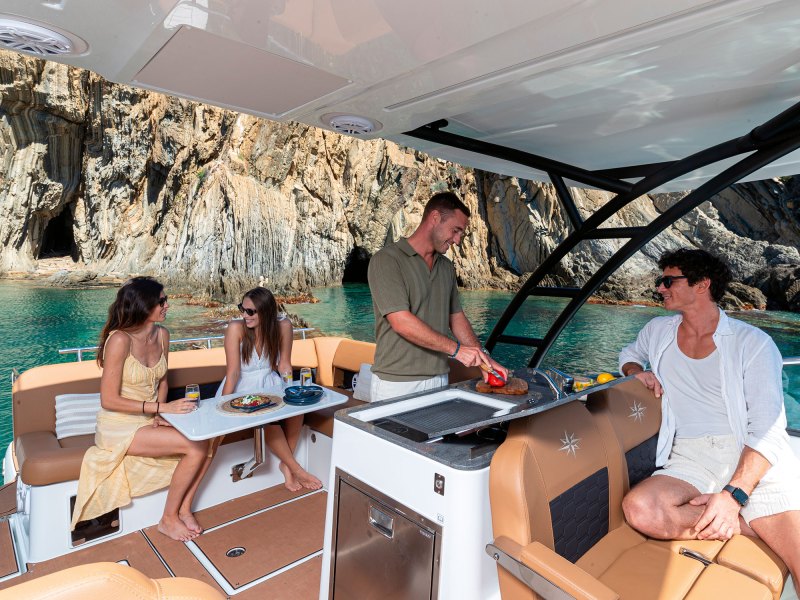
Both of these boats excel at their primary mission of providing a comfortable platform for enjoying a day or an evening on the water. With the addition of a summer kitchen, both boats can enable a skilled boat chef to do some culinary overachieving. The TH33 catamaran accommodates a larger group of up to 18, while the Four Winns H33 V-hull would be better suited to a dozen or fewer guests. The cat’s wide beam is inherently more stable at rest, so even sea-queasy guests will be comfortable. The Four Winns offers an equalizer, though, thanks to an optional Seakeeper 2 gyrostabilizer that will all but eliminate roll at anchor or when idling along on a sunset cruise. But the gyro is a $40,000 option. Both boats are entertainers, but the Jeanneau gets a slight nod for its ability to accommodate more guests.
Fuel Economy
The Jeanneau TH33’s twin 300 Mercury V-8 Verado outboards had to work harder to achieve a similar cruising speed compared to the Four Winns H33’s 400 horsepower Verados, but mpg basically equaled out. At 4,000 rpm the TH33 hit 25.3 mph burning 1.3 mpg while the 800 hp H33 revved 3,500 rpm for 26.6 mph and 1.4 mpg. Call this a wash.
Read Next: Sterndrive vs. Outboard
Fuel Capacity and Range
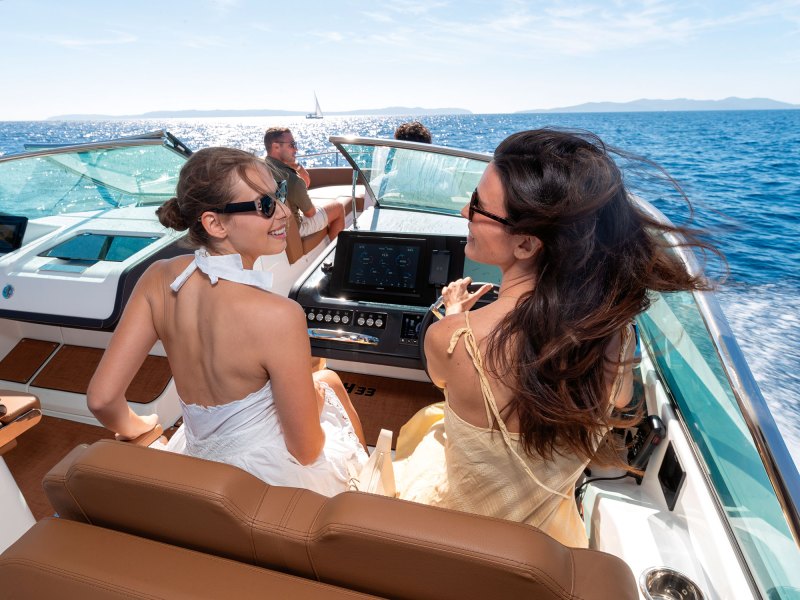
The Jeanneau TH33 comes with twin fuel tanks totaling 238 gallons, compared to the 160-gallon tank on the Four Winns H33. This capacity translates into extra range for the cat. If you take its 1.3 mpg cruise-speed economy times 238 gallons with a 10 percent reserve, this translates to 270 miles of range. By comparison, the Four Winns has a theoretical cruise-speed range of 206 miles. If this is important for your style of boating, give the cat a score of four or five.
Seaworthiness
Most catamarans offer a superior ride when running in choppy sea conditions, compared to monohulls of the same size. Although I didn’t get a chance to run the TH33 offshore, on test day, we experienced 23-plus-mph winds, and even the Intracoastal had a chop in spots. It was a busy stretch, so there were plenty of cruiser wakes to contend with, which were handled smoothly. It’s an easy boat to drive, and I liken it to driving a motorhome on the interstate. The trick is to run at a steady, but moderate planing speed that compresses air between the hulls to soften any potential impacts. The Four Winns H33 has a moderate deadrise of 17.6 degrees, which helps it get on plane quickly and provides good side-to-side stability, but it will fare less well in 3- to 4-foot head seas. If your brand of boating involves running in open water, give a higher score to the catamaran.
Handling at All Speeds
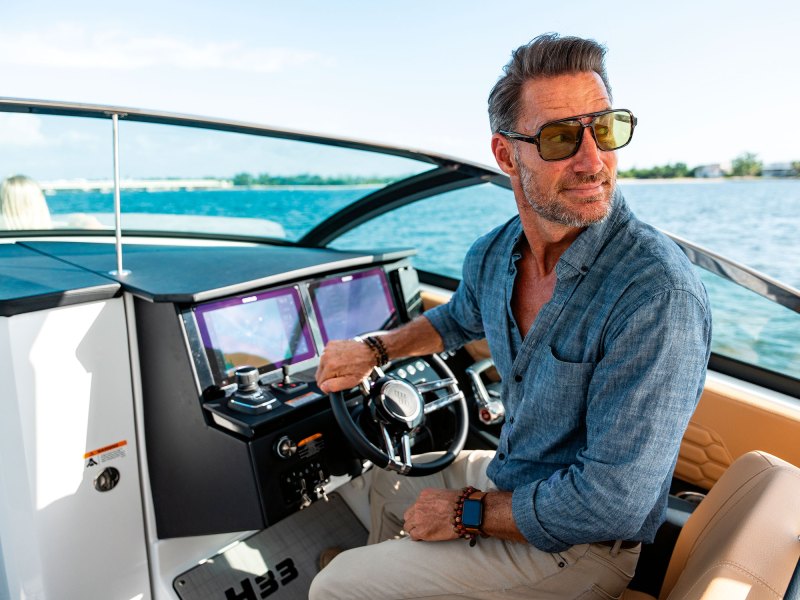
Both boats provide joystick control options, which help for maneuvering in tight quarters or holding position without tossing out the hook. The cat has more windage, which could be a problem when docking, but because the engines are set wide apart, its maneuvering—joystick, or no joystick—is more responsive. Impressively, with joystick controls, I made it move directly sideways into a 23-plus-mph wind. This maneuverability will come in handy because its wide beam means a tighter fit in slips. The Four Winns bow thruster option will help it get into tight spots. Both boats corner well. The cat displayed a slight lean inward during hard turns, while the H33 leans inward more and can carve a tighter turn in familiar V-hull fashion. Give the Four Winns a slight advantage in this category.
Overnighting Capability
Both bowriders are dayboats and are not designed as cruisers, yet both have compact cabins with berths that have plenty of headroom. The heads are yachtlike in their roominess and are well-appointed, though only the cat has a hot-water shower option. Another plus for the Jeanneau is that it has an option for an 8,000 Btu 12-volt air-conditioning system, which is a must if using it for overnighting in warmer climates. Plus, the TH33, like most cats, splits the accommodations, placing the head in one hull and the cabin in the other, providing phenomenal privacy. The edge here goes to the cat.
Comfort
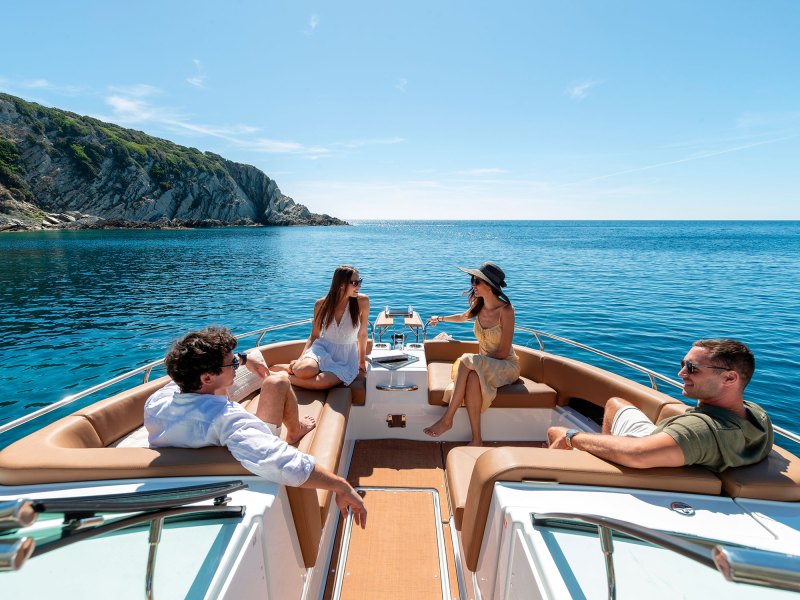
Both boat models feature first-rate seating. Because the full beam is carried forward on the TH33, its bowrider section is much larger and has more seating, making it a larger social zone. Removable seat bottoms add flexibility for riders who want to recline or sit with their feet on the deck. The amidships seating group is another large gathering spot, conducive to conversations. There are four forward-facing helm seats on the cat versus three for the Four Winns. The H33 scores extra points for the option to add an electronically extendable sunshade for the aft deck, which can be used while running. The aft sun lounger has a reversible seatback and, when flipped forward, offers a great place to recline. The scoring here depends on how many people an owner wants to entertain.
Dockage and Transport
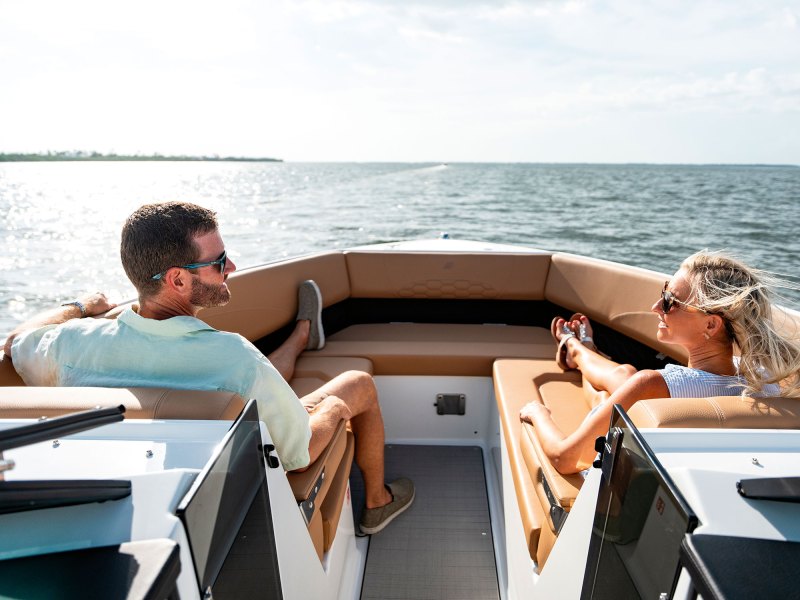
Although the cat’s 12-foot, 6-inch beam creates plenty of interior space, its exterior dimensions can pose a few challenges. For one, you may need to pay more for a larger slip due to its wider beam. Another issue comes if you need to tow it. Since the standard interstate lane is 12 feet wide, there’s a 6-inch overhang, which means jumping through more onerous regulatory wide-load hoops. In addition to permitting, most states will require a chase vehicle with flashing lights and other warnings. While the Four Winns beam of 10 feet 6 inches is also considered a wide load in all states, most only require permits, flags and signage. Score this in favor of the Four Winns.
Versatility
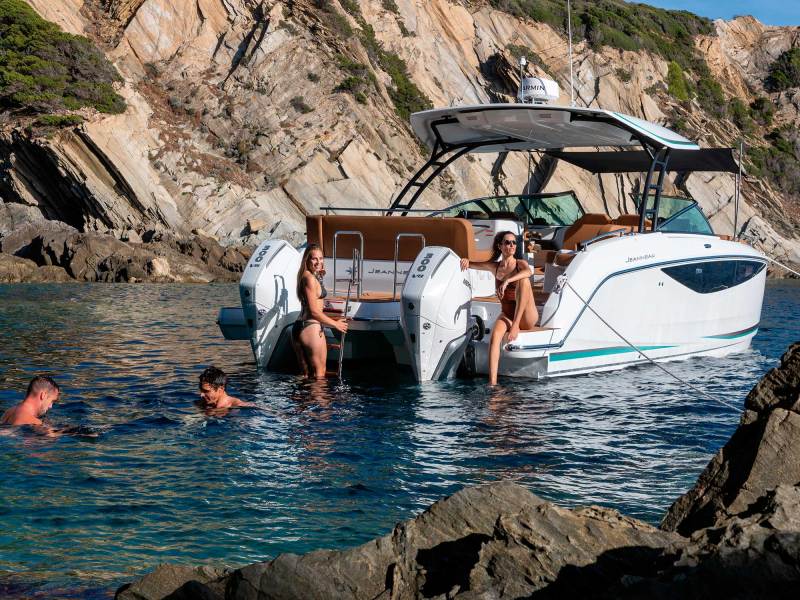
While neither boat is designed for fishing or diving, people like me will fish aboard any boat. Because the Jeanneau cat has low-profile railings on the transom and gunwales, rail-mounted items like rod holders and cutting boards can be easily added to help the occasional angler. The middle section of the swim platform, between the engines, is a good place to cast—away from guests—or to load and launch divers. There is also a giant insulated in-deck compartment that could hold several large tuna.
The TH33 would also make a better dive boat thanks to the deep in-deck storage, which could be rigged to hold tanks. The centerline-mounted dive ladder between the engines on the stern’s swim platform also makes it easier for divers to enter and exit the water in rough open-ocean conditions and has tall hand rails for safety. There’s also an option for a bow boarding ladder, which makes beach excursions a dry experience.
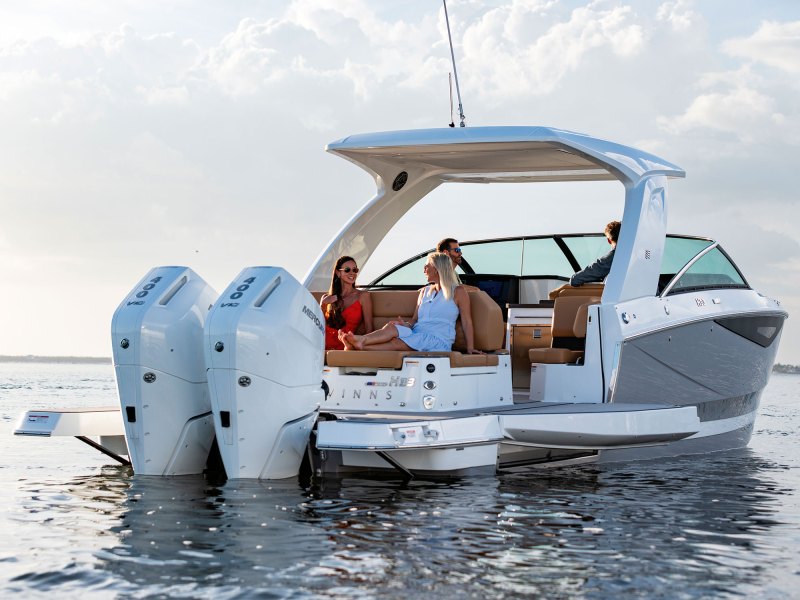
The Four Winns has a leg up if watersports are on the agenda, thanks to its greater maneuverability. There’s an optional ski tow, and because the outboard model still has the engine compartment where the sterndrive version’s engines would reside, it functions as a giant storage compartment that would be perfect for storing skis and oversized towable tubes, plus bicycles, cases of beverages and more. (The cat also offers huge in-hull stowage.) The Four Winns’ ladder sits side-saddle on the starboard side of its swim platform but angles outward to make it easier to use. The sterndrive version offers a huge, uncluttered swim platform that dwarfs the others. The scoring here depends on what extracurricular activities you intend to pursue. Score it accordingly.
Provenance
Because the Jeanneau TH33 is built in France, its price may be higher due to tariffs and other fees. Prospective buyers should check with their local dealer. The H33 was built in Cadillac, Michigan, so was not subject to import fees, but manufacturing will be moving as Beneteau has since closed the Cadillac plant. Buyers can calculate the price on the fourwinns.com website. Advantage Four Winns, for now.
Value
Because of the additional materials required to build a cat, the base price of the TH33 starts at around $500,000, compared to $414,000 for the Four Winns powered by twin Yamaha F300s. The price differential could be even higher for the Jeanneau due to current tariffs and the additional transport costs from Europe. Value, as opposed to cost, is one of those categories that are judgment calls.
Which is the Winner?
Everyone’s scoresheet should have a different total score because there is no inherently better boat between these two. Both are great entertainment-forward dayboats. By carefully considering the pros and cons of each, the right decision should be apparent. If not, there’s always the old coin-flip method. Heads you win, tails you win.
Four Winns H33 Pricing and Specs
| Price: | $414,000 (base; with test power) |
| Hull Design: | Monohull |
| LOA: | 35’6″ |
| Beam: | 10’6″ |
| Draft: | 3’4″ (outdrives up) |
| Displacement: | 13,585 lb. |
| Transom Deadrise: | 17.6 degrees |
| Fuel Capacity: | 160 gal. |
| Max Horsepower: | 800 |
| Available Outboard Power: | Twin Mercurys up to 800 hp or twin Yamahas up to 700 hp |
| Available Sterndrive Power: | Twin MerCruisers or Volvo Pentas up to 700 hp |
| Test Power: | Twin Mercury 400 |
Jeanneau TH33 Pricing and Specs
| Price: | $500,000 (base; with test power) |
| Hull Design: | Catamaran |
| LOA: | 34’5″ |
| Beam: | 12’6″ |
| Draft: | 3’2″ (sterndrives up) |
| Displacement: | 12,468 lb. |
| Transom Deadrise: | NA |
| Fuel Capacity: | 238 gal. |
| Max Horsepower: | 600 |
| Available Power: | Twin Mercury or Yamaha outboard motors to 600 hp |
| Test Power: | Twin Mercury 300 |
Speed, Efficiency, Operation