
Once upon a time, a 200 hp outboard was huge. Today, there are boats with a half-dozen 600 hp V-12s strapped onto the transom. But how did we even get here? And where are we going?
Ever since Gustave Trové put the first electric outboard motor on a rowboat—yes, the first outboard we can historically document was electric—people have been seeking ways to make outboards more powerful. First came the transition to gasoline-fueled engines, then one cylinder became two, four, six, eight and then 12. From Ole Evinrude’s first 1.5 hp commercially viable production outboard in 1907, these engines have grown steadily over time. As they’ve grown in size, they’ve also become more reliable, more efficient and quieter.
Do we really need all of this horsepower? Of course not. Truth be told, setting aside the mental-health factor, very few of us “need” to own a boat in the first place. But we sure do want them. And any boat owner can tell you, once you own a boat, it seems there is a never-ending urge to get a bigger one. But bigger boats need bigger powerplants, so market demand has constantly pushed for ever-larger outboards. Engine manufacturers have been more than happy to oblige. But it is not an easy task.
Weight is always a limiting factor, even as boat manufacturers redesign hull forms, weight distributions, and centers of gravity to account for larger, heavier outboards. The first wave of redesigns came with the transition from relatively light two-stroke motors to comparatively weighty four-strokes. These days, new outboards are often developed in tandem with boatbuilding partners who tweak boat construction and design specifically for the engine’s parameters. Still, it’s always a critical fight against weight, weight and weight—without sacrificing reliability. This is where technology, and especially the use of advanced computational abilities, comes into play.
“Our design-analysis capabilities allow us to run calculations today that result in better reliability, better integration, ease in manufacturing, and more,” said Tim Reid, Mercury Marine’s vice president of product development and engineering, after the introduction of the largest production outboard engine built today, Mercury’s mega-monster 600 hp V-12 Verado. “We can see where removing material will save weight without affecting strength, or where fatigue or stress of structural components may occur. In countless ways, these abilities allow us to put a better product into the customer’s hands.”
The ground-up development of that V-12 provided the opportunity to do more than merely provide the most power possible. It created a chance to rethink many facets of how outboards worked, and what might be done differently. An automatic two-speed transmission was added to bring larger, heavier boats onto plane quickly, then maximize efficiency at cruising speeds. A steerable gear case that eliminates the need for the entire engine to pivot was adopted, reducing the necessary mounting space to 27-inch centers and adding 15 degrees to the steerable range of motion. Both of these advancements are industry firsts.
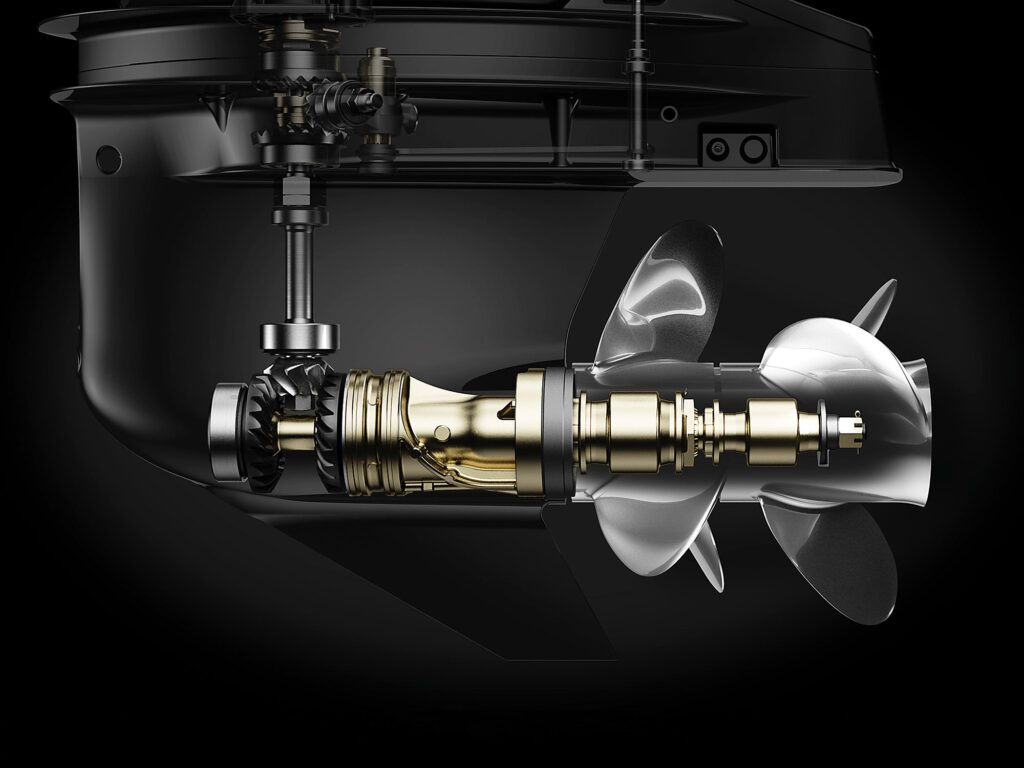
Contra-rotating propellers are yet another way in which manufacturers have boosted the ability of their engines to power larger, heavier boats. Suzuki is probably best known for popularizing this concept with outboards thanks to its DF350, which spins twin propellers on the same shaft. This radically boosts blade area (to the tune of 80 percent, according to Suzuki), goosing not only thrust, but also lift, to help bigger boats get over the hump and on plane. Slow speed and reverse handling improve as well. Utilizing contra-rotating props proved so effective for powering ever-bigger boats that Suzuki soon carried it over to its 300 hp range.
Existing outboard platforms have benefited from a tech boost in recent years, with Yamaha’s F450 and F350 outboards providing examples of making more horsepower with the same engine. In the case of the F450, an already advanced F425 (with touches such as automotive-style 2,900 psi direct fuel injection and plasma-fused cylinder walls) was cajoled into producing an additional 25 horses by merely discovering ways to improve airflow via the intakes and exhaust. And in the case of the F350, an extended stroke, a boost in compression ratio, improved airflow, carbon-coated valve lifters, and iridium spark plugs took Yamaha’s time-tested V-6 to a new level.

What comes next? The future is impossible to predict, but we’ll likely see more outboards over the 400 hp mark come from additional manufacturers. Honda crossed the 350 hp barrier this past year, and Suzuki has been there for a while, so there’s only one direction to go. Yet, while the ever-increasing horsepower measurements grab the headlines, the most significant change in outboard-power evolution might actually be found elsewhere.
Read Next: McLaren M300 Outboard
The days of smoke-belching, cantankerous, ear-splitting outboards are long gone. Today’s outboards are shockingly reliable, incredibly smooth and quiet, and far more efficient than those of yesteryear. Digital controls and joysticks make them easier than ever to operate. And therein lies the secret behind why we’ve seen the advent of massive outboards, multi-outboard rigs, and the overwhelming trend to replace sterndrives and inboards with these overgrown eggbeaters: It’s a vastly improved user experience. We know that we can depend on these engines, we can open up the throttles without covering our ears, and we can sit at idle without wishing for a gas mask. Finally, we can simply enjoy running outboard engines.
| Gasoline – Megajoules per Kilogram (approx.) | Modern Battery – Megajoules per Kilogram (approx.) |
|---|---|
| 46 | 0.7 |
Amping Up Electric
Despite electric outboards having an even longer history than their fuel-chugging brethren, electric-outboard-power progress pales in comparison to petrol. The problem isn’t with making the motors larger; you can find them on the market today up to the 300 hp range. The challenge is fuel. The energy density of gasoline is around 46 megajoules per kilogram, but the densest energy we can safely pack into a modern battery is closer to 0.7 megajoules per kilogram. In other words, you need about 65 times as much battery—by weight—to carry as much power as gasoline. For now, who wants to trade in a 100-gallon fuel tank weighing around 630 pounds when full for more than 40,000 pounds of batteries? No one. And that’s why it’s still uncommon to see those high-power electrified beasts out on the water. However, things are progressing. In the under-10-horsepower engine class, powering small boats—which generally don’t need to plane or boast a range of more than a few dozen miles—electric outboards excel. If battery manufacturers can find a technology that narrows the energy-density gap, then you can expect the popularity of larger electric outboards to grow quickly.
What About Diesel?
Many boaters, especially those wishing for single-source fueling of both the mothership and its yacht tender(s), have questions about using diesel-fueled outboards. While there have always been options, diesel outboards haven’t quite hit prime time. Their horsepower-to-weight ratio has been a challenge. Still, there’s been tremendous advancement on that front in recent years. We now have diesel outboards that replace the prop shaft with a carbon-fiber belt, and diesels cast with narrow-angle aluminum engine heads, which are capable of high compression. Just a few decades ago, a horsepower-to-weight ratio of 0.19 horses per pound would have been the norm. Today, it’s commonly more like 0.35 horses per pound, and Cox offers a twin turbocharged V-8 diesel outboard in 300 and 350 hp configurations that reaches a more-than-respectable 0.4 horsepower per pound. That still falls short of the 0.5 or so horses per pound you’ll sometimes see for some gasoline-fueled models, but the gap has lessened measurably. Diesel is now a viable alternative for some boaters and is expected to expand its footprint in the marketplace.