Editor’s Note: This article was created using AI to extract a transcript from videos produced by Boating Magazine and linked in the article. The resulting text was edited and vetted by Boating editors.
The idea sounds almost too simple: take a pair of experienced anglers who have never fished from a personal watercraft, hand them the keys to Kawasaki’s Ultra 160 LXS Angler, and turn them loose in some of Florida’s most productive fisheries. The result? Four days of hard-fighting fish, long runs offshore, and a fresh perspective on what a fishing machine can be.
Boating Magazine teamed with Kawasaki to put the Angler through its paces in real-world conditions by teaming-up with some of the hottest angling content creators going.
Ryan Izquierdo (YT: @RyanIzFishing) headed to Pensacola on Florida’s Emerald Coast, while veteran Tampa Bay anglers Tyler Wald (YT: @SunsOutfFishing) and Brent Schirmer (YT: @SeeYaDude) explored the grass flats, bridges, beaches, and offshore structure of west-central Florida. By trip’s end, these seasoned fishermen had caught loads of fish in a variety of conditions. How did the Kawasaki Ultra 160 LXS Angler measure-up in this real-world test?
Pensacola: Big Water, Bigger Kingfish
Ryan arrived in Pensacola curious but skeptical. Four days later, he had logged offshore miles, worked bridge structure, and landed the largest king mackerel of his life.
The adventure started nearly 30 miles offshore. Running deep into the Gulf with a support vessel carrying fuel and camera crews, Ryan and fellow creator John targeted reefs and hard-bottom structure with jigs and slow-trolled artificials. The first strike came from a blacktip shark, but the action quickly escalated when they found structure loaded with vermilion snapper, amberjack, and jacks.
Then came the trip’s defining moment.
A squid-style soft plastic was crushed by a fish that immediately peeled line from the reel. After a blistering fight, a king mackerel estimated at roughly 35 pounds surfaced alongside the ski. Ryan called it the biggest kingfish he had ever landed.
The offshore session also produced colorful juvenile red snapper and plenty of action before the long ride back to shore.
Later in the trip, Ryan shifted his attention to Pensacola’s famous bridge systems. Long runs to the Garcon Point and Three Mile bridges put him within casting range of bull redfish, black drum, sheepshead, and flounder. Working swimbaits and live shrimp around the pilings, he connected with a bruiser black drum and a mixed bag of inshore species.
But one fish still remained on the checklist.
On the final morning, with a flight looming just hours away, Ryan made one last run to Three Mile Bridge. His first cast with a swimbait produced the fish he had been chasing all week—a beautiful redfish pulled from beneath the pilings while seated aboard the Kawasaki Angler.
Mission accomplished.
Tampa Bay: From Inshore Slam to Offshore Grouper
Across the state, Tampa Bay offered a completely different test.
The local angler knew the fishery intimately but had never chased fish from a jet ski. His goal was ambitious: catch as many species as possible while exploring both the inshore and offshore potential of the platform.
The trip began along Gulf beaches and oyster bars. While the pompano failed to cooperate, spotted seatrout and redfish quickly found their way to the cooler.
Day two delivered the kind of action every Gulf Coast angler dreams about.
After catching threadfin herring at daybreak, the crew worked mangrove shorelines and beach structure. A live bait pinned tight to the mangroves disappeared instantly beneath the surface, resulting in a slot-sized redfish. A short time later, a chrome-bright snook exploded on another bait. As evening settled over the bay, a move to nearby grass flats produced a healthy trout on topwater.
The result: a Tampa Bay inshore grand slam—snook, redfish, and trout—all from a jet ski.
The final day shifted offshore.
Following a camera boat to productive hard-bottom structure, the anglers found a bite that bordered on ridiculous. Mangrove snapper attacked cut bait immediately after it hit the water. Live baits produced gag grouper, while soft-plastic paddle tails accounted for red grouper. By day’s end, the tally included multiple species of snapper and grouper, proving that the Angler is fully capable of handling serious offshore fishing missions.
Built for the Task
What impressed both crews most wasn’t just the fishing—it was how naturally the Kawasaki Ultra 160 LXS Angler adapted to the job.
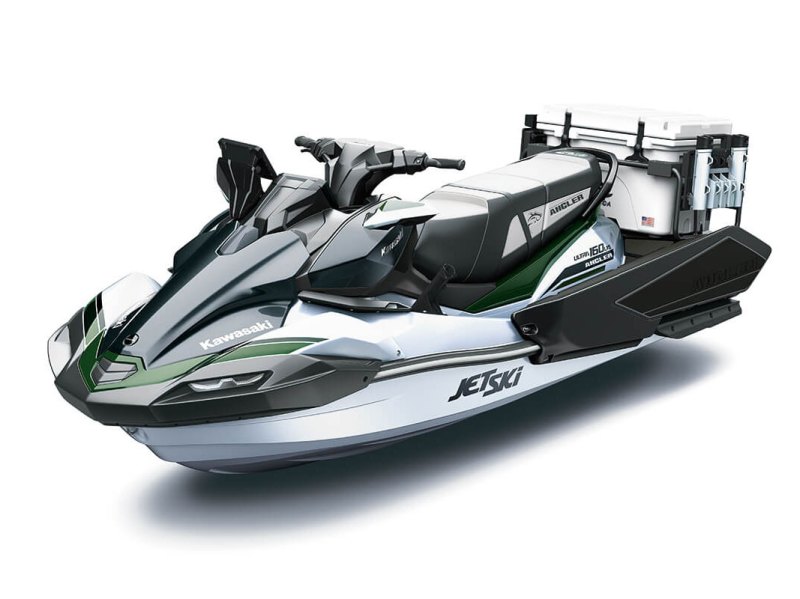
The dedicated fishing package includes a flat bench seat designed for fishing from the side, five rod holders, a large cooler, and a built-in 7-inch Garmin fishfinder. The electronics proved especially useful when locating offshore structure and tracking bottom contours.
Power comes from Kawasaki’s 160-horsepower engine, a naturally-aspirated, 1,498 cc powerplant that delivers thrust through a 155 mm jet pump. This machine made quick work of long offshore runs while offering the flexibility of multiple ride modes and trim adjustments for changing conditions. Learn more about this engine’s performance in a our test of Kawasaki Ultra 160 LX by our in-house PWC expert and retired PWC racer, Jeff Hemmel here: boatingmag.com/boats/2023-kawasaki-jet-ski-ultra-160lx-boat-test/.
Storage totals 45.5 gallons, while integrated side floats provide added stability and comfortable footing when fighting fish. Both crews noted the craft’s surprisingly capable ride offshore and its ability to access shallow-water spots that would challenge larger fishing boats.
Communication between skis and support vessels came courtesy of waterproof handheld VHF radios, providing reliable contact even when the fleet spread out across open water.
A Different Kind of Fishing Machine
What emerged from these Florida adventures was a new way of looking at personal-watercraft fishing.
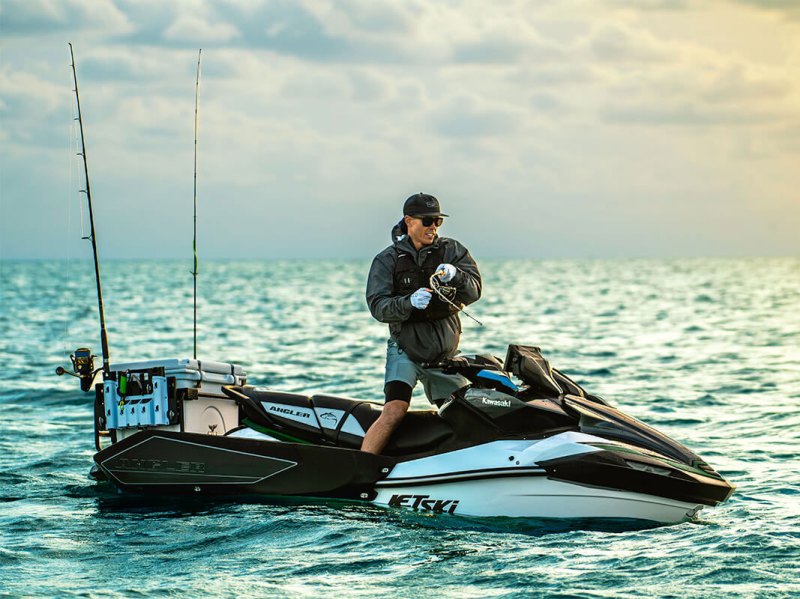
The Kawasaki Angler combines the range and speed needed for offshore runs with the shallow-water accessibility of much smaller fishing craft. It can troll, jig, fish live bait, throw topwaters, and work structure with equal confidence.
Most important, it opens doors to fisheries and experiences that many anglers might otherwise overlook.
As Ryan reflected at the end of his Pensacola trip, fishing is about exploration, learning, and chasing new challenges. After watching anglers run miles offshore, battle trophy fish, and complete inshore slams from the seat of a personal watercraft, it’s clear the Kawasaki Ultra 160 LXS Angler delivers all three.
If you are seeking a versatile, easily-stored and easily-trailered fishing machine, our experience warrants you check out a Kawasaki Ultra 160 LXS Angler.