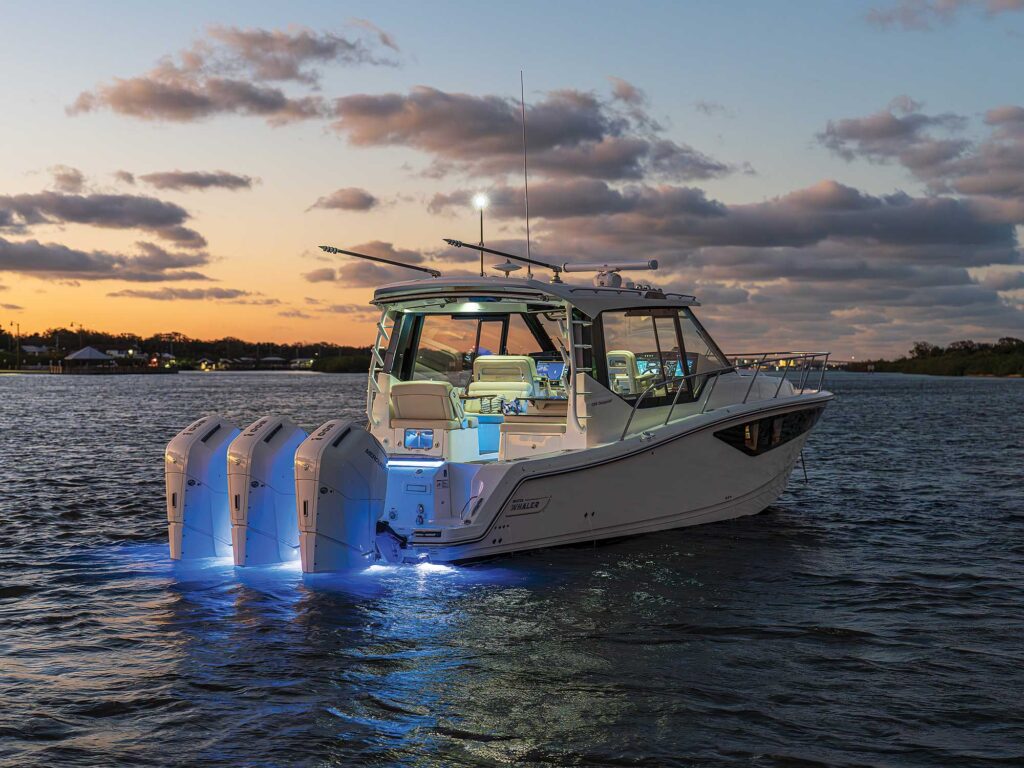
Advancing battery technology brings conveniences such as air conditioning and gyrostabilization to ever-smaller boats—even those without generators.
“Our Fathom M7000-X series e-power system, when paired to a V-10 or V-12 Mercury Verado outboard, is like having a pair of six kilowatt gensets,” says Daniel Clarkson, Navico’s director of integrated solutions. Inverters, along with enough lithium iron phosphate (LiFePO4) battery capacity, can power air conditioning, a water heater, and an electric grill simultaneously and continue to power air conditioning long after dinner.
Compared to generators, battery and inverter systems don’t need much maintenance. But they do require more thought during daily use, along with a few systems checks and storage considerations to ensure they will operate at full capacity for years to come. Consider this guidance we gleaned from the pros for your benefit here.
Battery Use
“We typically recommend not to discharge batteries deeper than 80 percent of the overall battery capacity,” says Menno Ligterink, a regional sales manager for Navico. Passing that point, or especially dipping near 90-percent discharge for LiFePO4 batteries, can affect performance and might degrade batteries. It’s best to plan ahead or risk losing the grill before steaks are cooked.

Juggling Power
“Align your power use to get the most from that fume-free, quiet inverter experience,” Clarkson says. Sitting in an anchorage, you might pull down the batteries throughout the day, and then late in the afternoon when air conditioning, showers, and dinner prep draw the most, fire up the generator, if you have one, or run engines to top up batteries for a quiet night.
On the other hand, if the goal is a quiet, exhaust-free six hours at the raft-up or sandbar, begin the afternoon near fully charged to ensure batteries last.
Maybe you have dinner reservations, and the combination of hot showers, cool air and hair dryers often trips the dockside circuit breaker. The newest inverters overcome this by supplementing AC power to overloaded shore cords, but only if you reserve battery power for use at the local marina.

Managing Heat
Whenever they’re charging or discharging, battery systems generate heat that can cause problems. “Inverters and chargers are usually the constraining item, not the batteries,” Clarkson says. Most begin reducing their power output or charge rate once air inside the compartment climbs above 100 degrees Fahrenheit, and they’ll shut down around 180 degrees. Batteries disconnect when cells reach 150 degrees. Modern chargers have warning functionality built in, so getting one is imperative.
Compartment ventilation systems mitigate problems, but be sure to check that those blowers operate properly—an infrared temperature gun will help. If temperatures climb, open a hatch or reduce inverter load.
Storage and Winterization
During regular downtime, leave the boat with LiFePO4 batteries above an 80 percent charge. For months-long storage, Clarkson says, “Most of the newer batteries have a protection relay that you can open. That’s like taking the battery out of the system. The only current draw is just the natural self-discharging of the battery, between 1 and 3 percent per month.”
“You want to prevent charging while it’s freezing,” Ligterink adds. “If the temperature of the battery drops below 32 degrees, you could damage the cells.” Safe storage temperature is about 13 degrees Fahrenheit below zero, and in both cases, that’s measuring battery cell temperature, not ambient air.
Read Next: Scout 400 LXF Li-Ion Fathom E-Power System

Electric Outboard Winterization
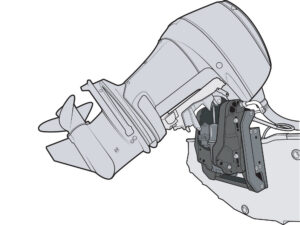
Using Mercury Avator basic guidance as an example, electric outboard winter service should include replacing anodes, lubing mounting brackets, and addressing obvious problems. Remove and store batteries above 32 degrees Fahrenheit (and below 90 degrees F) with at least a 95 percent charge. If the motor uses water cooling (Avator outboards do not), drain them.

Service and Repairs
“You’re pulling a lot of power through those devices [onboard appliances such as AC, stoves and more],” Clarkson warns. To avoid problems from loose wiring connections, periodically shut down the system and snug all fasteners. Keep an eye out for damaged wires or signs of deck leaks or splashing bilge water too.
What else might leave the cabin hot, showers cold, or burgers uncooked? “Those high-amperage fuses aren’t something you can find at the local auto-parts store,” Clarkson says. “Be sure you have spares.”