You know the routine. You pull back into the slip after a full day on the water, tie off, and then the real work begins. Wrestling a dirty cover over the gunwales. Snapping 74 snaps. Twenty minutes of effort that somehow feel longer than the entire ride home. By the time you’re done, the sunset you could’ve watched from the helm is already gone.
Ken Hey knows that routine. He lived it, and he’s spent the last three decades making sure nobody else has to.
Hey is the founder and CEO of Sunstream Boat Lifts, the Kent, Washington-based manufacturer that has been systematically dismantling the frustrations of boat ownership since 1996. The company’s origin story reads less like a marine industry case study and more like the logical outcome of putting an aerospace engineer on a waterfront lot with a brand-new Cobalt and a cable lift that required 75 hand-cranks to raise.
Before founding Sunstream, Hey was a young aerospace engineer who sold five patents to Boeing for a new method of attaching jet engines to the wings of commercial aircraft. That design debuted on the 777 and became standard across the fleet. Hey’s success led to a waterfront home, a new Cobalt, and a typical freestanding cable lift that required 75 hand-cranks to raise. The honeymoon didn’t last long.
“It was not only slow and ugly, but trying to hold the boat in the waves while turning a big wheel was difficult and dangerous,” Hey said.
He asked his dealer to find something better: a lift with hidden structure, hydraulic power like his trim and tilt, remote control, and speed comparable to a garage door opener. When he was told nothing like that existed, Hey built one in his garage. That prototype became the world’s first freestanding hydraulic boat lift, and the philosophy that a boat should be as easy to use as a car has driven every product Sunstream has launched since.
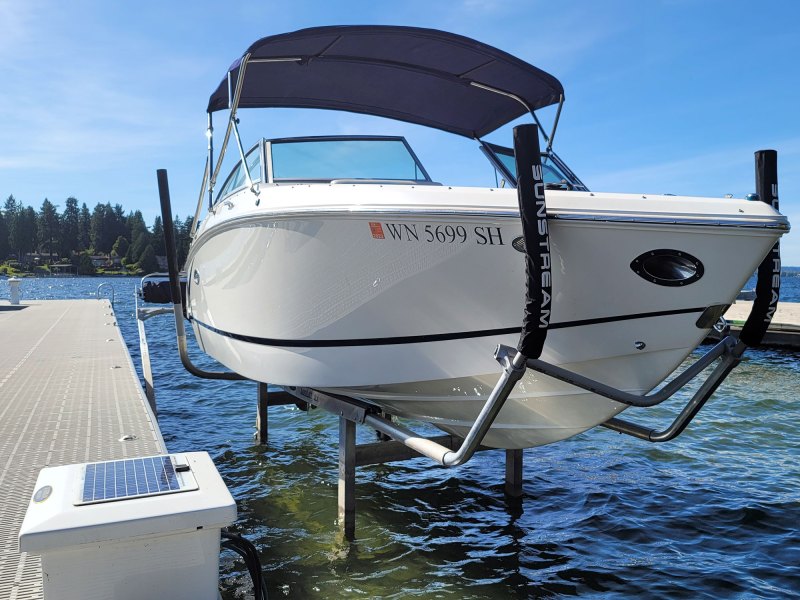
The SunLift solved the freestanding lift market. Then Hey turned to floating lifts, where the existing technology relied on air tanks under the hull that added feet of water depth and were vulnerable to leaks. Sunstream’s FloatLift replaced those tanks with hydraulic-driven, foam-filled pontoons that are functionally unsinkable, require as little as 12 inches of water under the keel, and can be deployed anywhere you’d tie a boat, like slips, side-ties, and even mooring buoys. A solar power option opened up remote locations that had never been candidates for a lift at all.
But it was the cover problem that kept nagging at Hey. He had the fastest lift on the market, smartphone control, and a boat he could launch in seconds. And then he’d spend 20 minutes fighting with snaps.
“When we were envisioning our next product, we asked ourselves what it would take to watch the sunset on your boat vs. your porch,” Hey said. The answer became the SwiftShield Automatic Boat Cover System, a hydraulic mechanism inspired by dump truck covers but engineered into a three-dimensional shape that wraps a vessel down to the waterline. It deploys and retracts with the same remote (or the same smartphone app) that operates the lift.
“Not only do users report boating 3 times more often, but it eliminates often 20 minutes of unpleasant work of putting on covers that are often dirty,” Hey said. “People appreciate that the boat is kept clean, and the boat does not age.”
According to Hey, the elimination of bulky, dirty covers also frees up locker space that boat owners didn’t realize they were sacrificing.
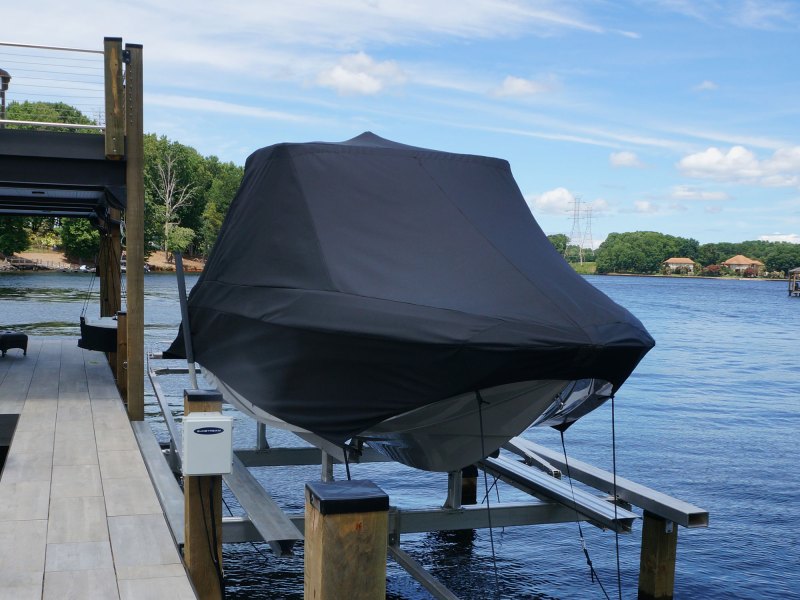
If Sunstream’s first chapter was about reinventing freestanding and floating lifts, its current chapter is aimed squarely at the piling lift segment. Hey describes that market as “yet another segment that is slow and ugly.”
The company’s Helix2-P hydraulic piling lift, launched earlier this year, was designed with a minimalist aesthetic that hides cables, motors, and gearboxes from view entirely. Pilings sit low. There are no side beams. The boat doesn’t need to be centered on the lift, which means the Helix2-P can be installed with as little as a four-inch gap between dock and hull. That brings the additional benefit of being an improvement for safe boarding and unloading.
The Helix2-P also addresses two chronic reliability weaknesses that have plagued conventional piling lifts for years. Sunstream replaced the industry-standard rotary limit switch, which has a limited operational life, with a proprietary travel limiter probe that has no moving parts. Because saltwater environments cause corroded aluminum spindle grooves and cable birdnesting, the Helix2-P offers the first-ever stainless steel spindles.
“A boat lift is more than a storage solution for your vessel,” Hey said. “It’s a way to protect your investment while showcasing the beauty of your boat.”
The Helix2-P is compatible with the Sunstream Power System, a centralized hydraulic powerpack that can drive multiple lifts and SwiftShield covers from a single low amp 110-volt connection or solar panel, eliminating the need for dedicated high amp 220-volt electrical service at each slip.
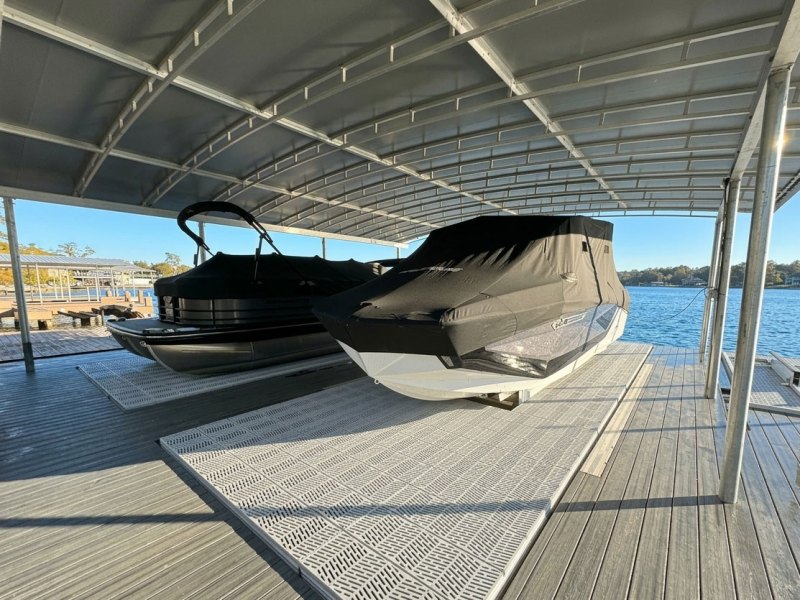
Then there’s the LiftBar, which may be the most consequential product Sunstream has ever released.
Winner of the 2025 Miami International Boat Show Innovation Award and named a 2025 Boating Industry Top Product, the LiftBar is the first boat lift to use a screw jack-based lifting mechanism housed entirely within a single aluminum tube. There are no cable winders, no cable-keepers, no limit switches, and no external powerpack cluttering the dock. The entire mechanism fits inside a 6-by-7-inch bar with contained hoses and a walkable lid.
The LiftBar’s contained design makes it fully submersible, which is of course a critical advantage in hurricane-prone coastal markets. Exposed motors and gearboxes on conventional piling lifts are often the first casualties of storm surge. All the components are IP69 submersible, and battery backup ensures operation even when dock power goes down.
LiftBar arrives pre-assembled and bolts onto pilings, fixed docks, or fabricated floating docks by hand, no crane required. Piling placement tolerances are dramatically wider than traditional four-post lifts, simplifying installation for dealers and reducing cost for marina operators.
“Every year, we’ve endeavored to not only build a better boat lift, but to truly innovate and drive the industry to try what has never been achieved to provide boaters with the best,” Hey said. “The culmination of this effort is the LiftBar.”
Available in five sizes accommodating vessels from 8,000 to 16,000lbs, soon to expand to 36,000 pounds, the LiftBar lifts and launches at speeds up to 10 feet per minute. For context, that means your boat is in the water in seconds, not several minutes.

Sunstream’s engineering has earned Hey the 2026 Alan J. Freedman Memorial Leadership Award from the National Marine Manufacturers Association, recognizing his contributions to the marine accessories industry. But the market trends the company is chasing may matter more than any single product launch.
Waterfront home and boat prices have surged over the past two decades, raising the stakes of protecting those investments. The average age of recreational boaters has climbed from 40 to roughly 60, creating demand for equipment that extends the boating years through safer boarding and reduced physical effort. A boat lift, as Hey notes, typically represents less than 10 percent of the vessel’s value. That’s often less than the depreciation saved when a well-maintained boat goes to market looking newer than its age.
“Sunstream’s products enable people to extend their boating passion longer with safer boarding and covering, and not needing to manage covers,” Hey said.
If you’re a saltwater angler who’s spent years accepting that getting the boat in and out of the water has to be slow, loud, and ugly, Sunstream is making a persuasive case that it doesn’t. Learn more at sunstreamboatlifts.com.