The waters of Homosassa, Florida, are not to be trifled with. While the natural beauty of the spring-fed Homosassa River and surrounding areas cannot be denied, the riverbed is mostly limestone disguised by sediment and sea grass that, when hit, can change the outcome of any boater’s day. The winding channels through the mangrove islands provide little warning for the skinny water outside of the markers. As one local says, “It’s a place where lower units go to die.”
True to form, on a recent trip to the area, I saw boats run aground with outboards trimmed completely out of the water, the captains leaning over the transom to inspect the props. There’s even a famous spot near channel marker 47 that’s not-so-affectionally known as “Million-Dollar Rock,” for all the damage it’s inflicted on unsuspecting boaters.
With all this, I was super excited to explore the area, because I had a secret weapon: the all- new Bay Rider 2260FS Skiff. It’s a flat-bottomed skiff that’s capable of so much more than what you thought you knew about such boats. To prove it, I set out to hit my version of a local grand slam: Fish, cruise, explore and check out the local dockside restaurant for good measure.
Monkey Business
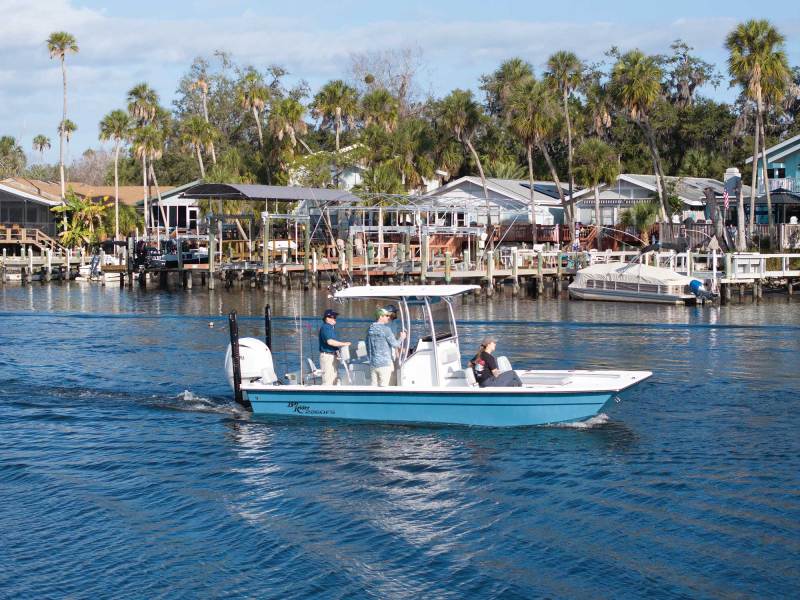
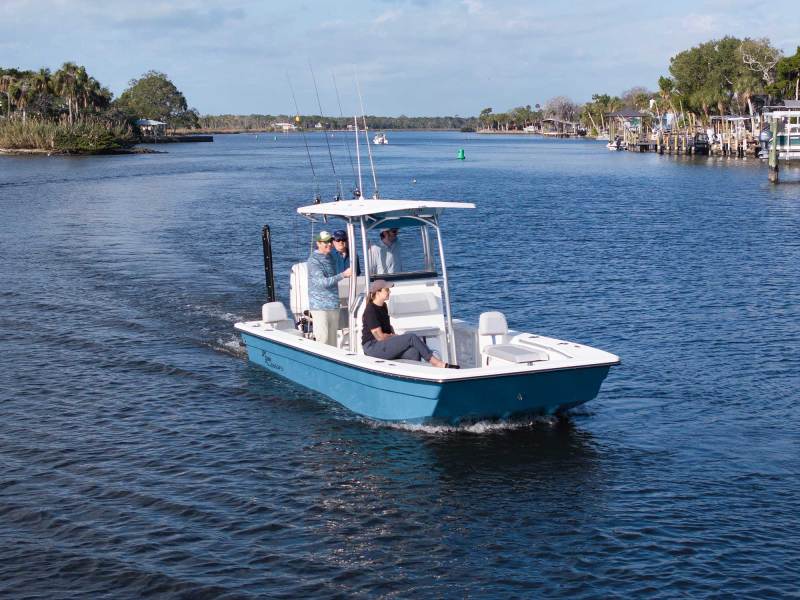
The day started at a backyard dock in a canal that gets so shallow at low tide that the owner has trouble launching his technical poling skiff, yet there was the 2260FS floating in less than a foot of water. In shape, this Bay Rider resembles a traditional inexpensive flat-bottom skiff that you’re used to seeing with rolled gunwales, speckle-finished decks and not much else. But there the similarities end. My test model had a striking Nassau Blue paint job, an integrated fiberglass center console sheltered by a hardtop, and creature comforts galore.
“We built this boat for the fisherman with a family,” said Robert Brunson, the son of company owner Bob Brunson, who had a heavy hand in its design and layout. I was set to join the Brunsons for a day of exploring the labyrinth of canals and mangrove islands where the spring-fed Homosassa River winds into the Gulf. We hopped on board and idled out of the canal. The first thing we saw, as we idled upriver, was a large center-console grounded just outside the channel marker, its engines trimmed up while the captain checked the bent skegs on his engines. A reminder not to stray too far outside of the channel.
Fortunately, we had enlisted some local knowledge: Bill Tinsley, a Vietnam veteran who’s semi-retired and spends a lot of time fishing the area. We also took comfort in the fact that the 2260FS can float in 10 inches of water and, with the optional Atlas jack plate, can run in that too. True to form, Robert Brunson raised the Yamaha 200 as high as he could as we idled to our first destination, Monkey Island.
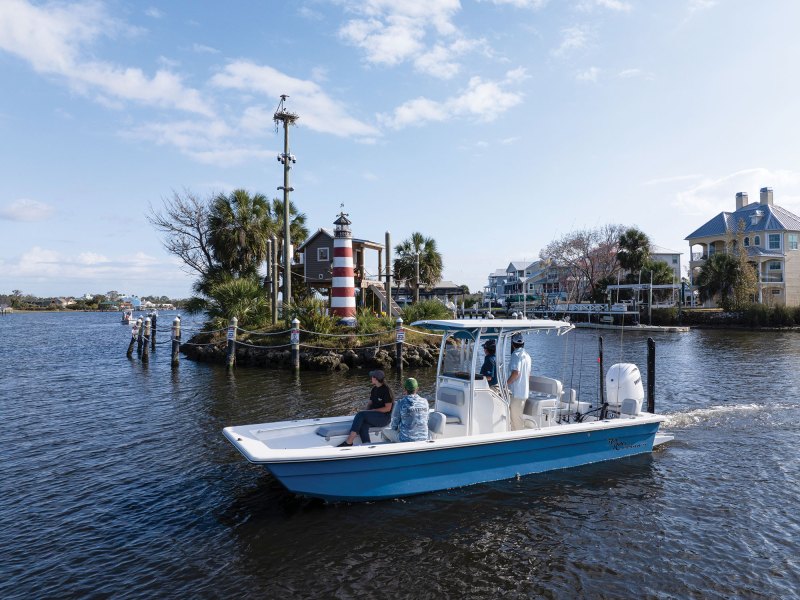
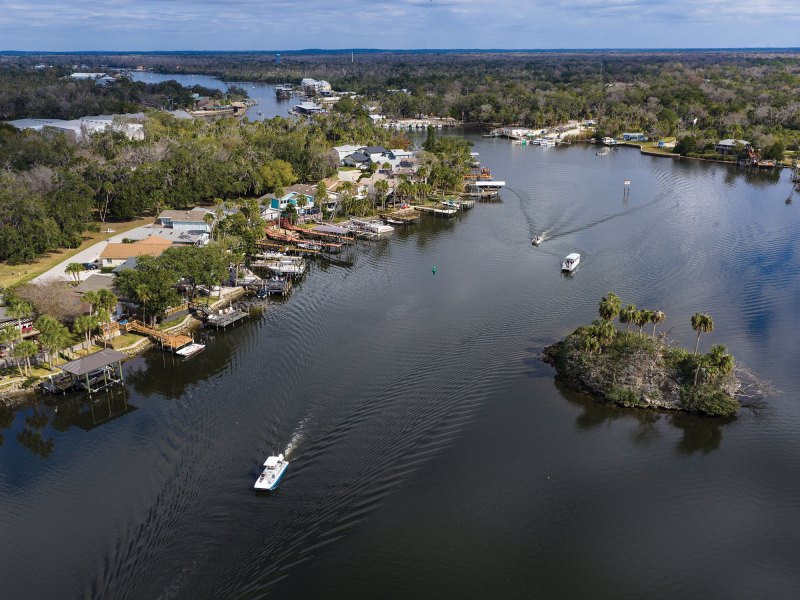
In the 1960s, a local named G.A. Furgason decided to convert a partially submerged navigation hazard near his riverfront property into a full island, erected a miniature lighthouse and populated it with a few spider monkeys.
As we approached, we eased our way into the shallows surrounding the island and watched the three resident monkeys lounging on Adirondack chairs on the deck of their plush tree house, barely looking at us as we slipped past. We circled around the island and noticed the monkeys had, among other things, an air conditioning unit for climate control. Life is good for these Homosassa primates. But we had other animals in mind to go see.
Cattle Call
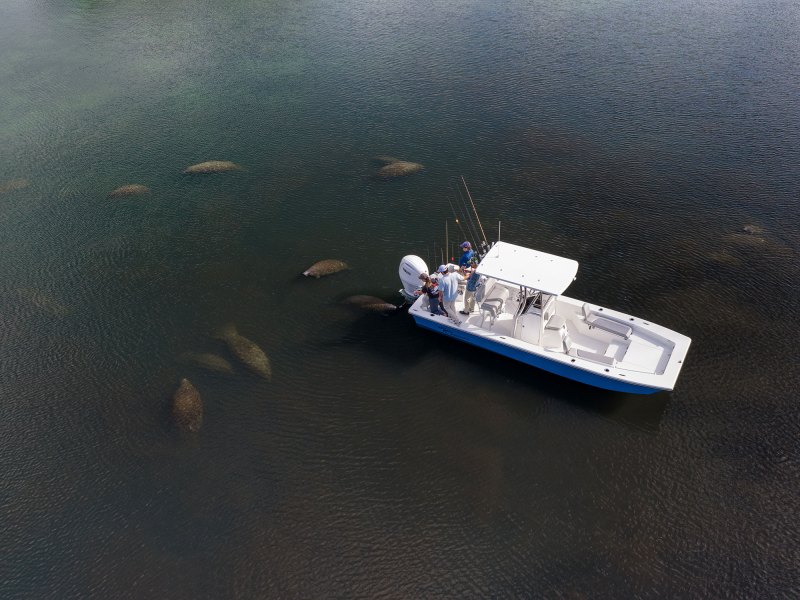
The sun started to penetrate the early morning cloud cover, illuminating the water and improving our ability to see the shoals, signaling it was time to head upriver to find some mammalian friends. West Indian manatees, often called sea cows, are actually more closely related to elephants, and can grow up to 13 feet in length and weigh up to 1,200 pounds. In the right place, with the right conditions, they’re actually fairly easy to spot.
Manatees happen to love Homosassa as much as anglers and boaters do, drawn to the freshwater springs and the near-constant 72-degree water temperatures in winter, plus an abundance of aquatic vegetation to dine on. So, we waved goodbye to our new monkey friends and headed towards the Ellie Schiller Homosassa Springs State Park. We made our way through the maze of waterfront homes into a mangrove-lined corner of the river, cut the engine and started to drift.
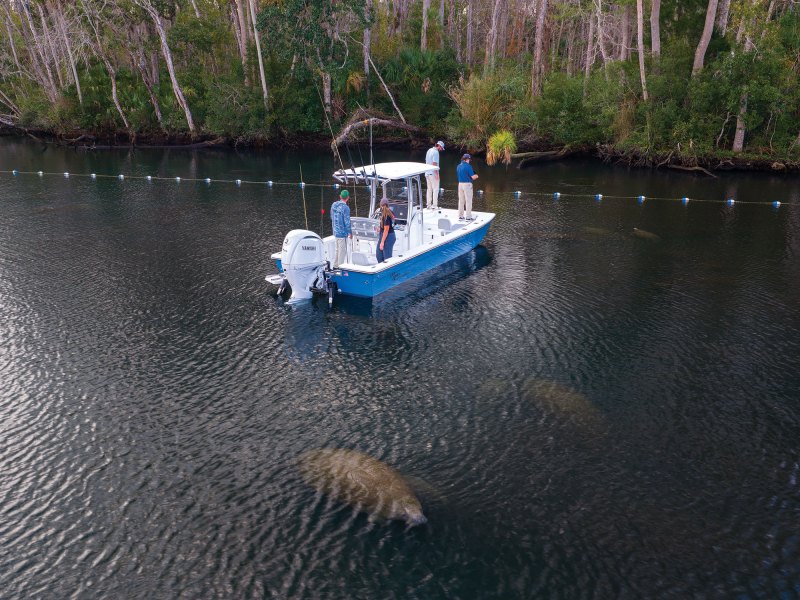
Within seconds, dozens of manatees surrounded the 2260 and the four of us, including marketing rep Victoria Henderson, jumped to our feet to snap pictures, quickly demonstrating the boat’s inherent stability. When all four of us tucked into the port quarter to watch the three sea cows hitching a ride on our Power-Poles shallow-water anchors, the boat did not tip or sway or knock anyone off balance. With the extra-wide gunwales and bow and stern casting platforms, we could quickly scoot around the boat to get a better vantage point as pods of manatees surrounded us.
We had a slight problem in that so many manatees surrounded the boat, we could not start the engine. We pulled up the Power-Poles and drifted a bit downriver, distracting the manatees by pouring fresh water off the bow, and soon we were able to start the Yamaha and head to Crump’s, a well-known waterside restaurant with dozens of slips and open-air dining along the river. Over gator bites and shrimp and fish sandwiches, we sat by the water and mapped out the next phase of our day.
Cruising and Casting
The Homosassa River extends 7.7 miles from the inland springs until it eventually dumps out into the Gulf of Mexico. Once you get past the system of lattice-work canals and waterfront homes that extend from the river into the town of Homosassa, the river twists and winds through a mangrove wilderness known as the Crystal River Wildlife Refuge. It splits into a series of shallow bays and tributaries that can test even the most seasoned boaters. With the cooler winter temperatures changing the fishing patterns, Tinsley had an idea of where we could find some fish to bend our rods. We hopped on plane and eked through a narrow channel lined with stilted fish camps and made our way into Shivers Bay. Here, we really got to enjoy the 2260’s many creature comforts.
Two could sit in the transom jump seats with removable cushions and backrests, and two others could lounge in the foredeck seats with forward-facing backrests and recessed handholds, just chilling as we zipped along the shallow channel. The bow and stern casting platforms are inset a few inches below the gunwale topsides, helping to keep the passengers and gear secure underway. The hardtop, built at the Bay Rider facility, kept the captain and navigator protected at the helm.
What impressed me the most about this boat was its incredible handling. Typically, flat bottom skiffs slide and skitter in tight turns, creatingan unsettling feeling at the helm. But the Brunsons designed the 2260 to, literally, run on rails. Its proprietary running surface features hard chines that dig into the water during turns as would a V-hull.
“Turn the wheel as hard as you can,” Bob Brunson said to me as we cruised along at around 35 mph. The look on his face conveyed confidence and trust, so I cranked the wheel and marveled as we leaned into the turn, performing a complete 180 in a tight space without sliding or blowing out the prop.
Though this boat’s bottom is said to be flat, we suspect there may be 2 or 3 degrees of deadrise that—though invisible to the eye—would aid the hard chines in delivering the superb handling that we experienced at speed.
Read Next: Boat Test: Bay Rider 269 Bay
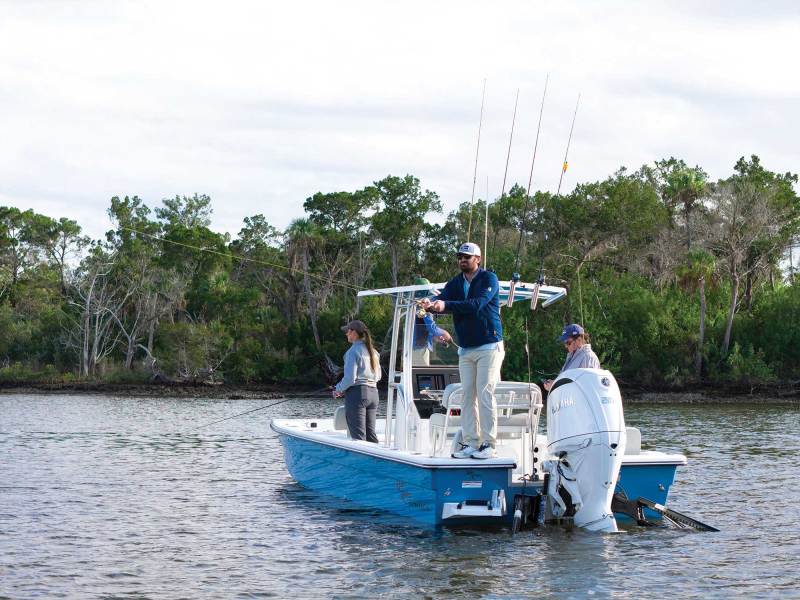
We settled back into the run and, with the jack plate raising the Yamaha 200, cruised in around 1 foot of water to Tinsley’s fishing spot. We wound our way to a small, narrow bay with two narrow creeks feeding into the back end, planted the Power-Poles and set up to fish. We quickly removed all the cushions held in place by super-strong, molded-in magnets that Bob Brunson personally tested by trailering the boat down the highway with the cushions still in place. Within seconds the boat converted from a family cruiser to a fishing machine, as we had anglers set up on all four corners.
We fished Tinsley’s go-to lures, but the boat has two livewells—a 22-gallon one under the port cockpit jump seat and a 15-gallon one forward of the console—should you want to fish with live bait. We had all the rod storage we could stand, with six built into the hardtop, four behind the helm leaning post, and another six integrated between the aft jump seats, not to mention the rod holder-cup holder combos in the gunwale topsides and the inwale rod racks to either side of the cockpit.
After fanning casts in every direction, we finally found what we were after, the sight of a bent rod and a reel screaming in reverse from the pull of a local redfish. With the skunk off the boat, we fished in peace for a few hours until only one logical choice remained: Head back to Crumps for a victory beer, live music and another round of fresh seafood.
All in all, the Bay Rider 2260FS Skiff proved capable of everything we hoped it would. We spent a day in one of the skinniest water locations we could find, sightseeing, cruising, fishing and having fun—all achieved on a flat-bottomed skiff. The only thing we didn’t get to do was nose up to a crowded sandbar and blast tunes in a party cove. While sitting at Crumps, I volunteered to give this story a sequel.
Bay Rider 2260FS Skiff Specs
- LOA: 22’0″
- Beam: 8’4″
- Displacement: 2,550 lb.
- Draft: 10″
- Fuel Capacity: 35 gal.
- Max Horsepower: 200
- Price: $73,643 (base with Yamaha 150)
Bay Rider Boats – Wilson, North Carolina; bayriderboats.com