What seemed like electronic sorcery 30-some years ago was the overlay of a waypoint “lollipop” on our radar screens. That simple round circle with a dotted line was a game-changer. We knew, for the first time, which radar blip to steer toward, and we could follow a visual line to reach that destination.
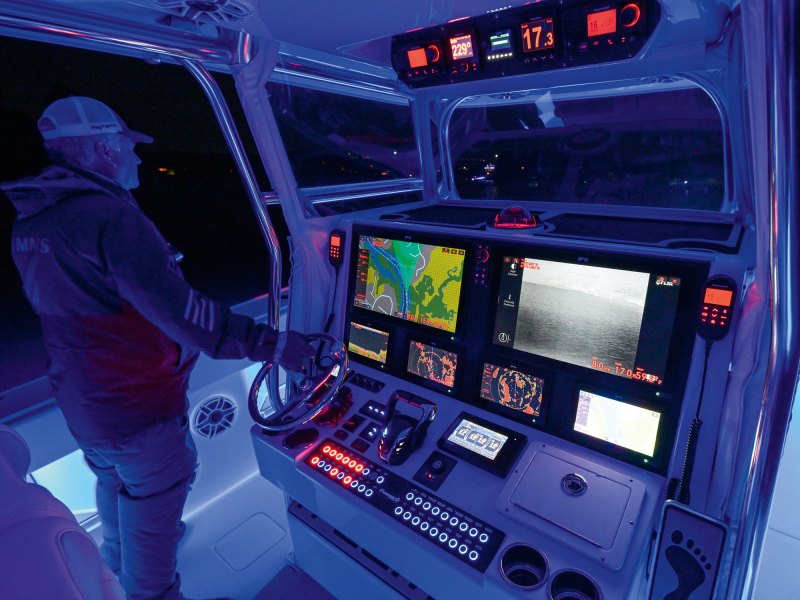
Fast forward to the present, where today’s multifunction displays place waypoint icons directly onto electronic charts. Vector arrows indicate GPS location, course and speed. Radar returns and Automatic Radar Plotting Aids (ARPA) collision-avoidance plots appear on that chart, as does Automatic Identification System (AIS) information from nearby boats and navigation aids. We view engine data, monitor video cameras, and even control music and lights through those displays.
That standalone radar, plotter, or fish finder got the job done three decades ago. But today, what truly sets the modern helm suite ahead is how it shares data among components and then displays information tailored to each skipper’s preferences. Instead of two wires sharing a “lollipop,” data-rich layers now materialize through electronic conjurations of NMEA 2000, ethernet, and new gigabit networks. Boating reached out to a pair of electronics wizards to better understand how these networks make their magic.
Universal vs. Proprietary networks
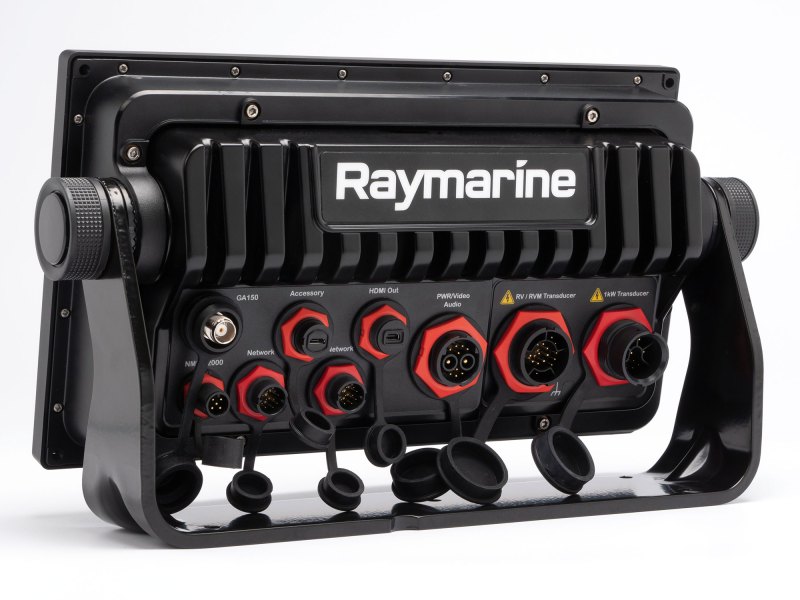
“We essentially have two networks on board,” says Kevin Boughton, who is both a National Marine Electronics Association (nmea.org) instructor and the senior technician at Midcoast Marine Electronics in Rockland, Maine. NMEA 2000 (N2K) shares things such as GPS position, heading, speed, depth, wind and engine information. Universal protocols ensure all equipment brands can provide, utilize or display that data. But N2K is strictly alphanumeric. Everything else is video, including charts, radar, and fish finder display information, and that requires the second network. “We just don’t have the bandwidth for that on N2K,” Boughton says. “Ethernet supports video sharing, but every manufacturer has its own network.”
“You can still do the basics over NMEA 2000, but it’s antiquated by today’s standards,” says Dave Dunn, Garmin’s (garmin.com) senior director of sales. That includes sharing range and bearing from one brand GPS to create a waypoint “lollipop” on another manufacturer’s radar or exchanging position and Maritime Mobile Service Identity (MMSI) data between competitors’ GPS and VHF units. “The really cool stuff requires integration that’s typically not carried over NMEA,” Dunn says. “Those true overlays—and many of the ‘wow’ features we have today—are beholden to the bigger network.”
Competing Systems
The iPod seemed like digital witchcraft when it replaced 5-disc CD carousels in 2001. NMEA 2000, which debuted that same year, easily handled that tech, but as new features such as custom audio zones and album art came along, expectations grew beyond N2K.
“You can control your Garmin stereo with your Simrad display, but it’s very basic—just audio sources, track information, volume, skip, play, and stop,” Dunn says. “Using your Garmin MFD, you get the full set of features that are within that Garmin stereo. You can even read the video out of it.”
While NMEA’s upcoming OneNet can resolve bandwidth and connection constraints, it won’t unify command and control. “That would be a huge undertaking—re-engineering all of the language and protocols,” Boughton says, and it would still leave compelling reasons to keep manufacturers’ equipment separate.
“It goes back to customers’ expectations that things will work,” Dunn says. “Our MFDs run on a Garmin proprietary operating system. Each brand has [its own] network to ensure integrity of their system. As manufacturers, we do our best to share what we all need as a common collective, and then what’s specific to our systems is what’s kept proprietary.”
Read Next: OneNet for Networking Marine Electronics
Integrations
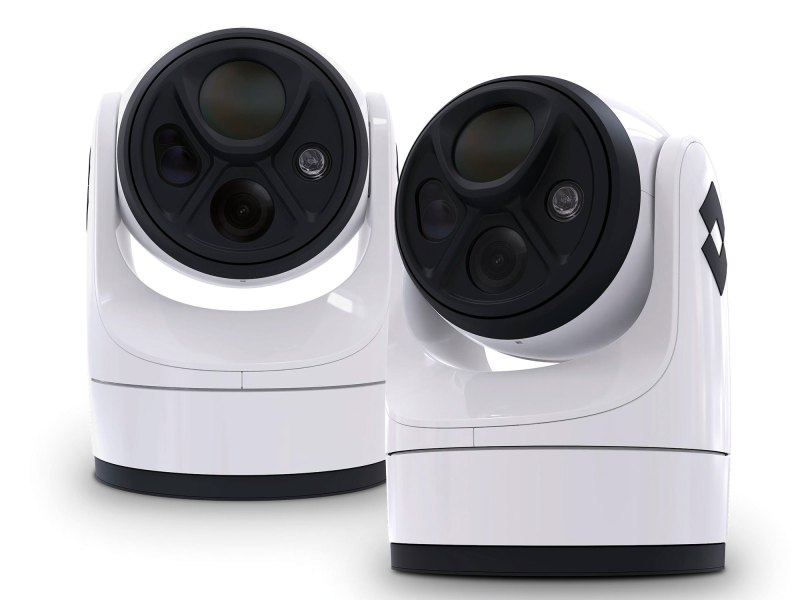
“There are exceptions,” Boughton says. “Some third-party devices, such as FLIR or SiOnyx cameras, work with all the big manufacturers, and those manufacturers are going out of their way to accommodate these companies as well.”
Digital switching can control nearly any electrical circuit aboard through the N2K network, even crossing brands with some switch equipment. The systems that control those switches, however, won’t interconnect. “Turning a switch ‘on,’ or ‘off,’ or it being momentary, that is generic,” Boughton says. “But each manufacturer does that with its own programming within its proprietary software.
Marine Network Speeds Timeline
| Network | Speed | Date |
|---|---|---|
| NMEA 0183 | 4,800 bps | 1983 |
| NMEA 2000 | 250 Kbps | 2001 |
| GigaBit (OneNet) | 1,000 Mbps | 2024 |
Next-Gen Networks
Evolution continues. Marine networking will almost certainly leverage AI, for example. It’s easy to forget we were once enchanted by a simple waypoint “lollipop.”
OneNet
NMEA 2000 (N2K) has long served as the standard network for connecting marine electronics and onboard systems. Now, the National Marine Electronics Association has introduced OneNet, an Ethernet-based system offering far greater speed and bandwidth. Capable of handling large data streams and supporting up to 60 devices, OneNet complements existing N2K networks through gateways. Though not yet widely adopted, it promises easier integration, centralized power, and future-ready applications for radar, sonar, and video. For more information, visit nmea.org/nmea-onenet.html. —Jim Hendricks