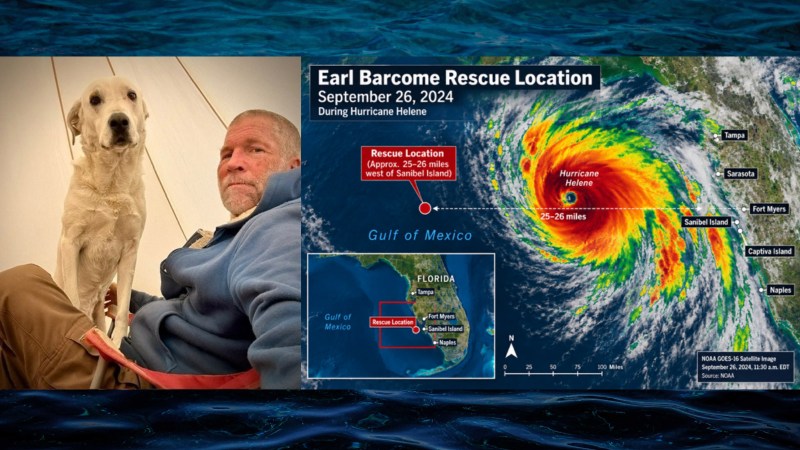
On September 26, 2024, Hurricane Helene made landfall along Florida’s west coast before veering north and causing catastrophic flooding across the Southeast. Hours before the Category 4 storm came ashore and tore a relentless path of destruction from the Gulf to the Appalachians, the U.S. Coast Guard received a distress call from the water. A man and his dog were adrift in the storm, and their boat was taking on water.
Hurricane Helene would cause at least 250 fatalities, making it the deadliest U.S. storm since Hurricane Katrina, according to the National Hurricane Center. But thanks to the swift actions of a Coast Guard helicopter crew, Earl Barcome and his golden retriever, Gunn, were spared.
The helicopter crew from Coast Guard Air Station Clearwater miraculously located Barcome’s disabled 36-foot sailing vessel in the storm. Petty Officer 2nd Class Todd Hudson, an aviation survival technician from Air Station Clearwater, hoisted Barcome and Gunn to safety.
A single image from water level told an irresistible story of bravery, humanity, and one man’s love for his dog. It quickly went viral, and an extraordinary video from the rescue chopper and Hudson’s body-worn camera later showed the recovery was everything we imagined it to be. Two years on, the circumstances of the rescue still seem incomprehensible, but the lessons learned are much more concrete.
From Flat Calm to Category 4
Barcome and Gunn were headed south for the Caribbean, on a course paralleling Florida’s west coast. Barcome’s tropical getaway became a nightmarish fight for survival in the last week of September 2024, when a weak tropical storm called Helene morphed into a Category 4 hurricane in just two days.
As the storm intensified, Barcome began making arrangements to wait it out somewhere safe. “I had reached the north end of the Everglades, had a quiet bay to pull into, maybe an hour out,” he said. As Barcome made his way toward land and safety, however, everything changed in a matter of minutes.
“The wind picked up. The engine broke down. The inner stay snapped,” he recalled. “Now I had a 40-foot cable with a steel fixture on the end making figure eights on my starboard side.”
A series of unfortunate events onboard combined with a rapidly approaching hurricane turned his short journey to land into a multi-day fight for survival.
As the weather intensified and his list of boat issues grew, Barcome buttoned up his vessel and made sure Gunn was secured below. Over the next two days, he said the wind picked up from about 50 to 150 knots.
A Last-Minute Radio Transmission and a Miracle At Sea
As the boat lay adrift in worsening weather, Barcome says water began coming into the cabin. He pumped the bilge for two days and made sure Gunn, wearing his life vest, was safe. He said he hoped the storm would let them go, but eventually he had to make a decision.
“After two-plus days, I radioed the Coast Guard. We’d been up for two days. Falling off 40 to 70-foot seas,” Barcome said. But soon after he radioed for a rescue, his situation grew even dire.
“After 20 minutes on the radio, the rising waters in the cabin shorted out my electrical,” he said.
Barcome would later recall rescuers telling him that locating his boat under those circumstances was like finding a needle in a haystack. According to Barcome, three hours after the electricity on his vessel failed, the Coast Guard spotted him.
“All I can say was by the grace of God,” he said.
Petty Officer 2nd Class Todd Hudson was soon lowered from the helicopter into the massive swells to rescue Barcome and Gunn.
“I swam over to the boat, and I started telling them to get the water so we can get this done as soon as possible, because the helicopter was in 60-mile-an-hour winds,” said Hudson in an interview released by the Coast Guard. “The pilots have to control that the whole time, so it’s a dangerous situation to be in, and I was just trying to get out of there as fast as possible.”
Video of the rescue shows Hudson being lowered into the churning water before approaching the vessel. You then see Barcome holding Gunn, and both men encouraging the dog to jump towards Hudson.
“The dog was a little skeptical at first to jump in, and then he finally decided that he had to jump in,” Hudson said. “He swam right to me, and I just held onto his little life vest, and he seemed to do well from there.”
Barcome and Gunn were hoisted together into the helicopter and carried to safety. Barcome’s vessel was never recovered.
Lessons Learned Two Years After the Rescue
Barcome and Gunn were unbelievably lucky that the Coast Guard located his disabled vessel in a major storm, without constant communication. Two years after the rescue, Barcome encourages boaters facing similar emergencies to act, not react.
“As I progressed into the storm, options kept fading away,” he said.
To prepare for his journey, Barcome said he spent 13 months on the water, mostly in western Florida, doing his best to ensure all his boat’s systems were functioning.
“We had backup systems, hardware, several months of provisions, and various gear to work inside and outside the boat. I was more than comfortable when we headed out,” Barcome said. Then came Helene.
Hurricane Helene strengthened from a Category 1 to a Category 4 storm in less than 24 hours. Tropical storms are unpredictable, and Barcome’s saga is a sobering reminder that all boaters must check the weather diligently, watch developing storms, and follow all weather advisories. Conditions can change drastically in minutes, as Barcome witnessed firsthand.
Locating a drifting vessel with no radio signal is no easy feat, which is why every boat operator should carry multiple signaling devices. As this incident illustrates, electrical systems can fail, especially when your boat starts taking on water. That is why a battery-operated VHF radio and multiple emergency signaling devices are so crucial.
Barcome did not have an Emergency Position-Indicating Radio Beacon (EPIRB) because he says he couldn’t afford one. Now he says such beacons should be mandatory for those traveling offshore. In addition to emergency signaling devices, the Coast Guard recommends that all vessels file a float plan with a trusted contact on land. That’s good advice whether you’re going out for an hour or two, or crossing an ocean.
Barcome and Gunn’s rescue is a prime example of the importance of taking safety precautions for your pets on board, just as you would any other passenger. Barcome encourages all boaters never to leave dogs unattended, and to keep a life jacket close at hand for every person – and pet – aboard.
“The rescue crew was very happy Gunn was ready,” he said. “They don’t always come across that,” he said.
Reflecting On The Rescue, Loss, and New Beginnings
After the rescue, Barcome and Gunn’s saga gained national attention. The incredible rescue was newsworthy on its own, but the video of a golden retriever bravely jumping into churning waters was inspiring, and it captured the hearts of many dog lovers. Barcome had Gunn for 13 years, the two of them were inseparable until this year, when Gunn passed away.
“He was a champ,” Barcome said. “Absolute sea dog. Took to boat life with excitement, as if endless adventure was always in front of us.”
The tragedy of losing his companion of 13 years took its toll on Barcome. In San Diego two months after Gunn’s passing, Barcome walked into an animal shelter and rescued a Great Pyrenees and Anatolian Shepherd mix named Thor.
“I was not doing well, and Thor was the answer,” he said.
Barcome and Thor spent more than six months sailing in Southern California, but more boat problems arose. When the vessel’s transmission failed on his way to Catalina Island, Barcome decided to trade his life at sea for one on land.
He had his vessel hauled out and shipped to New Mexico. Then he found a parcel of land in the high desert, where he and Thor can once again live on the boat – only this time, they’ll do it on solid ground.
“The switch from life on the water to dry land was a necessary change in this healing journey,” Barcome said. “This walkabout continues.”