During a flight-attendant safety talk, I noticed that the plane’s inflatable life jackets are manual only. That is, a passenger needs pull a cord to inflate one. Yet most passengers have no training with inflatable life jackets, so wouldn’t automatically inflating models be better?
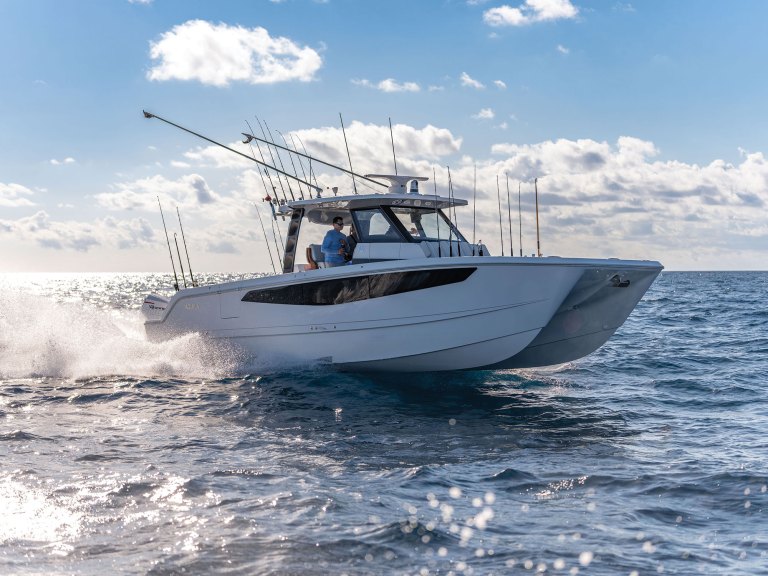
Not always. Take, for example, the pilothouse boat that capsized in big swells while negotiating the inlet to California’s Mission Bay. The captain’s automatic inflatable life jacket deployed as water flooded the pilothouse, pinning him inside. He lived to tell the story thanks to quick thinking and a belt knife, which he used to puncture the jacket and escape. The same scenario can occur on an airplane that needs to ditch, hence manual jackets.
So which type of inflatable is best for boaters? To help you decide, we asked Jonathan Liu, senior product manager, flotation, for Mustang Survival, a leading name in life-jacket technology. Full disclosure: Mustang supplies Boating magazine with life jackets for our boat tests and photo shoots.
Automatic
The term “automatic” means that an inflatable life jacket has a hydrostatic trigger that deploys a CO2 cartridge once the water depth reaches approximately 4 inches. Mustang calls it Hammar Hydrostatic Inflation Technology. A pressure-activated valve prevents accidental inflation from rain or spray.
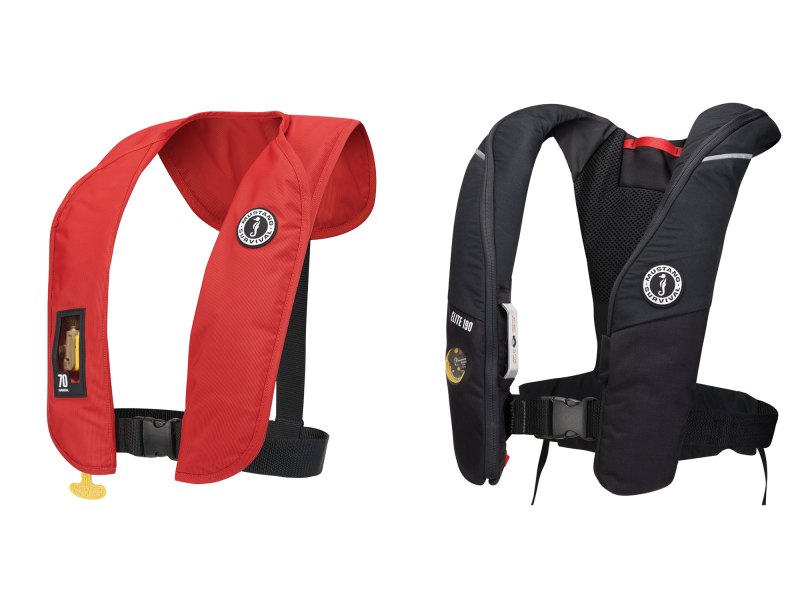
This makes automatic models such as Mustang’s Elite 190 a strong choice, because going into the water unexpectedly can be a shocking experience, especially in cold, rough seas. Pulling an inflation cord is not necessarily second nature; the auto function is usually quicker on the draw.
Automatic inflatables are the absolute best choice for boaters who venture out solo, Liu says, because accidentally going overboard might include a blow to the head or other injury, leaving the individual unconscious or incapacitated. “The jacket will inflate no matter what, keeping an unconscious person’s head above water,” he explains. That’s crucial when there’s no else aboard to render help.
“Keep in mind that all automatic inflatable life jackets by US Coast Guard regulations must also include a manual pull-cord activation,” Liu reveals. This enables boaters to override or pre-inflate jackets in cases such as a planned abandon-ship scenario. So, it’s not actually a choice between auto and manual, but rather auto/manual versus manual-only.
Read Next: Four Top Inflatable PFDs Tested
Manual-Only
Inflatable models such as the Mustang MIT 70 with manual-only activation are good for strong swimmers who might need to jump in the water in a rescue or assistance situation, but may or may not need flotation, Liu says. It’s good to have it standing by, but the swimmer might not need it.
Manual-only is also a consideration for pilothouse or cabin boats with crew members sheltered inside. Capsizing or sinking can happen quickly, and the buoyancy of an inflated life jacket with water rushing into an enclosed space can trap crew members inside, as described earlier.
Convertible
“Some auto/manual inflatable life jackets such as the Mustang MIT 100 can be converted to manual-only,” Liu says. It’s not something than can be done quickly, so you should decide before you head out on the boat whether you want to retain the auto function or not, he advises. “It comes down to the boater’s choice,” Liu explains. “Sometimes you want full control of inflation, and other times you don’t want to have to think about it.”