
Every day it seems there’s a new report or social-media post about a runaway boat. Usually, the captain has fallen overboard and, often, the boat goes into the so-called “death circle,” speeding around the victim. Being a good swimmer doesn’t help; even Katie Ledecky can’t out-swim a speeding boat.
So rampant is this issue that the US Coast Guard now requires the use of an engine cut-off switch (ECOS), which is most commonly activated by use of an engine cut-off switch lanyard (ECOSL). Boaters operating from exterior helm stations of boats less than 26 feet in length overall and operating at 5 mph or more are required to have one of these devices installed and operable and be wearing the device while under way. Learn more at boatingmag.com/ecos.
Now, the most likely explanation for the circle of death is that when captains get thrown overboard, their grip on the wheel causes a turn. Single-engine boats may also go into a turn due to propeller torque. While the circle of death happens frequently, at other times the boat simply continues on its way until it hits something—or someone.
Using an ECOS/ECOSL doesn’t prevent falls overboard, but it does help to ensure a better outcome should you end up in the drink.
Watch: Replacing an Engine Cut Off Switch on Your Boat
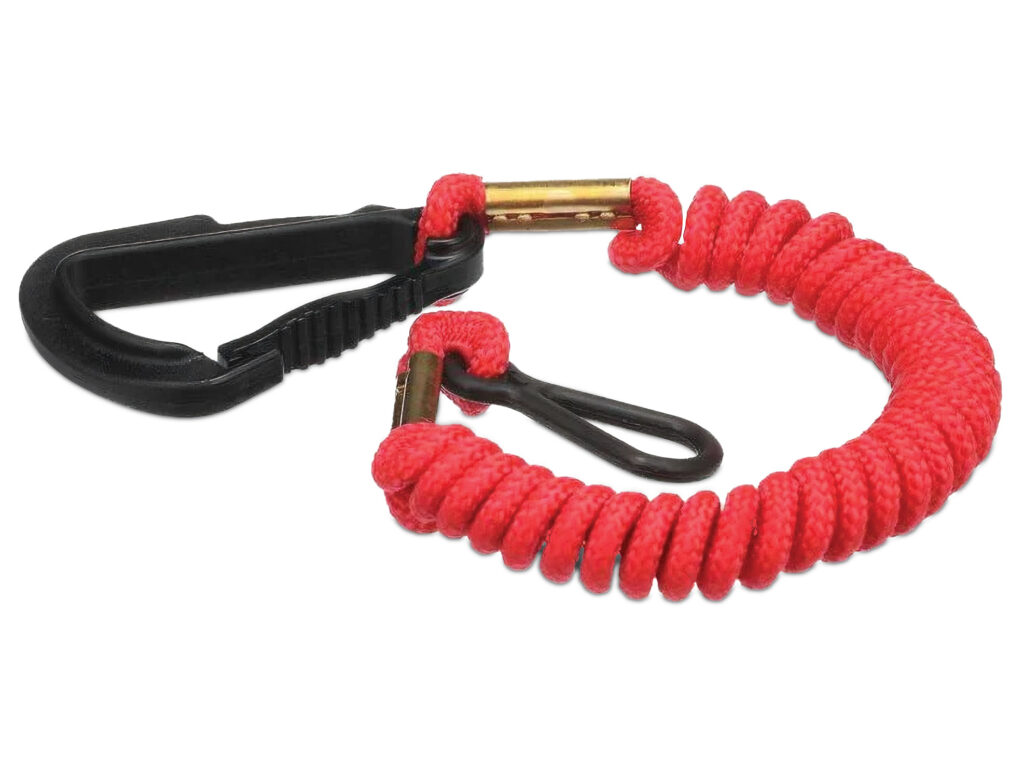
The most common cut-off device is the safety lanyard—that ubiquitous red, coiled cord. Leave the helm, the cord comes with you, killing the engine. The complaint often voiced about lanyards is that they effectively tie the captain in place; even simply reaching for something atop the helm or in the seat beside you can stretch the lanyard to its limit and will shut the engine down. So, if you choose the lanyard, you need to get in the habit of restricting your movements to the space allowed by its length.
My biggest complaint is that the darn snaps are too small and too stiff to use easily. A larger snap would allow more leverage, making safety lanyards both easier to open and to attach.
Enter the wireless ECOS/ECOSL systems such as 1st Mate, and others. These are proximity sensors. Basically, the transmitter is on the boat. The receiver is on your body in the form of a key fob or wristwatch. You set the activation distance suitable for your boat. Maybe that’s 25 feet aboard a 25-foot boat. The system kills the engine if you go beyond that distance. The benefit over a physical lanyard is that you can leave the helm and roam around the boat without killing the engine, while still maintaining man-overboard protection.
These wireless systems, which are easy DIY installations, also provide other benefits. A major one is that after activation—when you fall overboard—your crew can restart the boat and retrieve you. With a physical lanyard, this is harder for many to do, since the lanyard goes overboard with the captain and is required to restart the engine. Wireless ECOS/ECOSL systems also allow you to protect multiple crew members—even pets—and utilize apps that display MOB positions on a chart. Some even serve as security systems. Thieves can’t start the engines without the fob/electronic lanyard.
Choose and use the best engine cut-off system for you.