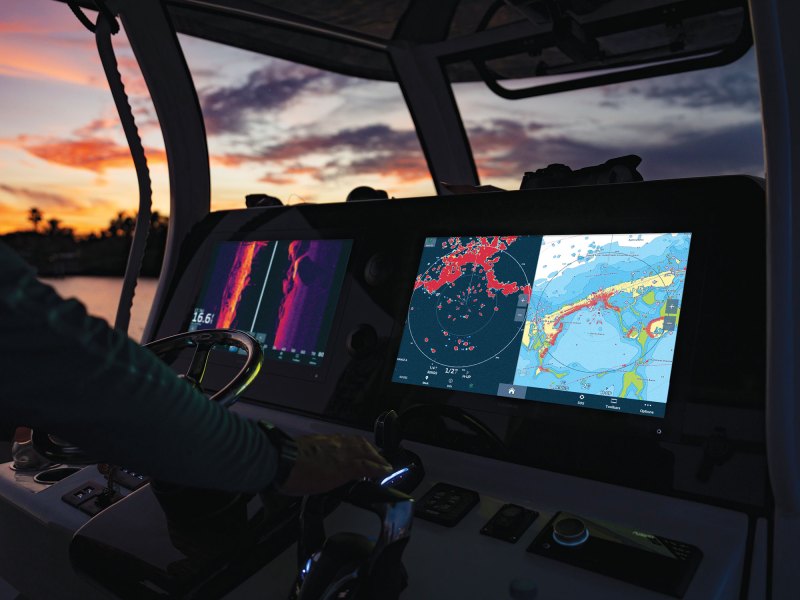
NMEA 2000, otherwise known as N2K, is a universal networking system that allows marine electronic units such as GPS, AIS, engine-control modules and more to share certain digital information back and forth. We talk about N2K a lot. Yet what are the elements of this network?
N2K plug-and-play components make it easier than ever to integrate marine electronics, allowing you to view, control and share functions and information across a network of displays. The system relies on N2K-compatible marine electronics (not necessarily of the same brand) in order to share and receive digital information via special cables and connectors that tie electronic units together. Here are the main N2K elements.
T-Connectors
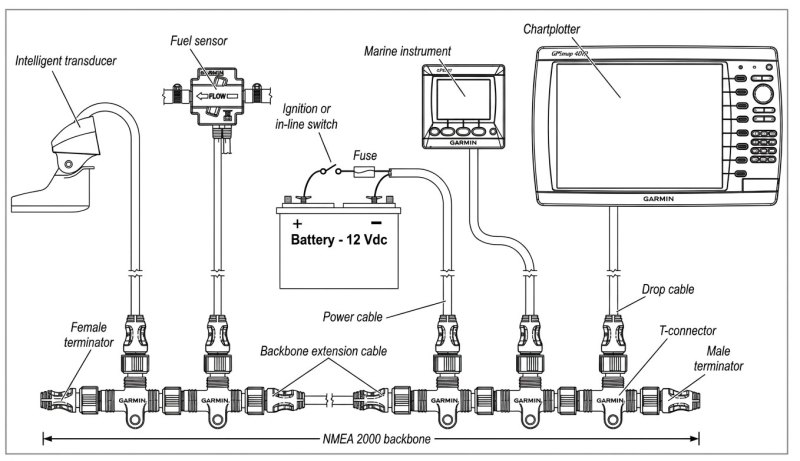
These serve as the intersections for the flow of digital information to and from marine electronics and other data sources. Small numbers of T-connectors can be strung together (at the point where the T is crossed) in a linear manner, directly with each other or via extension cables. You can also find available multiple T-connector ports grouped into one junction block, thus eliminating the need to string together a large group of single T-connectors. The series of T-connectors assembled in a linear fashion is known as a N2K backbone. There can be multiple backbones throughout boat, each connected to the other via N2K extension cables. Backbones also can be expanded with additional T-connectors if and when new electronics are added.
Drop Cables
Each piece of marine electronics or data source (engine-control module, for example) connects with a single drop cable to a port on the end of the vertical stem of a T-connector and a N2K port on the electronics unit at the other. The drop cable serves as the on-ramp and off-ramp for digital information to be shared across the N2K network with all other electronics. As a rule of thumb, try to avoid using long drop cables. N2K signals can be hampered by resistance, which causes a reduction in the voltage needed to carry the digital information. The maximum length for a single drop cable is 20 feet. If you require a longer cable run to connect an item such as a fuel-flow sensor or sea-surface temperature sensor, use a T-junction at either the end or the middle of the run to tie in 12-volt DC power cable (more on these in just a bit). Augmenting the power in this manner helps prevent an excessive drop in voltage.
Read Next: Use an NMEA Translator to Network a VHF Radio
Power Cables
A N2K power cable is like a drop cable in that it connects at the end to the vertical stem of a T-connector in the N2K backbone. The other end has two wire leads (red positive and black negative) with an inline fuse for the positive wire that connects to a 12-volt DC onboard power source. Make sure the power source you choose is indeed 12 volts DC; do not connect your N2K network to any other power source such as 24 volts DC. This power cord energizes the backbone to send and receive data, be it depth information, GPS position coordinates, AIS targets, and more. As mentioned above, a backbone extension or drop cable that reaches or exceeds 20 feet in length requires an additional power cable to be installed to ensure proper and full functionality of the N2K network.
Terminators
No, these are not characters from an Arnold Schwarzenegger movie. These threaded caps on each end of a N2K backbone are simple, but vital to the N2K network. Without terminators, the system will not function. You need to use one female terminator and one male terminator at opposite ends of your N2K backbone.