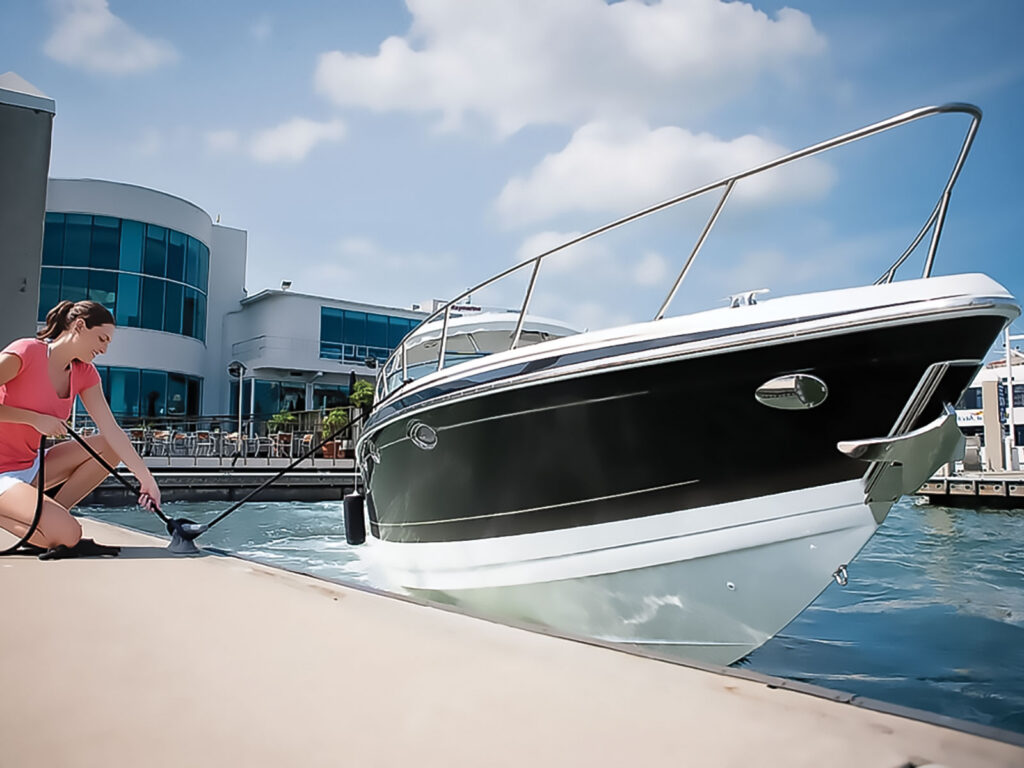
Ask any new boater about what they find most intimidating on the water, and you might get an answer about backing a trailer, running an inlet or playing in traffic. But odds are, people will say docking. The thought of having to pull up to a busy fuel dock or waterside restaurant is enough to knot many boaters’ stomachs. Joysticks and bowthrusters have done wonders for reducing anxiety levels, but most boats don’t have these tools. Up your docking expertise by mastering these three techniques.
Nose-In, Stern Out
For side-to docking, particularly in a tight space between two boats, approach the space by going nose-in at idle speeds. Align your boat down-current, or down-wind, to serve as a natural brake. Head in at a 45-degree angle and then, as you get close, shift to neutral and then sharply turn the wheel towards the dock. Next, hit reverse, and then shift back to neutral, while keeping your wheel turned into the dock. The reverse thrust will swing your stern in towards the dock. This requires feel and finesse as you’ll need to bring the throttles to neutral and may need a subsequent short burst of reverse to build just the right momentum to carry you in. Naturally, deploy fenders.
Spring, Sprang, Sprung
When pulling into a slip or pier in a cross-current or heavy winds, “springing” uses your boat’s power against a fixed line to swing in or out of a tight space or against a brisk wind. For example, with a line from the dock tied off to a spring cleat, you can hold the boat against a stiff wind blowing from shore by powering gently forward with the wheel turned away from the dock. That’s a common scenario, but there are many permutations of springing. You can use it to pivot and back into a slip, swing your stern out, and more, by using different line placement.
Read Next: How to Cleat a Dock Line
Basic Elements
While wind and current can make docking a nightmare, when the elements are properly aligned they can make you look like an expert. As mentioned above, if the wind and/or current is working directly against you, you can use them as a natural brake to keep your vessel under control on your approach. If the wind or current is pushing you directly into a dock or slip, you can also line up your boat several feet away from your docking destination and let the wind or current guide you in. With a cross-current or wind, take the time to gauge how quickly it’s moving you in one direction, then aim off target accordingly. For instance, if you’re trying to head bow into a slip, aim your bow so your boat is pointing straight, but a few feet upwind or current of your final destination, then put it in gear. As you idle forward, the elements will naturally push you into alignment.
Finesse
All of these techniques require a lot of touch and finesse at the helm, and if it’s not working out, abort the mission and restart the process away from the dock. Better to get it right on the third try than to crunch on the first or second. And always keep your speed under control. As an old pro once said to me, “When it comes to docking, it’s slow like a pro, fast like an ass.”