You might have seen the viral video in which a Florida fishing-charter captain loses his temper and lashes out at a family who paid to go fishing with him.
What triggered the explosive, expletive-laden tantrum? Per the captain, while he was landing a fish for one of the kids, the father inadvertently knocked the idling outboard into gear and advanced the binnacle lever to nearly full throttle.
This sent the captain flying headlong into the splashwell. Fortunately, he stopped his fall with one hand on the outboard cowling, his head dangled inches above the propwash. Moments later, the theatrics commenced.
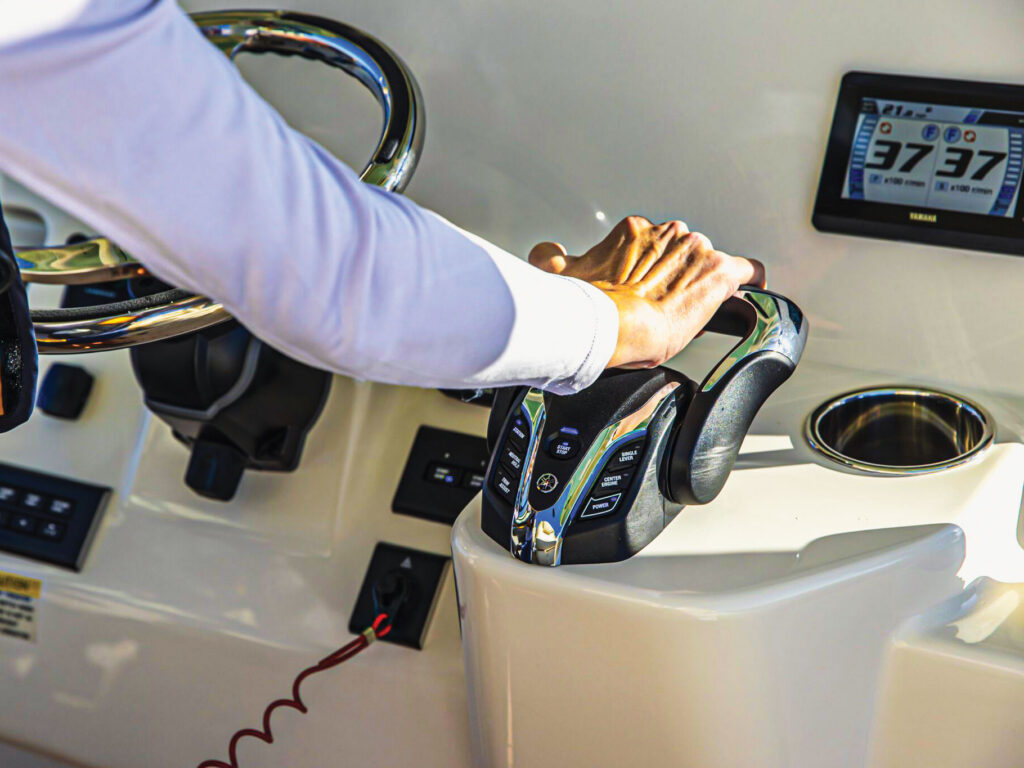
This and other similar throttle mishaps point to the need to manage binnacle controls for safety, especially when it comes to the easier-shifting electronic controls.
At issue here is the nature of neutral safety locks on binnacles. Absent is the kind found on side-mount control boxes. With these, you need to squeeze the neutral safety lock on the underside of the grip to shift into forward or reverse. Pull back to neutral and the safety lock is automatically reactivated. It works without much extra thought to prevent inadvertently shifting.
Many binnacle controls have gear-shift lockouts of sorts. With some binnacles for cable shift-and-throttle systems, for example, you can pull the handle away from the control box to give you throttle only. However, once you return the lever to neutral position, the gear-shift lockout is deactivated.
With the latest binnacles for electronic shift-and-throttle motors, there is a throttle-only button either on the control box itself or on the push-button start panel. Once activated, the engine will remain in neutral until deactivated.
Yet neither of these systems are intuitive and, in my experience, seldom employed. Whatever the case, skippers must exercise vigilance in managing the binnacle control box for safety. Here are my three safety tips for preventing scenarios in which the binnacle control lever can be unexpectedly advanced.
Turn the Engine(s) Off
This is no doubt the simplest and most prudent way to prevent throttle mishaps, whether at the dock, while fishing, or just floating along admiring the scenery. Besides, it’s quieter and eliminates exhaust fumes. Some argue also that excessive idling leads to fuel blow-by that can dilute engine oil.
Read Next: How to Handle Five Boating Emergencies
Use the Throttle-Only System
When far offshore or drift-fishing close to the beach or jetties, some skippers are hesitant to shut off the engine over concern that it might not restart, potentially putting the boat and its crew at risk. On these types of occasions, using the throttle-only system for the binnacle negates that concern. As mentioned earlier, such a system is not automatic, so the captain must develop the habit of using it whenever leaving the helm unattended. This practice needs to become second nature.
Restrict Helm Access
Crew members gravitate to the helm, because they find comfortable seating and interest in the glowing electronic displays and fancy controls. Aboard a center-console with a T-top, it might be the only place to find shade. But if you need to leave the helm, don’t leave youngsters or any less-than-qualified crew at the helm with the engine running. With young boys especially, the first things they instinctively reach for are the wheel and the throttle. When you’re not at the helm, keep the kids away or turn off the engine and take the keys.