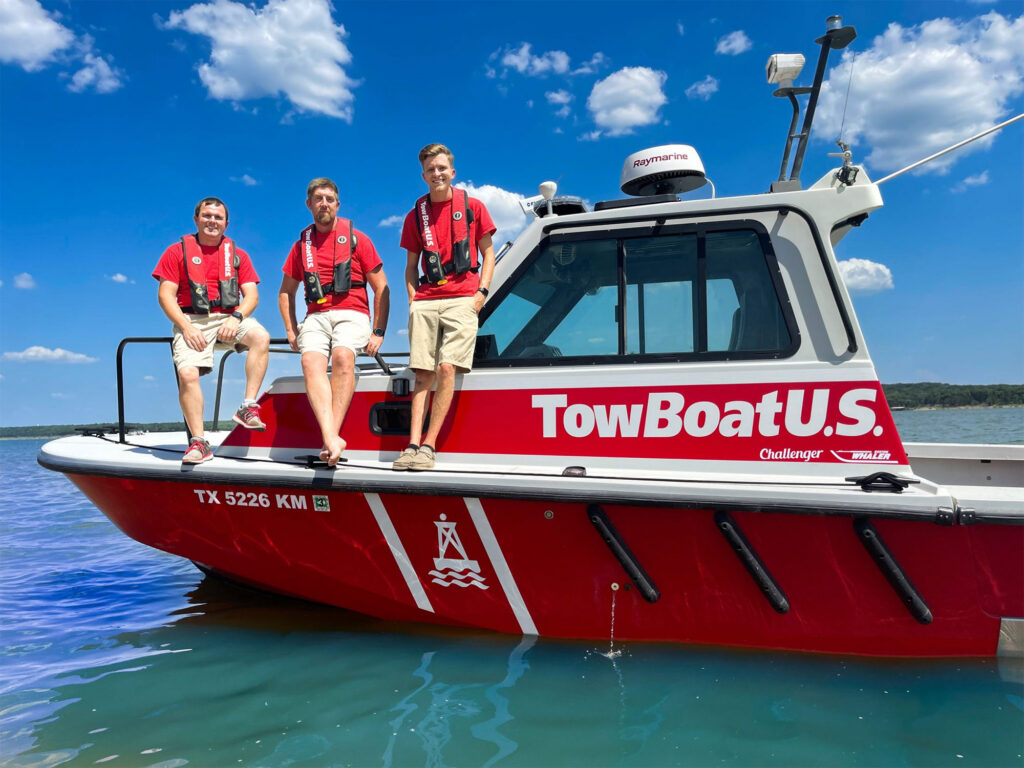
“I immediately realized this was a serious situation,” says Captain Michael Tucker of TowBoatUS Lake Texoma. He had just received a request from Grayson County 911 to assist a young man in a small runabout bow rider on Lake Texoma. Tucker would later be honored by the Association for Rescue at Sea (AFRAS) for his decisive and brave action he took that day, ultimately saving five lives, four of whom were children.
Tucker has two decades as a Coast Guard certified captain and has been patrolling Texoma for 16 years. At about 140 square miles straddling the Texas-Oklahoma border, Texoma has a reputation for switching from flat calm to life-threatening in minutes. The call came on one of those days. A pop-up thunderstorm brought sudden 35 mph winds and swells of five to seven feet. Tucker knew he had no time to spare.
The runabout’s reported position was three miles from his marina, and Tucker’s towboat had been pulled for service. That left him two options, neither of them good: He could drive to another marina to grab a towboat, which would put him on scene in 45 minutes. Or he could try to pilot a 24-foot rental pontoon boat into the teeth of the wind and waves.
The choice was an easy one for Capt. Tucker. He grabbed his business manager Elie Karam from the fuel dock, fired up the pontoon’s 115-horse outboard, and sped off. For the uninitiated, this was a bold decision. Pontoon boats offer almost no freeboard or bow rise. Running one into head-high swells demands superlative seamanship.
It took all of Tucker’s experience and skill to shoulder the pontoon into the big wind-driven swells, hitting them at a 45-degree angle, working the throttle constantly, taking waves over the bow and railings.
When Tucker and Karam were about a mile away, they spotted the distressed vessel. They’d run only two or three minutes from the marina, and their total response time from the 911 call was a mere 11 minutes. When they arrived, Tucker says, there was just one person in the boat – a teenaged boy, overcome with grief and stress.
Tucker tried to get a sense of what was happening.
“Where?” he shouted.
The boy pointed upwind.
“How many?”
Five – four kids between the ages of 8 and 16, and their father.
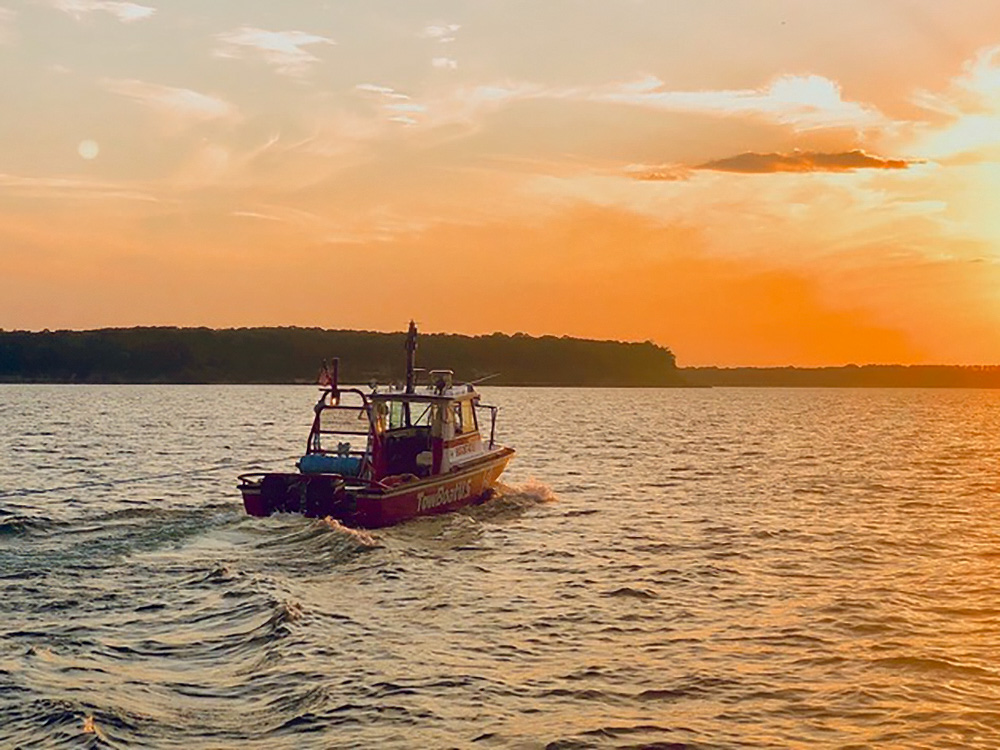
Tucker turned the pontoon into the wind, scanning the wave tops. “It wasn’t ideal,” says the captain, who is prone to understatement.
About four minutes later, the rescuers spotted a young girl in the water. She was about 12 or 13 years old and not wearing a life jacket. Karam hauled her onto the pontoon where she collapsed, utterly exhausted.
“Where’s the next one,” Tucker asked the girl, who indicated upswell. Wasting no time, Tucker pointed the pontoon upwind again and soon encountered the youngest siblings. The boy was wearing water wings, desperately holding his sister’s head just above the surface.
Three souls saved so far. Where’s the next?
“She’s swimming towards shore,” one of the kids said. Tucker remembers thinking the shore was impossibly far for a child in such savage conditions. As he motored toward the shoreline, the kids in the boat were yelling that their dad was not going to make it. They thought they’d lost him.
Tucker and Karam found the last girl just in time. She was sinking beneath the surface and briefly surfacing. She was moments from drowning.
“It was dire,” Tucker recalls. The girl wasn’t wearing a life jacket. Tucker was prepared to go into the water after her but Karam was able to use a paddle to pull the near-drowning child to the back of the boat.
Four souls saved. Only the father was still missing.
Tucker credits Karam for calming the children and offering them emotional support.
“We train everyone as a deckhand,” the captain says. “We fail to our highest level of training. He was the right person for the job,” Tucker says of Karam. “He was absolutely critical to the rescue.”
“I was fearing the worst for the dad,” Tucker recalls thinking. That’s when he and Karam noticed a sailboat maybe 500 to 700 feet away. A sailor was trying to throw a life ring into the water, directly into the wind. The ring kept coming directly back to the sailboat. Tucker sped off in the pontoon one more time, quickly reaching the kids’ father.
The two rescuers manhandled dad onto the pontoon. He also wasn’t wearing a life jacket.
“Once they were all in the boat, I was hit by the gravity of the situation and a sense of relief,” Tucker says. The family was huddled together and crying. “It was incredibly emotional,” says Tucker.
Only 20 to 25 minutes had passed since Tucker and Karam left the dock. Every one of those minutes counted.
“The reality is ten minutes later we would have been working a recovery,” Capt. Tucker says soberly.
By then, the lake was relaxing into its normal sea state. The winds were down to just 12 to 15 miles per hour.
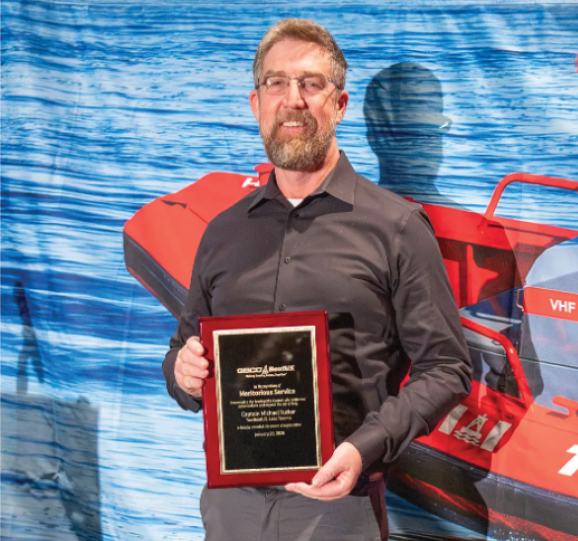
Tucker says there was no clear answer how the family ended up in the water. When TowBoatUS awarded Tucker the Meritorious Service Award in February, the citation noted only that “four children between 8 and 16 years old along with an adult male were tossed overboard, none of them wearing life jackets.” When the lone teenager left aboard attempted to throw a line to the others, it fouled the prop. The vessel was left incapacitated, drifting rapidly downwind, away from the scattered family members. The young man immediately called 911, and Tucker and Karam were on the water moments later.
“As professionals, we have thousands to tens of thousands of hours on the water. We wear life jackets every time we leave the dock,” Tucker says. He recommends boaters should at least have their life jackets out and ready. Events can go south at a moment’s notice.
“Smart safety is wearing a life jacket,” the captain adds.
He singled out the boy behind the controls for praise. “He did the right thing by calling 911 immediately. That call probably saved five lives that day. Don’t be afraid to call and ask for help.”