Transiting a bridge can present a number of challenges to a boater. What first comes to most skippers’ minds is the bridge clearance or “air draft.” While that might seem like a Captain Obvious situation, there’s more to safely passing under a bridge with your boat than knowing whether your boat will fit under it. That’s what we’ll discuss in this article: techniques and tips for safely passing under a bridge with your boat.
Bridge Clearance
Bridge clearance is a big deal. But, how do you determine whether your boat will fit under? The first thing to do is to determine the height of the boat from the waterline to its highest point, including masts, flagstaffs, and non-folding antennas. Many boat builders list bridge clearance as a basic spec. You can also measure the bridge clearance yourself. I recommend doing this in stages and then adding up the total.
For example, with the boat floating in the water, measure from the waterline to the top of the gunwale, then measure from the top of the gunwale to the top of the hard top. Then measure from the top to the top of your radar or other protruding fixtures. By measuring in increments and adding up the total, you will be more accurate than trying to measure from the waterline, which is out at the boat’s maximum beam, to the top of the mast, which is on the boat’s centerline.

Fixed Bridges
Now that you know your boat’s bridge clearance, you’ll want to check the nautical charts for the area in which you plan to boat. These will list the clearance under bridges. For coastal areas, the clearance will be given at a specific stage of tide, so you will also need a tide table to look up what the clearance will be at the time you plan to be at the bridge.
As an aside, you’ll also need knowledge of how weather and atmospheric conditions affect tides. Generally, an onshore wind creates higher tides that often occur earlier; an offshore wind creates lower tides that often occur later. Low pressure can mean a higher tide; a rising barometer can mean lower tide levels.
Now, as you approach the bridge, look for lights and signs showing where to pass under. The center of the bridge is often the spot with the highest clearance, but not always. Furthermore, even if you have clearance at a spot other than the designated channel, you may not have sufficient draft under the water. Be aware.
Mounted on the apron or dolphins protecting the bridge, you may find a sign stating the clearance (at a certain stage of the pool or height of tide). Additionally, you should look for a clearance gauge, which is a vertical board marked like a ruler, and installed at the surface of the water. The clearance gauge shows the bridge clearance at any given moment as the water level changes.
Finally, keeping a lookout applies to passing under a bridge. Position a crewmember as high as safely possible on your boat so that they can “eyeball” the clearance between the highest point of your vessel and the underside of the bridge. Remember this saying: If there is any doubt, back out.
Opening Bridges
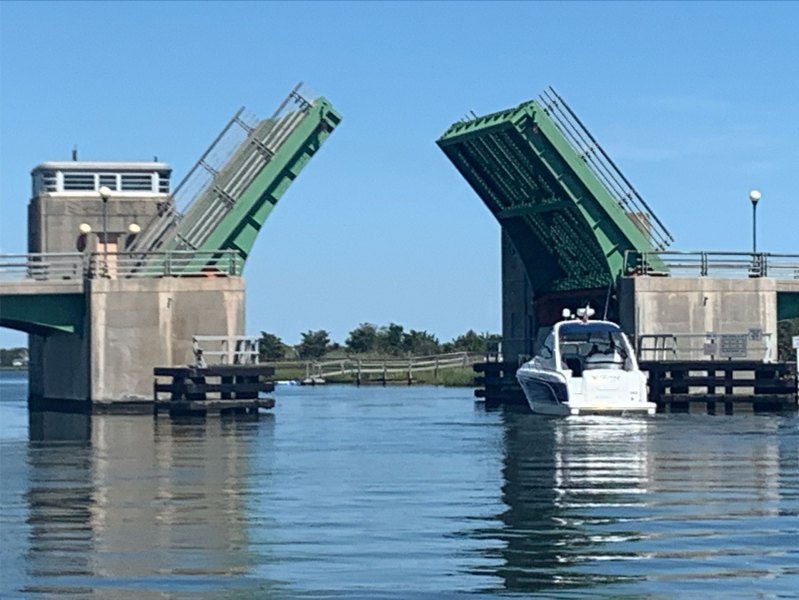
Drawbridges, swing bridges, vertical lift bridges…these are just some of the different types of opening bridges. (Did you know that a drawbridge is also known as a bascule bridge?) These bridges open to allow taller vessels to pass that would be impossible when they are closed. Such bridges may open upon request of the mariner, on a set schedule, or both.
To safely transit an opening bridge, first apply the principles previously outlined about fixed bridges. Remember, you can pass under an opening bridge when it’s closed, so long (obviously) as your boat can fit. Therefore, check the nautical charts for the clearance, check the tide chart if applicable, and look for the clearance gauge mounted at the bridge itself.
Too tall to fit under the closed bridge? Don’t put away your nautical chart. Find the bridge on the chart, and you will see a note delineating the opening schedule. If the bridge opens on demand, that will be noted as well, along with the VHF channel that the bridge tender (the person who operates the bridge is known as a tender) monitors. This information will also be posted on a sign at the bridge itself. Usually, you’ll hail a bridge on channel 13. How do you do that?
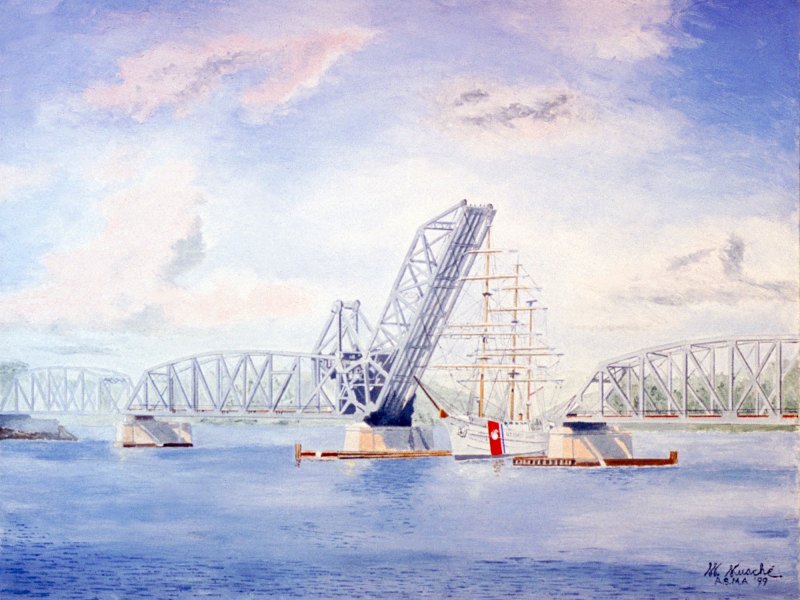
“Maple Street Bridge, Maple Street Bridge, Maple Street Bridge. This is Vessel Therapy requesting an opening.”
From there, wait for the bridge tender’s response. Then, follow the direction they give you. To open the bridge, the tender needs to stop automobile traffic on the bridge. You may be asked to wait until other boats approaching the bridge are ready to pass, so that only one bridge opening (one stoppage of auto traffic) m occurs.
Once the bridge begins to open, make sure it is fully open before you head through. Also, it’s not a race—other boats may be queued up to go through from either direction. Stay to the right and proceed at minimum speed. A big wake coupled with multiple boats between bridge abutments is a recipe for injury or damage. Confident, close-quarters maneuvering is what is called for, not plowing through with a “damn the torpedoes” attitude.
Current
Bridges are often located at places with exceptionally-strong current. This is by design; that is, bridges are often constructed at a narrows. Narrow spots, such as between two opposing points of land, allow building a shorter, less expensive bridge. As a boater, you probably already know that a narrows is where strong currents can be expected as the water is forced between the points.
This being the case, one needs to be confident in many phases of slow-speed boat operation when passing under a bridge. The skipper heading into the current needs to use the minimum speed possible to make headway. I see many boaters in this situation who are applying too much throttle, which causes the boat to squat and throw a big wake. That’s not the way to do it. Instead, trim the drives vertically, and use just enough throttle to make forward way.
Conversely, if you are passing under a bridge with the strong current behind you, you have a tougher job. Keeping the boat straight and preventing it from swerving can be done without using excessive throttle, but requires practice. You must work the wheel and use short bursts of throttle. Ideally, you will have learned how slow you can go while maintaining control with a following current before you are passing under a bridge with a dozen other boats heading in both directions. To be sure, it will be an unnerving experience for those who have never been in the situation before. At least, make mental preparations.
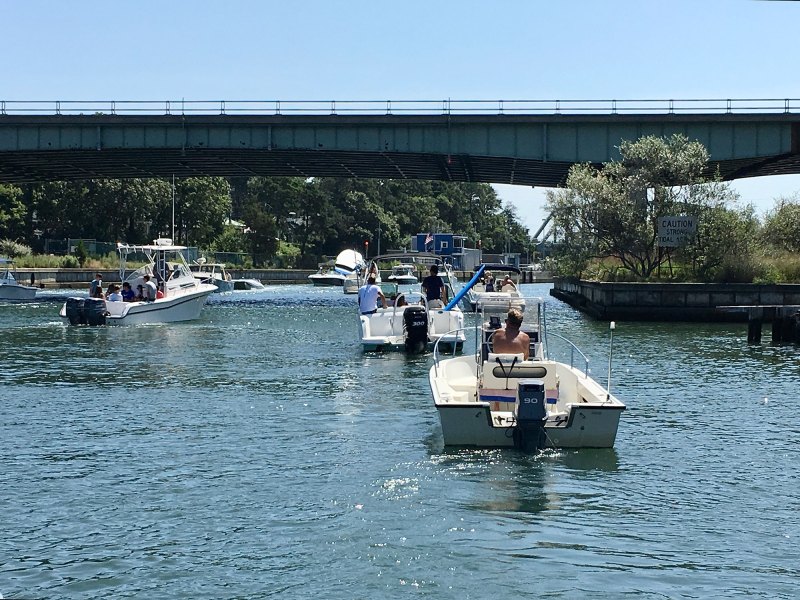
Another way in which current affects how you pass under a bridge occurs while you are waiting for an opening bridge to open. Yours may not be the only boat wanting to transit the bridge. You may be waiting in close quarters with a small fleet of other boats. You’ll need to be able to hover in place with confidence—as well as now, when it’s best to just fall back and out of the way with the current. Tempers have been known to flare as boats await an opening. Keep your cool. It’s not a race. You’ll get through.
Final Thoughts On Passing Under a Bridge In A Boat
In closing, make sure you know your boat’s bridge clearance, measuring it yourself by the instructions given in this article, or by reading the boatbuilder’s specs. Secondly, do your homework with respect to finding out bridge clearances, tide times, and bridge opening schedules and procedures. Finally, practice and be confident in slow-speed boat handling, both when running with and against a strong current.
Remember: Passing under a bridge is not a race. Take the time to do it safely. (And, if there’s any doubt, back on out!) It is usually only 100 feet or so, after which you can most likely resume normal operation and head to whatever adventure awaits you.