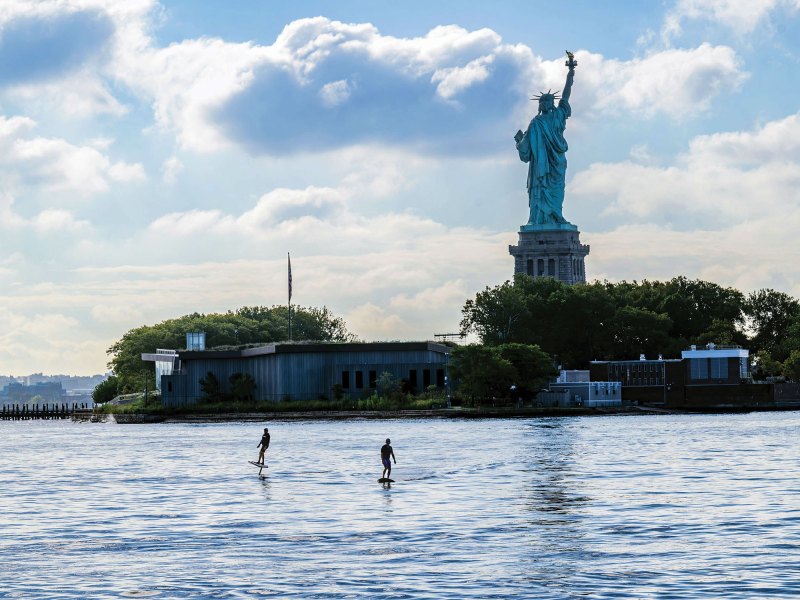
The Lady of the Harbor stands over 30 stories high from the base of her island pedestal, jutting her torch-bearing hand into the New York skyline. By comparison she is dwarfed by the skyscrapers dominating the cityscape, from the Freedom Tower in lower Manhattan to the Empire State Building and the Chrysler Building in midtown. Yet to the world, no other edifice symbolizes New York City, or the United States of America, more than the Statue of Liberty. Since first erected in the harbor in 1886 (after being gifted from France to celebrate our country’s first 100 years), she has served as a welcoming beacon to everyone making their way to the country through nearby Ellis Island.
Liberty Landing State Park, on the New Jersey side of New York Harbor, offers some of the best views of the Statue from land, with walking and biking pathways running along the harbor as well as an observation deck. It also has a boat ramp and a kayak launch site, which is where I met Rudi Miklosvary, the vice president of sales for Fliteboard, a brand of efoil owned by the Brunswick Corporation. In the past few years, efoils have exploded in popularity for a variety of reasons: You can tote one in a large backpack, throw it in the back of any car, head to the water, plug in the battery and go. They come in a variety of shapes and sizes designed for all different skill levels, have a relatively easy learning curve to get started, and most importantly, are ridiculously fun.
On a crisp, bright morning at low tide, I met Miklosvary in the parking lot, where we both donned a watersports life jacket and a safety helmet, and started walking to the water as the sun rose over Lady Liberty and the New York skyline. What better way to demonstrate the, dare I say it, the unbelievable feeling of freedom that comes from riding a foil.
Flite Path
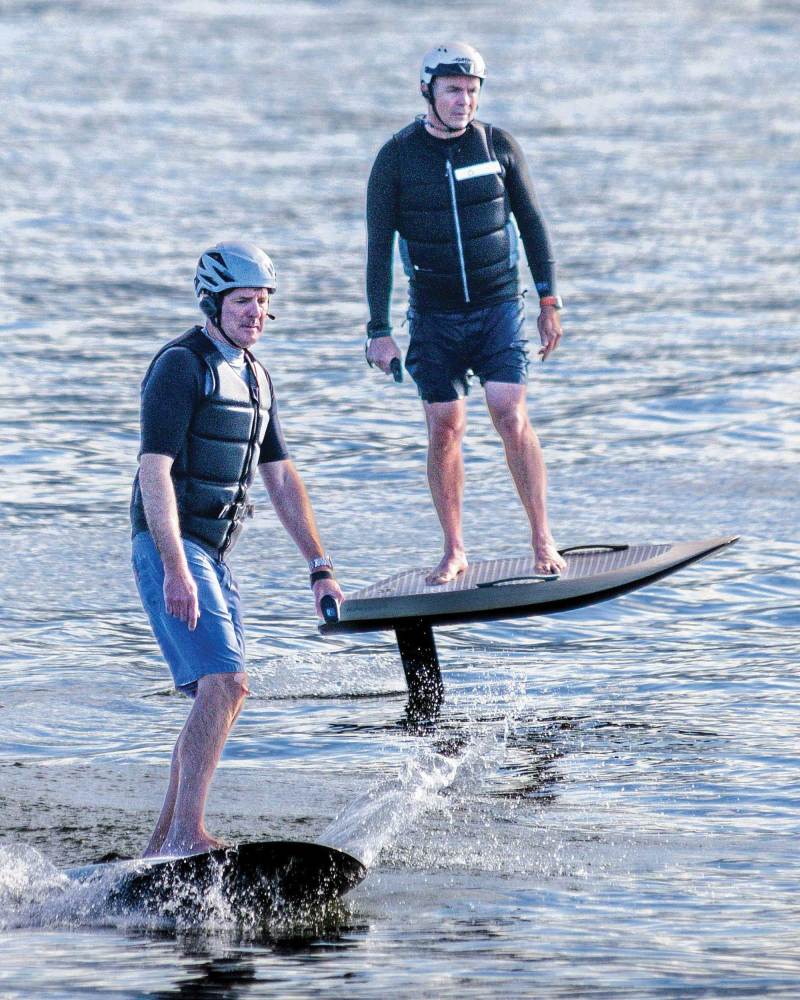
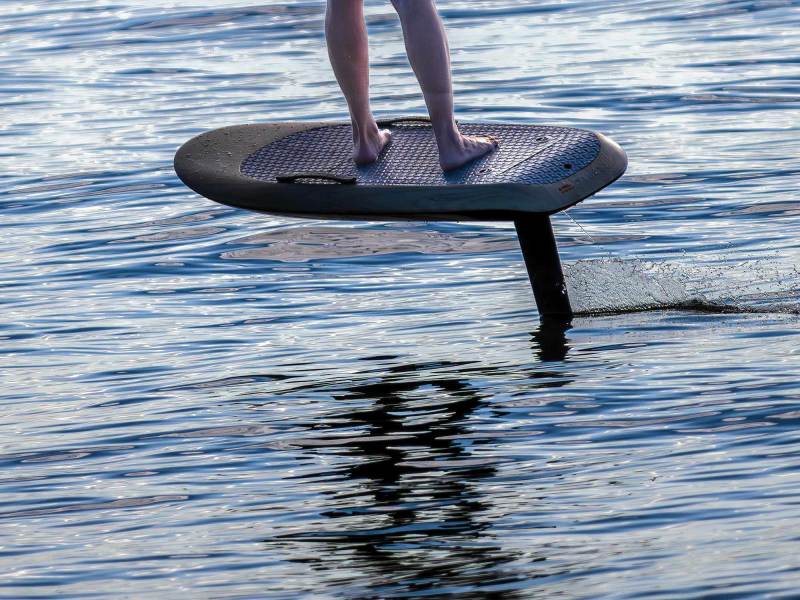
This story actually started in 2019, when I met with David Trewern, a former world-record holder in kitesurfing, who had spent the previous year developing his pet project, a battery-powered foiling board that a rider could operate by a handheld remote control. It resembled a motorized surfboard, except for the large foil system underneath that works the same as an airplane’s wings to provide lift. When operated correctly, the foil lifts the board completely out of the water, so that you’re standing in the air and gliding through the water on the foil’s wings. Excited to show me his creation, Trewern took me into the water, taught me how to lay flat on the board, pull the trigger on the handheld to get started and eventually how to stand. After about 20 minutes of getting used to standing on the board, he showed me how to adjust my weight using my feet, increase speed with the handheld remote, and generate lift. That was it. Within a half an hour of ever seeing an efoil, I was foiling, and it felt like a was flying on top of the water.
At the time I thought the Flite might be the coolest thing ever, an accessible water toy that almost anyone could learn to use, restricted only by the battery’s range and how close you were to an electrical outlet for recharging. The main drawback at that time? Price. Due to the expense of development and technology, Trewern’s original Fliteboards cost upwards of $20,000, limiting their audience at the time mostly to yacht owners looking for the next cool toy to bring aboard.
Fast forward to 2023, when Brunswick, obviously seeing the same potential in efoils that I did, bought Fliteboard. Owner of Sea Ray Boats, Boston Whaler and Mercury Marine among other brands, Brunswick had the infrastructure in place to take efoils mainstream. One of the company’s first missions was to make Fliteboards more affordable. Sure, there are still several models that cost in the $20,000 range, but the real game changer came when Fliteboard introduced the Fliteboard Air. Instead of using a carbon-fiber-bodied board, the AIR featured an inflatable soft top board that was easier to use, provided a ton of stability for beginners, and cost, with an entry-level foil system, under $7,000.
To show off the new Fliteboard lineup, Brunswick invited several members of the media to Charleston, South Carolina, for a day of testing and cruising. After not setting foot on an efoil for a few years, I took the test ride and fell in love all over again. Our instructor that day happened to be Miklosvary, an expert foiler and a great teacher on how to get started and get the most out of your foiling experience. While cruising around the waters of Charleston with Miklosvary, who lives in the tri-state New York metro area, he said to me, “You know what’s really fun? Taking a Fliteboard around the Statue of Liberty.”
Light-bulb moment. Fast forward again to that morning in Liberty Landing State park, where I was standing knee deep in the waters of New York Harbor, ready to launch and take one of the most unforgettable rides of my life.
Mission Control
The waters around the Statue of Liberty are a little different than the calm, protected waters we’d previously run in Charleston. For one, there’s an incredible amount of commercial traffic, and the waters can get very turbulent in a hurry, particularly when the fast commuter ferries start shuttling office workers and others from the Jersey side into Manhattan for the day. Then there are the tourist ferries that bring boatloads of sightseers to the front side of the Statue. The waters around the backside of the Statue, however, are protected from commercial traffic, making it an ideal place to launch a kayak, a standup paddleboard or, in our case, an efoil.
This being my third time on a Fliteboard, Miklosvary chose a 100L EVA Soft Top model, designed to be similar in buoyancy to the original inflatable board I first tried. The board itself is made of fiberglass, but it features a top layer made of thermoformed foam that is softer and more forgiving should you wipe out. It is designed to provide more stability. He paired my soft top with a standard foil that extends about 2 feet below the board with wings that protrude about 18 inches to either side. The battery, housed inside the board, delivers 5 kilowatts of power to the propeller, which is protected by a circular shroud.
While I used the entry-level version, Fliteboard offers several models designed for varying levels of riding and ability, up to high-end carbon-fiber boards with super-fast foils underneath. Just this year, it even introduced the Flite x Mercury Racing board that’s touted as the world’s fasted efoil, reaching speeds up to 34 mph. Safe to say, I would get nowhere near that speed.
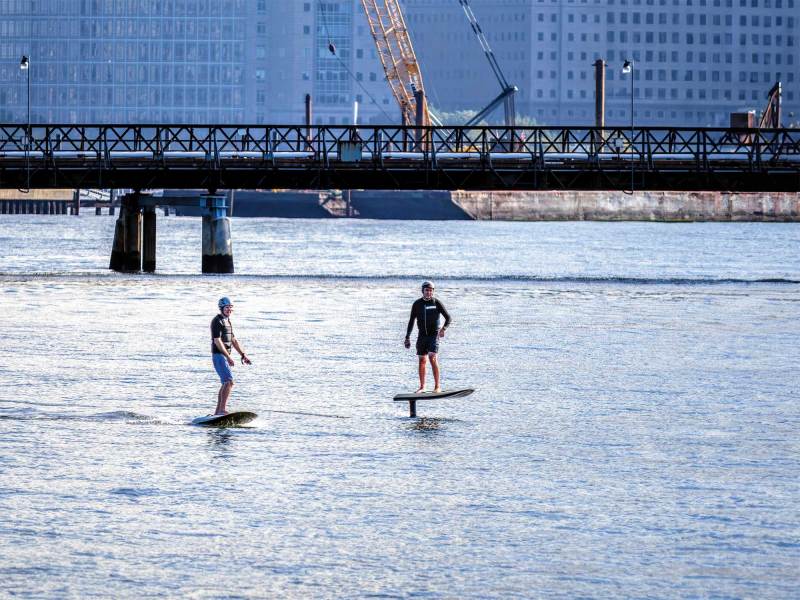
As I was still a relative newcomer to the foiling game, Miklosvary gave me a refresher tutorial on how to use the board. Start by laying on the board with your feet dangling off the stern, elbows propped up to keep your hands on the board and able to use the handheld remote. The remote attaches to your wrist with a lanyard, and works with a trigger-style control to engage. It’s very intuitive to use and has the failsafe that, when you let go of the trigger, the prop stops spinning. My particular remote had 10 speed settings, and Miklosvary suggested I start on 2 to get moving at a speed fast enough to keep the board from plowing, but slow enough to be able to stand up under control. After a few circles around the kayak launch on my stomach, I pushed up on my arms, went first to my knees and then proceeded to stand on top of the board. After a few more test circles around the protected area, I upped the speed first to 3 and then 4 and felt the board start to rise under my feet. Pushing hard on my forward foot to control my weight distribution, as Miklosvary had taught me, I felt the board level out underneath me. Then I distributed my weight to execute a leaning turn and, Miklosvary, riding on a more advanced carbon-fiber model, led the way around the corner and into the most impressive view of the Statue of Liberty I have ever seen. (And, I used to keep a boat docked right across from her.)
Read Next: How to Equip a PWC for Towing a FoilBoard
Freedom Run
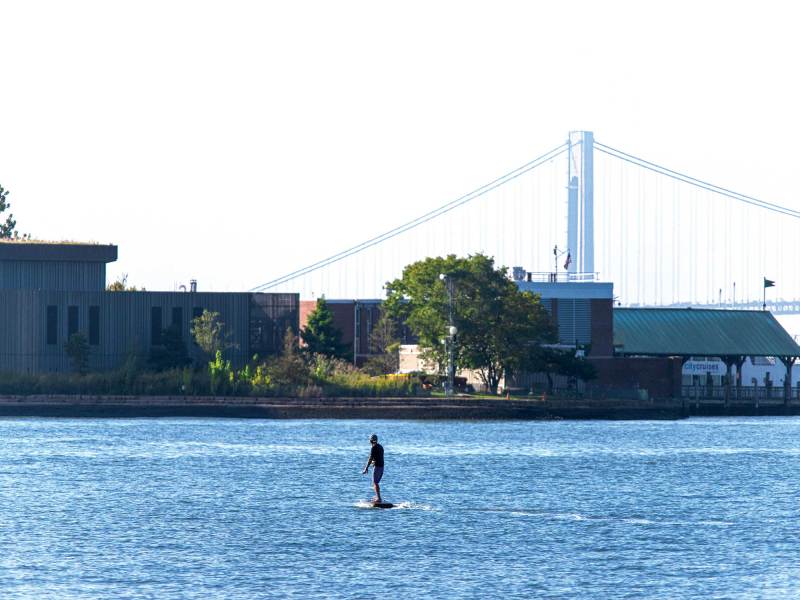
I have seen the Statue of Liberty up close many times in my life, from high in the sky in an airplane window seat, to taking the ferry over and doing a walking tour, to even fishing around the area (New York Harbor has some excellent striped bass fishing). But I had never seen it this up close and personal, standing basically just above the water on a small piece of fiberglass. It was exhilarating. We ran up as close as we could, right up to the buoys marking the restricted area around the island, seeing the Statue in all of her glory on one of the most beautiful sunny mornings you can imagine. Morning being the key word here as we tried to get most of our run in before the ferry traffic kicked up, sending huge rollers toward the breakwater around Liberty Landing. For the first 40 minutes we cruised around the harbor behind the Statue in glass-calm waters, sharing the space with a few anglers in pedal-powered kayaks. Beyond the Statue, we could see the skyline of Manhattan taking shape and we had an easy run all the way up to Ellis Island, where we crisscrossed underneath the long walkway bridge connecting the landmark to Liberty Landing park.
Then, on the way back to the Statue, we felt the first waves of ferry wakes rolling through. The beauty of an efoil—for an experienced rider—is that it can elevate you above boat wakes and surface chop, with only the foil carving through the rough water and the rider standing on the board above it. When I saw the wakes coming, I made the mistake of slowing down, causing my board to drop to the level of the rollers. Boom, I got caught. One thing Miklosvary stressed is that when you fall, try to jump away from the board, so as not to land on the hard body or expose yourself to the foils underneath. Thankfully, I heeded his advice, as a wave caught me off guard and knocked me off the board. As I fell, I let go of the handheld trigger, so the board glided only a short distance away. While I’m sure I looked awkward, I swam back over, slid onto the board, pulled the trigger and started up again.
I headed back toward the Statue, elevating the board again, and as I stared at the towering green lady, I took a moment to reflect on what she means to so many—especially now as we get set to celebrate the 250th anniversary of the founding of our country—and I felt a level of gratitude about what it meant to be standing on a Fliteboard at that moment, flying free.
Fliteboard Race
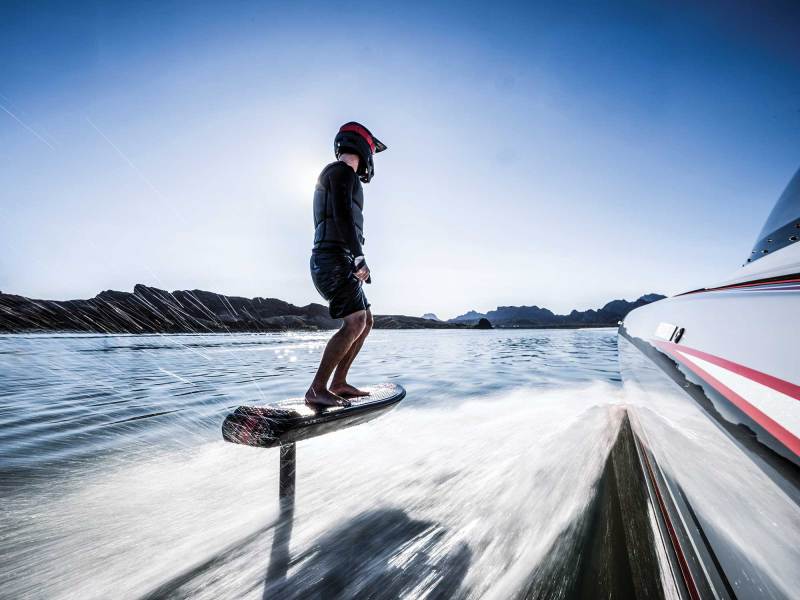
The new Fliteoard Race is one of the fastest efoils around. It features a custom impeller to crank up the rpm, letting you fly up to 34 mph. It also features FliteLab surf foiling wings. Its style is inspired by Mercury Racing, adding sleek contours and signature carbon Innegra details. The board has a longer, narrower profile, which makes it more aerodynamic, and taking off and touching down feel incredibly smooth.