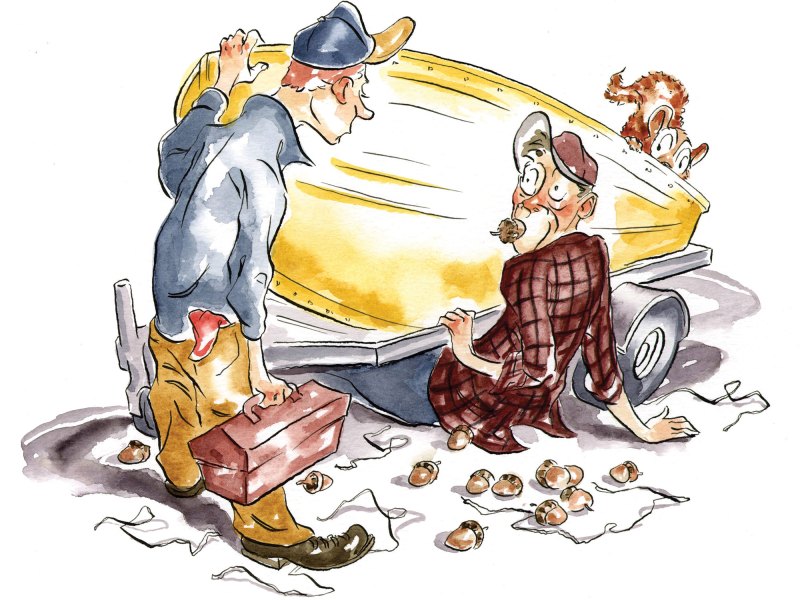
Last fall, the widow of my departed friend Donnie Schultz asked for my help selling his fishing boat. Of course, I said yes. My good friend Chuck Larson offered to assist, and on a bright, warm day in March, we met at the storage site—an auxiliary garage at the end of a grass driveway. My plan was to tow the boat over to the shop of Dan the Outboard Man, who would go through the 1980-ish 25 hp Mercury outboard clamped to the transom of the faded yellow, 16-foot aluminum Starcraft. We pushed the rig out of the garage and confronted the challenge of the trailer-light wiring.
“This is really boogered up,” Chuck said as he examined the flat four end near the hitch. The wire insulation was faded and cracked, two wires were broken, and a third was wrapped in ancient, rock-hard electrical tape. Using a multitool, Chuck and I tried to MacGyver things to functionality for the short run to Dan’s shop, but all the lights stayed dark. I crawled under the trailer and found multiple repairs executed with blue Scotchloks and even wire nuts. Oh, Donnie, I thought, what were you thinking? The solution was a new light kit.
“I’ll run to NAPA” I said to Chuck. “Why don’t you get us some lunch?”
I decided to do this right and also ran home to get a wire stripper, my nifty Ancor crimp tool and heat-shrink butt connectors. When I returned to the garage, Chuck’s legs were sticking out from under the trailer.
“Just snipping off the last of the old wires,” Chuck said waving a pair of side cutters. I looked down and saw the rest of the harness tangled on the ground.
“I wish you hadn’t pulled the wires out of the trailer tongue,” I said. “I’d use the old wire to pull the new through. But if it pulled right out it should be fine.” Well, of course the new wire would not go farther than about 2 feet into the tongue. What could it be? There were no fasteners in the way. I dug around in the garage and found a length of half-inch PVC pipe, slid it down the tongue and met resistance. I taped the end of the harness to the tip of the PVC, hoping to push it through the obstruction to the other end of the tongue.
Read Next: Planning for a Boat-Trailer Breakdown
“I’ll stay under here and be ready to grab the end of the wires and pull them through,” Chuck said. I gave the pipe a few good pokes.
“Oh, nuts!,” Chuck yelled. I gave the PVC another poke. “Nuts! Nuts!” Chuck called out.
“What is the problem?” I asked.
“When I said nuts, I meant real nuts—acorns!” Chuck exclaimed. “One right in my mouth!”
I withdrew the pipe from the tongue, and a handful of acorns rolled out, each with a neatly gnawed hole in one end. This was some animal’s food cache. I eventually forced the PVC to the end of the tongue, and Chuck pulled the wires through. The new LED lights sparked right to life. We stepped back to admire our handiwork.
“Well, I’ve never seen that before—mice or squirrels stashing nuts in a trailer tongue,” Chuck said. “I wonder where else those little guys have hidden acorns?”
“You never know,” I said, eyeing the black cowl of the Mercury outboard. “But let’s let Dan find the rest of them.”