Lift off your outboard motor cowl and you’ll probably find a cast aluminum powerhead shielded from salt corrosion by a thick coat of durable paint. Protecting the internal cooling passages exposed to salt water has long been a bigger challenge for outboard manufacturers. Suzuki Marine is touting a new anti-corrosion solution it calls Suzuki Edge eCoat, an aluminum anodizing process that it claims delivers superior corrosion protection and reduces environmental impact during manufacturing by reducing CO2 emissions by 50 percent. Edge eCoat was developed by Suzuki Motor Corporation to protect complex internal cooling and exhaust passages from corrosion by uniformly anodizing surfaces that come in contact with salt water. Suzuki is implementing the Edge eCoat process for its best-selling four-cylinder DF140 and DF115 models, with plans to progressively adopt the process across its model line-up.
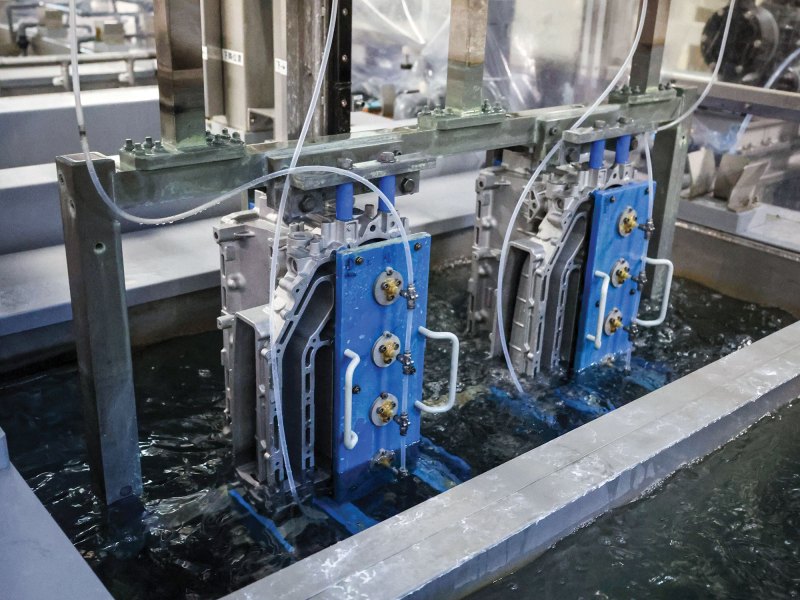
Anodizing is a process of controlled oxidation of a non-ferrous metal to create the durable and smooth finish seen on many aluminum objects, from fishing reels to flashlights. Anodizing is accomplished by immersing the aluminum part into an acid electrolyte bath and passing an electric current through the medium. The Suzuki cylinder block, cylinder head, crankcase, and exhaust passages are immersed in this solution, ensuring even coverage. The aluminum acts as an anode, so that oxygen ions are released from the electrolyte to combine with aluminum atoms at the surface of the part being anodized. Unlike painting or plating, this aluminum oxide is fully integrated with the underlying aluminum substrate and cannot chip or peel. By employing a low-temperature sealing treatment Suzuki can maintain corrosion resistance even when exposed to a surface temperature as high as 572 degrees F. The Edge eCoat also replaces paint on exterior surfaces.
Read Next: Suzuki V-6 vs. Inline-4 Outboard Test
Suzuki previously submerged engine castings in an electrified bath of CrO2 (chromium oxide), a chemical treatment often called chrome conversion used to protect aluminum from corrosion. Mercury utilizes a combination of anodizing and a chrome conversion process, depending on the part, followed by an immersion in EDP (electro deposited paint). Yamaha uses a combination of Alumite anodizing and EDP. Honda uses an unspecified anticorrosion sealing treatment. Suzuki, Yamaha and Honda also place a number of easy-to-replace sacrificial anodes within powerhead water passages. Mercury states that its proprietary aluminum alloy and surface treatments make anodes unnecessary.
Protect Your Powerhead
- Follow the operator’s manual instructions and freshwater flush your outboard after every use in salt water.
- Check and replace the powerhead anodes frequently using only quality OEM parts. The location of each anode will be indicated in the engine operators’ manual.
- Occasionally remove the cowl and rinse the powerhead with a gentle flow of fresh water. Never use a power washer and keep water away from the engine air intake and the alternator. Allow the powerhead to dry and then apply a water-dispersant protectant spray (Yamalube Yamashield, Mercury Corrosion Guard Engine Protect, Honda Marine Corrosion Inhibitor, Boeshield T-9) to the powerhead, avoiding any exposed drive belts.