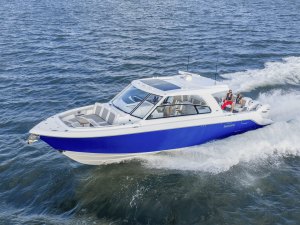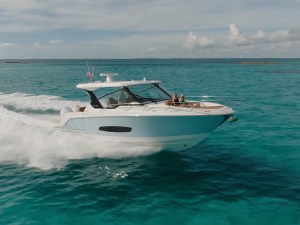
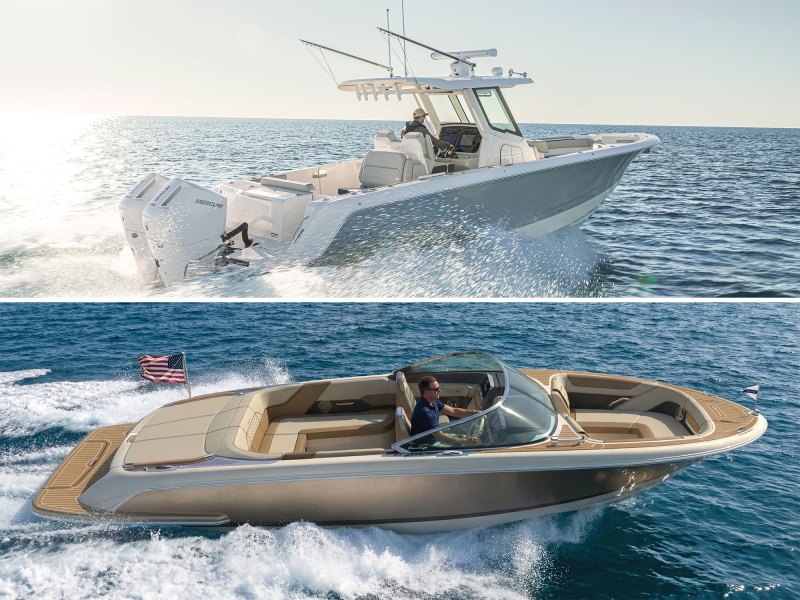
If we asked you to name a lip balm, your answer would almost certainly be ChapStick. Ask a random stranger to name a brand of bleach, and the reply will be Clorox. Ask any non-boater to name a boat brand, and the answer is very likely to be one of two names: Chris-Craft or Boston Whaler.
In fact, our Facebook survey reached over 10,000 boaters, and 63 percent named one or both as the most well-known boat brand. Your friends at the marina will, of course, name their own boat.
They are the two brands that have been in existence from Boating’s founding in October 1956 to the present day. Chris-Craft was founded in 1874. The patents for Whaler’s build process were applied for in 1956 and awarded in 1957, and the company was founded in June 1958.
The Chris-Craft and Boston Whaler brands demonstrate the power of American culture capital. They are brands with legacy—a story that was indelibly imprinted on the culture generations ago.
“Some brands become icons. Think of Nike, Harley-Davidson, Apple, Absolut, Volkswagen—they’re the brands every marketer regards with awe,” writes Douglas Holt, founder and president of the Cultural Strategy Group and author of How Brands Become Icons: The Principles of Cultural Branding. “These brands win competitive battles not because they deliver distinctive benefits, trustworthy service, or innovative technologies (though they may provide all of these). Rather, they succeed because they forge a deep connection with the culture. In essence, they compete for culture share.”
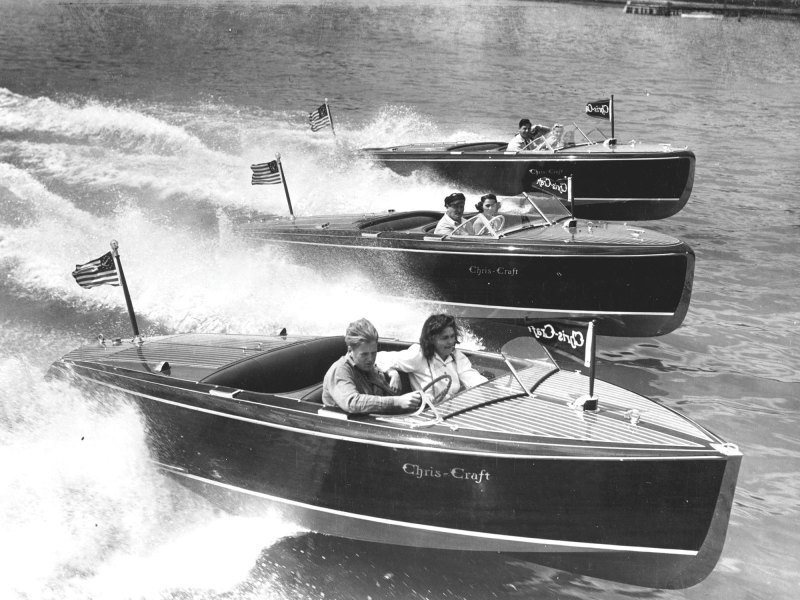
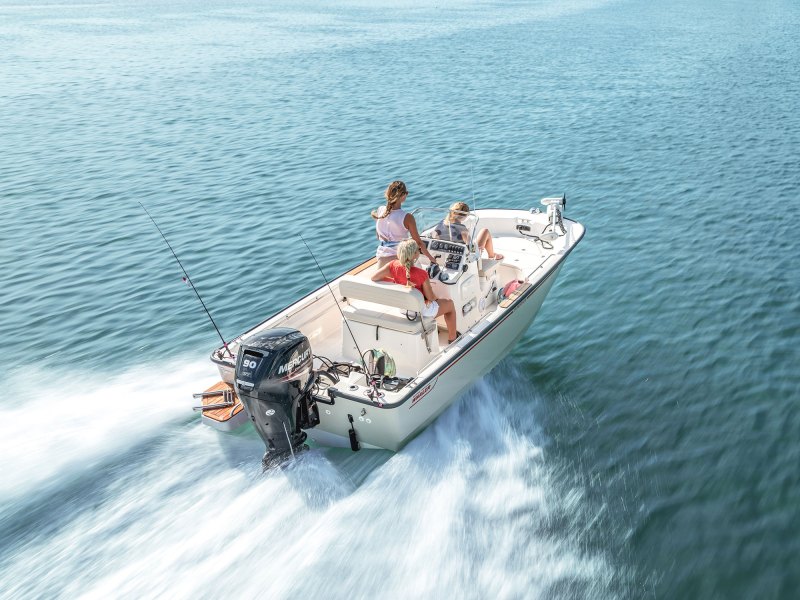
Chris-Craft is etched on the culture in its classic form—a gleaming mahogany barrel-back runabout or a stately mid-century cabin cruiser. Boston Whaler is the boat proven in New England—a boat designed to stand up to the rigors of that rugged environment and the demands of flinty Yankee owners, salts who’ve probably forgotten more about boats than you’ll ever know. There’s a legend behind each of these iconic brands.
Chris-Craft
In the decade following World War I, the companies behind the Chris-Craft brand created a template for the pleasure-boat industry we know today. They used racing and celebrities as promotional tools, developed standardized boat designs to reduce costs, and advertised nationally at a time when boatbuilding was a regional enterprise. By the 1950s, Chris-Craft dominated the American pleasure-boat market.
“Chris-Craft built 250,000 wood boats, by far more boats than all other brands combined into the 1950s. So at the time, a nice-looking boat at the marina was very likely a Chris-Craft,” said David Bortner, owner of Freedom Boat Service, a classic-boat restoration shop in Mayer, Minnesota, and a member of the International Advisory Council of the Antique Boat Museum in Clayton, New York. “If you are a baby boomer, your father either owned a Chris-Craft or wanted to own one.”
In about 1874 13-year-old Christopher Columbus Smith and his older brother Henry built a pair of wooden row boats to use in their waterfowl hunting business on the St. Clair River near Algonac, Michigan. They were capable boats and in 1881 they built and sold their first commissioned copy. Over the next 15 years the Smith brothers built up a steady business constructing duck boats, canoes, row boats, sail boats and launches. In 1896 Chris Smith tinkered with a new-fangled Sintz single-cylinder engine and installed it in a rowboat that may have been the first internal-combustion-powered craft on the Great Lakes.
Henry left the business in 1900 and C.C. Smith Boat Builder was formed by Chris, who continued to develop powered displacement hull boats. Seeking more speed, Smith designed what may have been the first single-step hydroplane built in the US—the 26-foot Reliance III, powered by a 75 hp engine, ran 34.7 mph. Smith-designed boats won eight consecutive Gold Cup races (1914 to 1921), the pinnacle of powerboat competition, including five consecutive wins for a new business partner, Gar Wood. Wood also captured the Harmsworth Cup in 1920 and 1921, the latter in the twin-engine, 80.56-mph Miss America II.
Chris and his sons Jay, Bernard and Owen bought out Wood in 1922 to form Chris Smith & Sons Boat Company. Jay Smith would become president and general manager in 1927 and lead the firm until 1958. Smith & Sons boat sales grew from 24 in 1922 to 946 in 1929, most time-consuming, semi-custom builds. Jay developed a standardized model that could be built in an efficient assembly line format. This $3,200 (about $62,000 today), 26-foot runabout model was called the Chris-Craft. To further expand the business Smith signed the company’s first dealer in 1926 and hired former auto executive Jack Clifford to organize nationwide distribution and sales. In 1927 Smith & Sons’ manufacturing covered 114,000 square feet in Algonac and contracted to buy 1 million board feet of mahogany annually. In 1928 the company offered its first enclosed boats, 30-foot and 38-foot cruiser models.
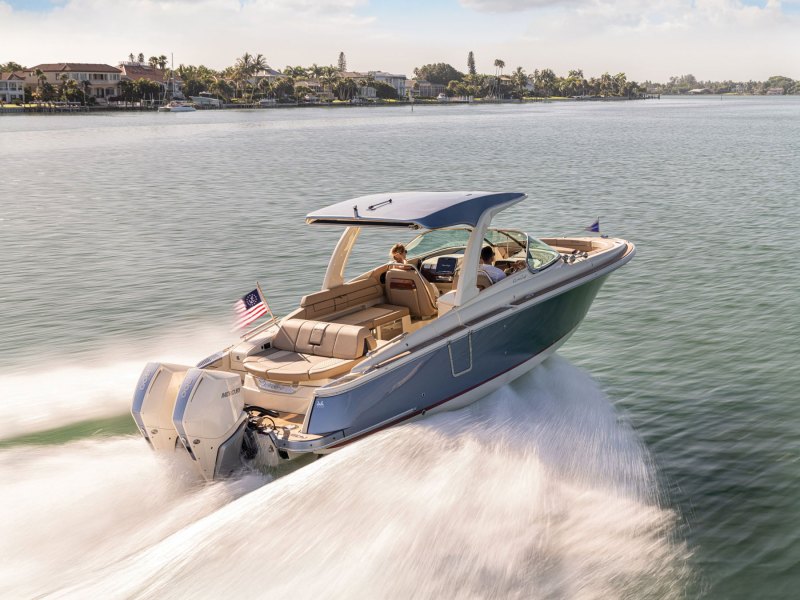
Chris Smith, dubbed “the Henry Ford of the speedboat world,” died in 1939. As the nation’s largest and most-respected boatbuilder, Chris-Craft Corporation was perfectly positioned for exponential growth during the post-war economic boom when it became virtually synonymous with pleasure boating.
Chris-Craft was the boat of choice for America’s elite, including Frank Sinatra, Elvis Presley, Katharine Hepburn, Dean Martin, Henry Ford, and Presidents Franklin D. Roosevelt and John F. Kennedy.
The brand remains in the public eye through appearances in film—On Golden Pond and Indiana Jones and the Last Crusade—and at every classic boat show. In 2024 the Minnesota Twins revealed The Dock presented by Winnebago Industries—an exclusive 12-guest Chris-Craft-branded experience located beyond the right field wall of Target Field featuring elevated seating inspired by open-bow boats.
In 1960 Chris-Craft Corporation trustees sold the company for $40 million ($450 million today) to NAFI. The brand is now controlled by Winnebago Industries.
Boston Whaler
Just as Chris-Craft was reaching its market zenith in the mid-1950s selling very traditional powerboats, a Harvard-educated (philosophy, ‘36) tinkering entrepreneur was working on prototypes of a boat that would introduce a radical new construction process and an evolutionary hull form. Dick Fisher was a partner with Bob Pierce in Fisher-Pierce Company and Sigma Instruments, a Boston-area electrical switching manufacturer. As young men in Massachusetts, Fisher and Pierce spent time on the water, sometimes with their friend C. Raymond Hunt.
During World War II, Fisher worked on designing a lightweight rowboat made of balsa, eventually abandoning the project. A decade later, Kopper Company released Dylite, an expandable polystyrene (EPS), “small beads resembling sugar with the characteristic of being foamable to shape with the mere application of heat.” Fisher saw Dylite as potential replacement for balsa in a lightweight boat if it were covered with a durable resin skin. In 1955 he produced his first prototype—a sailing hull. Realizing he needed technical help designing the hull form, he contacted his friend Hunt, who was by now a highly regarded naval architect.
Aware there was more market potential for an outboard-powered craft than a sailboat, Hunt steered the project in a new direction with a design inspired by the Hickman Sea Sled, an inverted-V-hull powerboat. Fisher built a 15-foot prototype cored with EPS based on Hunt’s design. The boat’s flaw was prop cavitation caused by aerated water flowing off the twin hulls. A center section was added to eliminate the cavitation and Hunt and Fisher continued to fine-tune the design, with Fisher hand-building countless prototypes in a back shop at Fisher-Pierce. Fisher applied for a patent on the construction process in 1957.
Boston was never a center of whaling activity, but before his death in 1995 Fisher explained that “We didn’t feel that a straight name was what we wanted. We decided to use an unstraight name that everyone would remember, so we called it Boston Whaler. It was a contradiction in terms that caught on.”
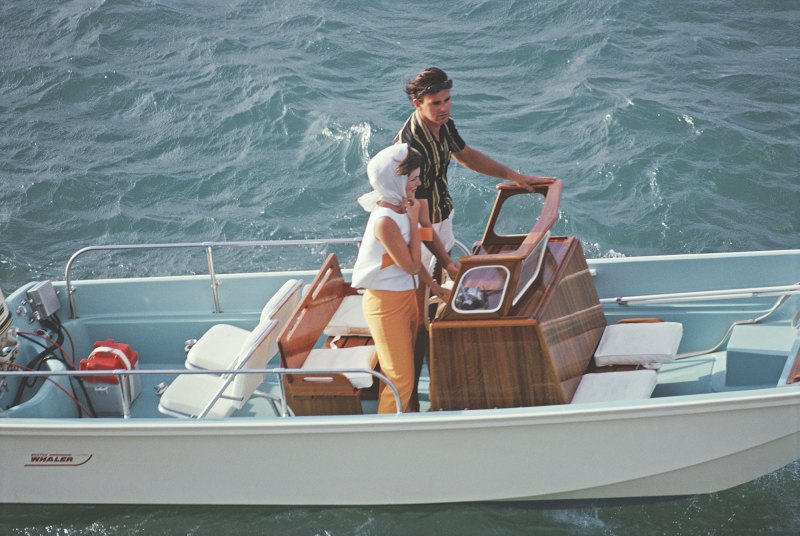
When “The ultimate expression of Yankee utility” was introduced as a 13-foot, 250-pound Boston Whaler at the 1958 Boston Boat Show it was dubbed by some “a baby blue bathtub without a faucet.” For three years the boats were built, one per day, in a 30-by-40-foot shop in Braintree, Massachusetts. Fisher sold each boat off his trailer. Fisher hired Henry Smith and Bob Dougherty in the early 1960s, and the pair worked together to improve production and solve numerous technical issues on boats sold with a “lifetime guarantee.” Dougherty would have a 30-year career at Whaler, eventually as lead of R&D.
Read Next: Catamaran vs. Monohull
It took one photo to imprint Boston Whaler on American culture. The image of Dick Fisher sitting stoically at the transom in tweed blazer and bow tie, arms crossed as a large crosscut saw is slicing a Boston Whaler in half, appeared in the May 19, 1961, issue of Life when that magazine had a weekly circulation of 7 million. The message that came across was simple: A Boston Whaler is unsinkable. Fisher may have first sawed a Whaler in half in 1959 to demonstrate the unsinkable design. Life heard about the stunt and the editors commissioned photographer George Silk to create that iconic photo.
Boston Whaler next received broad exposure through another media channel. The television show Flipper (1964 to 1967) transported viewers to the fictional Coral Key Park and Marine Preserve for the adventures of Porter Ricks, chief warden, his young sons Sandy and Bud, and a precocious bottlenose dolphin named Flipper. Sandy and Bud had a 13-foot Whaler with a tiller Mercury outboard that offered freedom and adventure on the water that thrilled pre-teen viewers—the next generation of Whaler fans.
By 1966 Fisher-Pierce was selling 5,000 Boston Whaler boats annually. “It looked a little ugly … New Englanders, because of a strong nautical background, seem to be quicker to recognize what’s good and bad in boats. They were the first to grasp the Whaler. It performed.” —William Wallace, New York Times, January 13, 1966.
Acquired in 1969 by conglomerate CML Group, Whaler was led into the 1970s by David Loveless, who sought to diversify the product line, beginning with the 1971 Outrage, a Dougherty design that had more elements of a V-hull. The Boston Whaler fleet has been part of the Brunswick Boat Group since 1996.
The Whaler bisected for Life magazine in 1961 is on display in the Mystic Seaport Museum in Stonington, Connecticut, and the brand continues to cement its iconic image in media channels: Jason Statham navigating a 22 Outrage through the twisting canals of Venice in an exhilarating, high-stakes water chase in The Italian Job (2006); Jerry Seinfeld and Jimmy Fallon cruising a classic 13-foot Whaler in a 2014 episode of Comedians in Cars Getting Coffee.
Brand names alter our daily language, drive social status, and shape cultural values by transforming normal objects such as boats into powerful cultural artifacts. Or so say the experts.
Regard for the Boston Whaler and Chris-Craft brands transcend boating—each is iconic and embedded within the public mindset outside of the hardcore boating culture, and each continues to raise awareness about boating as well as elevate the prestige of boat owners.