Let’s face it, choosing the perfect towable or water toy for your boat and crew sometimes feels a little like online dating. The profile pictures always promise good times and sunny days, but the real-life experience is often cloudy. Sometimes it’s obvious right after that first introduction. That pumped-up 10 of a tube reveals itself to be more of an underinflated 6 before you even leave the dock. Other times, it takes a few dates to realize you’re just not compatible. A large inflatable or sandbar float isn’t the best mate if you’re hauling it aboard an 11-foot personal watercraft. Likewise, the kids are probably not going to be having the best time water-skiing behind a 35-foot dayboat.
Let the relationship experts at Boating play matchmaker. Oh yeah, we’ve been around. Over the years we’ve experienced everything from love at first sight to the dreaded dates from hell. Ultimately, we’ve learned that a boat—and a boater’s soulmate—isn’t always what you might expect. But once you find the one, you’ll know it.
Ready to find water-toy love? Here are five popular boat categories—and our expert advice on a product match that definitely deserves a swipe right.
Open-Bow Runabout
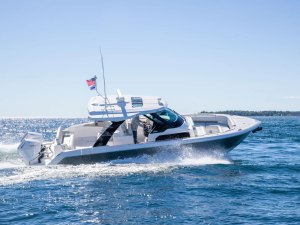
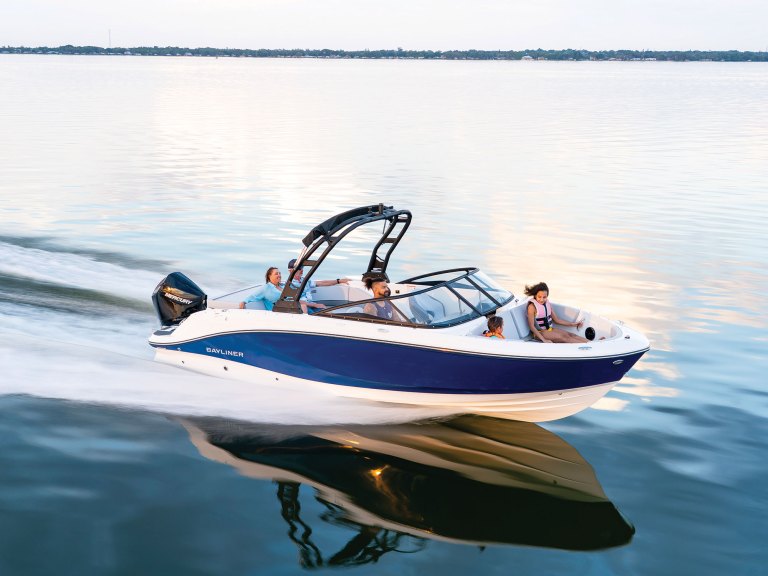
Bowriders and dual consoles dot lakes and inshore waters for good reason. They’re versatile, with enough space for family and friends, and can cruise, fish, entertain, cove or sandbar, and—yes—pull a wide variety of water toys.
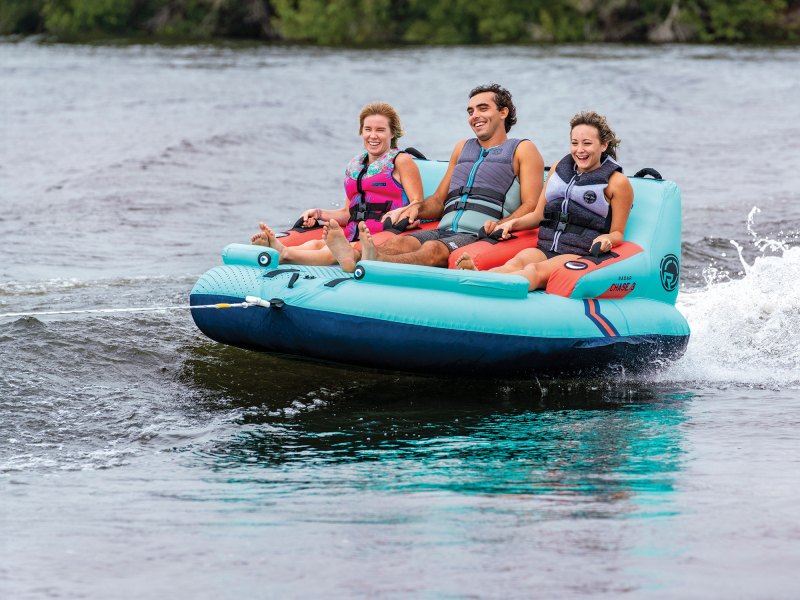
Radar Chase 3 Inflatable
With such a potentially diverse audience onboard, it makes sense that our toy of choice is the one ready to please the widest variety of ages and skill levels. Inflatables don’t have a ski or board’s learning curve, reward only those blessed with better balance or coordination, or even carry much of an age or size limit. Aggressive riders can slingshot across the water, while others can just kick back and enjoy the ride.
How to narrow an overly crowded field? Don’t get caught up in the extras. Tubes that have crazy shapes or spin like a dervish are unique, but don’t always deliver the most versatile ride. Their size and extras may also prove difficult to stow or haul. In contrast, a single-passenger donut might be easy to inflate/stow and prove high-performance on the water, but may leave the rest of the crew waiting anxiously—or growing bored—waiting to get in on the fun. Our sweet spot is found in an inflatable with two-to-three-passenger capacity and a simpler design that easily crosses wakes and accelerates into the flats.
Enter Radar’s Chase 3. It’s slightly convex “Spoon-O-Vation” bottom shape reduces drag and creates lift, pleasing the thrill-seekers. Yet, a high backrest, passenger dividers and even cup holders are ready for those looking to chill. You can even turn it 180 degrees and ride chariot style. $429.99; radarskis.com
V-Drive
Inboard V-drives revolutionized board sports by relocating the engine from the center of the cockpit to the stern. The design packed in more family and friends, but also positioned more weight at the back of the boat, boosting wake volume. Add in wake-shaping hulls, ballast tanks and transom tabs—and you’ve got the ultimate wake generators.
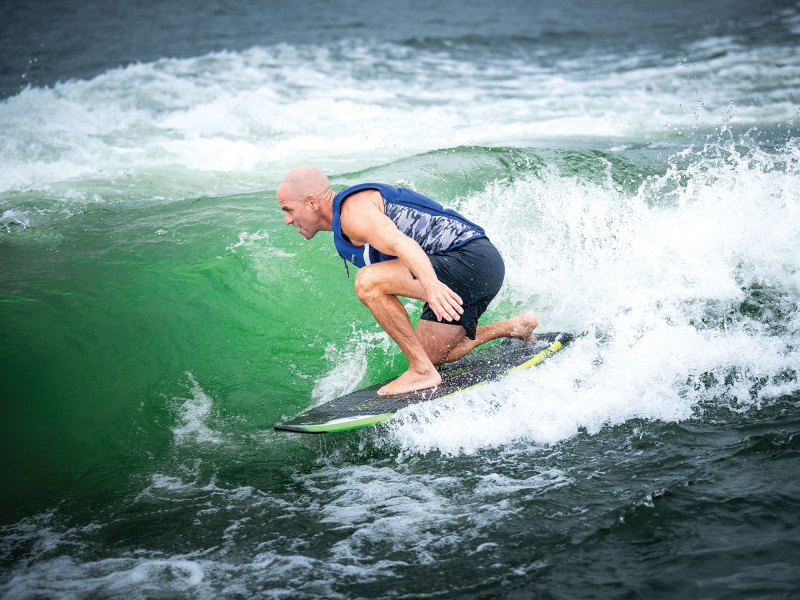
Hyperlite Broadcast
While wakeboarding led the charge, wakesurfing’s lower speed requirements and easier-on-the-body falls make it a match for a far wider audience. The lack of bindings also make a wakesurf board easier to share amongst family or crew. And then there’s the coolness factor. Wakesurfing allows riders to experience something that once required proximity to an ocean but is now as close as the nearest lake or river.
Surf-style boards are typically more stable and buoyant, making them great for first timers. Skim-style boards are loose and playful, but often harder to learn on. Other factors that come into play include a board’s rocker (its tip to tail curvature). A gentler curve typically makes it easier to stay in the wave’s pocket, where you have plenty of push. More pronounced rocker, however, will make a board more maneuverable.
Swipe right on a board that offers the best of both worlds. Hyperlite’s Broadcast does a great job at getting beginners up and riding, yet allows for progression as skills improve. Rolled edges, wide midsection and its swallow tail are forgiving and stable. A dual-concave base will help riders stay in the sweet spot of the wake with plenty of momentum, but can also generate speed for the air and rotational tricks that may follow. Its triple fins can also be reduced or even removed to bring in more of a skim-style feel. $505; hyperlite.com
Coastal Dayboat
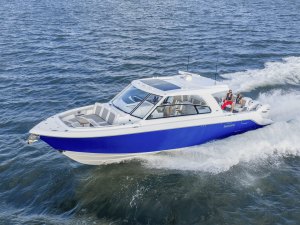
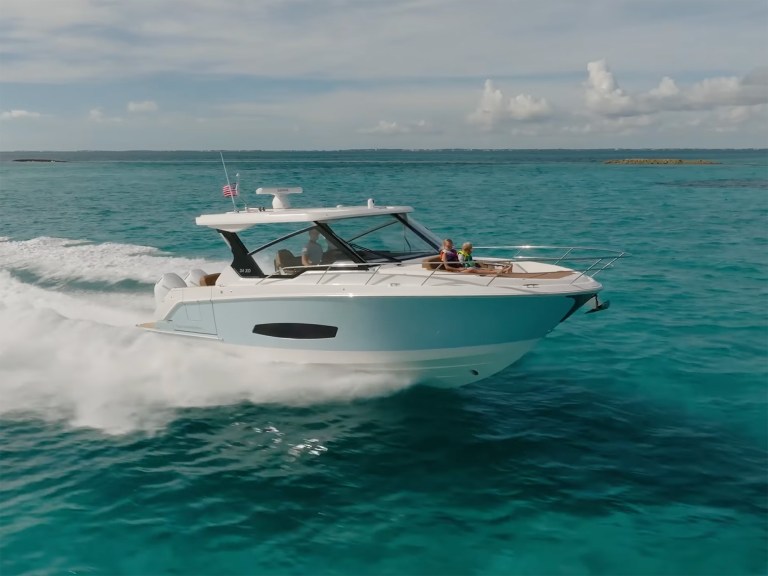
A favorite for day trips and entertaining, luxury dayboats are also tailor made for coving or sandbar duty. One of the primary reasons for the latter is their increasing emphasis on aft cockpit design. Breezy “summer” kitchens, fold-out terrace doors, and amenity-filled transom and swim platforms literally bring the party to the water’s edge—and beyond.
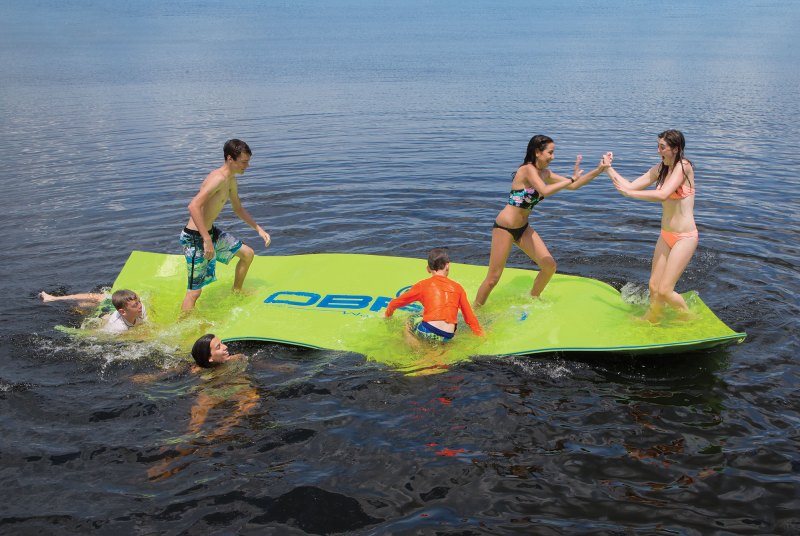
O’Brien Water Carpet
With lounging, relaxation and maybe even a little roughhousing on the menu, large water mats have become an increasingly popular option to have aboard. Made of high-density closed-cell foams like Cross-linked Polyethylene (XPE) or Ethylene Vinyl Acetate (EVA), they’re buoyant enough to handle a surprising number of passengers topside and yet thin and pliable enough to be rolled like a carpet and strapped to the swim platform or stored in dedicated lockers. As closed-cell foams don’t absorb water, mats are fast drying. They also aren’t subject to a memory effect, transitioning from a tight roll to flat carpet without retaining any cumbersome curls. The material is also pliable and tear-resistant, able to flex, bend, and withstand all that occupants dish out above.
How do these mega-mats offer such buoyancy while being little more than an inch thick? Just like on a boat, it’s not magic but physics, specifically Archimedes’ principle. The more water an object displaces, the stronger the upward force the water exerts. On a lightweight water mat with a large surface area, that force creates buoyancy far greater than the mat’s physical size might suggest.
O’Brien’s Water Carpet offers a whopping 108 square feet of Archimedes’ principle. Its dense, polyethylene foam allows the 18-by-6-foot mat to float a six-passenger crew (up to 1,190 pounds) despite a minimal 1.25-inch thickness. Its sizable length can also be rolled up as tight as 6-feet-by-2-feet-by-6 inches for storage and transport. A corner grommet with an attachment loop allows the Water Carpet to be tethered to an anchor bag or drift anchor. $610.99; obrien.com
Center-Console
Center-consoles hull designs are ready to take on the rougher conditions of coastal waters. When lines aren’t in the water, however, they also make great explorers, able to serve as a home base for crew to venture beyond the boat.
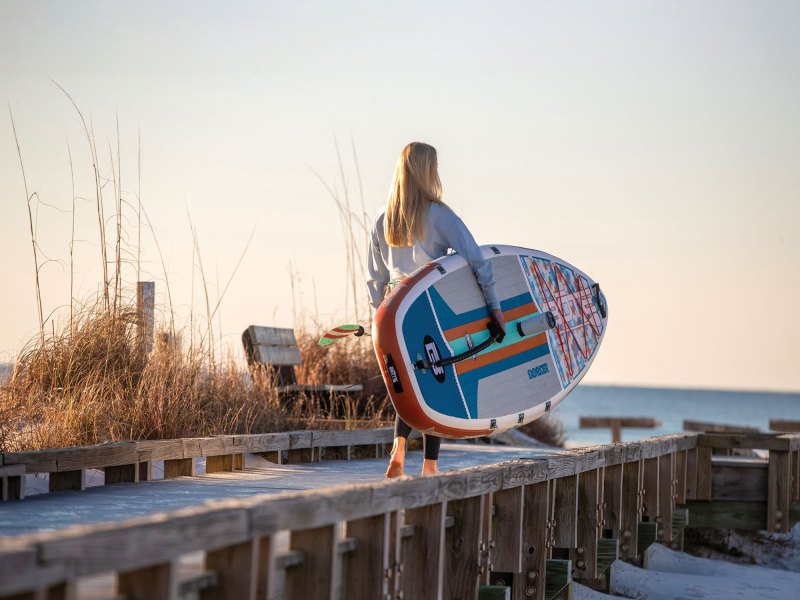
BOTE EasyRider Aero
Consider making a standup paddle board (SUP) your next partner. SUPs allow you to explore meandering channels or skinny waters, enjoy a workout, even grab a rod and take on a water-level battle with a fish. Nearly all ages are welcome, the learning curve is gentle, and you determine the effort required.
The limitation, of course, is how to bring something taller than a basketball hoop onboard without clogging up the cockpit. While rack solutions are available, arguably the most versatile solution comes from that class of paddle board that travels well and doesn’t cramp your cockpit. Inflatable SUPs pack into an oversized backpack, and can be stored within larger compartments or tucked into an out-of-the-way spot on deck. When you’re ready to ride, unpack, and inflate. An inflatable’s drop-stitch internal construction produces a rigid, full-size paddle board without the full-size headaches of a rigid alternative
Again, chose a partner that’s easy to get along with. BOTE’s EasyRider Aero is a beginner-friendly design that features an ultra-stable 34-inch width and 250-pound capacity, making for a board that can handle a wide variety of rider sizes and skill levels. The EasyRider also doubles its appeal by transitioning into a sit-down kayak with the addition of its inflatable seat with supportive backrest and additional paddle blade. Tip? With 12-volt availability onboard, ditch the bicep-busting manual pump in favor of an electric version. It will inflate the board to higher pressures with ease, as well as suck that air back out when it’s time to pack up. $399; boteboard.com
Read Next: Top Water Toys for Summer
Personal Watercraft
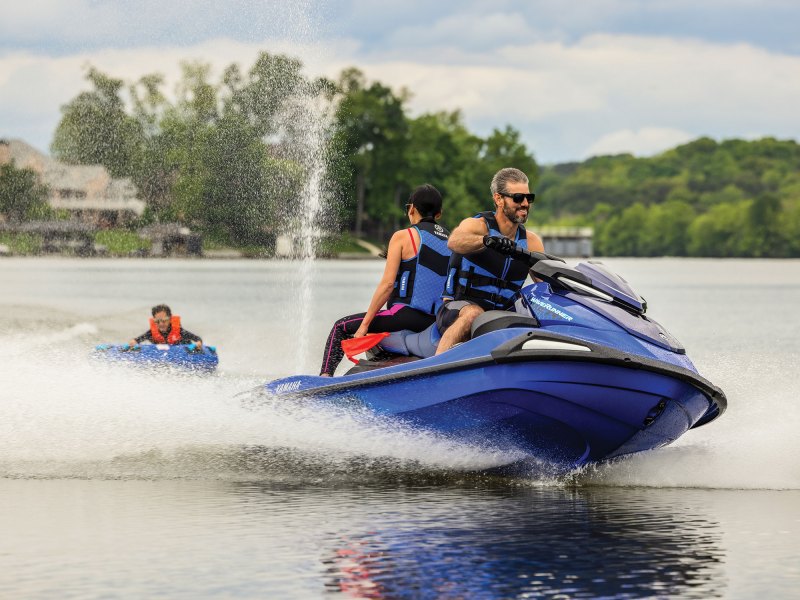
Personal watercraft are often tagged as one-to-three-passenger thrill rides. Small, agile and with advantageous horsepower-to-weight ratios, they offer a close-to-the-water adrenaline rush that arguably no other vessel can match.
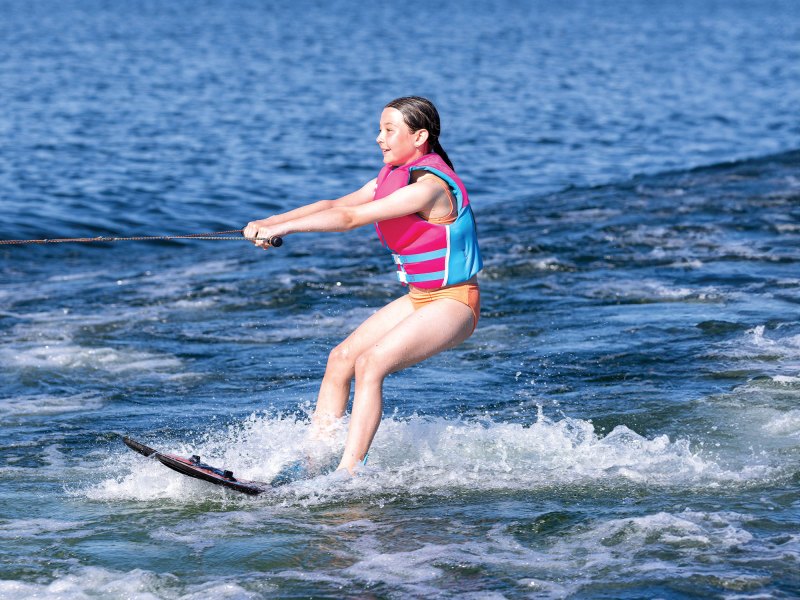
O’Brien All-Star Trainer Water Skis
So why are we suggesting matching with something as tame as a pair of kids’ combo skis? Because the same open feeling that makes a PWC such a sensory experience to ride also makes one a reassuring platform for a nervous child at the end of a towrope. Rather than a glimpse of a parent or friend behind the intimidating transom of a large tow boat, kids see a reassuring figure close to the water, one who’s able to offer encouragement and even suggestions to help them succeed. Should they fall, a PWC also won’t leave them watching a tow boat travel further away as they float alone in the water. Instead, the craft’s size and agile handling will allow it to quickly return.
Three-passenger models are both suited and legal for tow duties, with spots for driver, observer and skier. While tow hooks are standard issue, tow pylons and even board racks are available as accessories. Speed control can also be engaged for a smooth, steady pull, eliminating the jerkiness that can occur with a human hand on the throttle.
As to those O’Brien trainers, adjustable bindings accommodate a variety of kids’ sizes. Broad ski tips with a V-shaped entry also allow them to slice through the water and deliver a smooth ride. The kicker? A stabilizer bar keeps skis together during the learning process, avoiding the inevitable splits. Once skills improve, take it off so skiers can progress to the next level. $229.99; obrien.com