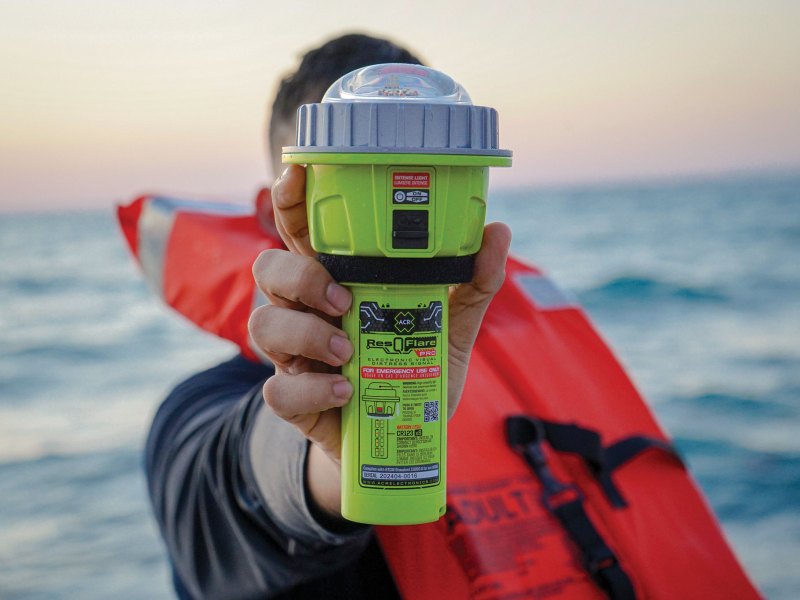
An Electronic Visual Distress Signaling Device (eVDSD)—aka e-flare—is a US Coast Guard-approved replacement for pyrotechnic night-time visual signaling devices for recreational boats. So far, a low percentage of boaters have switched over, per industry estimates. The big question is: Should you make the switch?
In doing so, you’d be in good company. The Coast Guard has issued orders to remove pyrotechnics from its own cutters in favor of eVDSDs (USCG Bulletin ALCOAST 396/25 – SEP 2025). “This clearly points to the Coast Guard’s preference,” says Mikele D’Arcangelo, VP of Global Marketing, Product Management, and Customer Support, ACR Electronics, Inc.
Why such a directive? According to the bulletin: “eVDSDs offer significantly longer operational life than pyrotechnic flares…and eliminate the hazards associated with handling and deploying pyrotechnic flares, reducing the risk of burns, misfires, and accidental ignition.”
Pryrotechnic devices can potentially injure crew and can disable safety gear such as inflatable life jackets and rafts. E-flares pose no such threats. While pyrotechnics burn more brightly than e-flares (and aerial flares offer greater visibility), the visual signal lasts only minutes or seconds, compared to 20-plus hours for a battery-operated eVDSD’s flashing strobe that can be seen from miles away. Finally, an e-flare never expires (the batteries need annual replacement) or requires special disposal methods.
To be clear, an e-flare alone is not sufficient to replace pyrotechnic devices under Coast Guard regs. An eVDSD qualifies only as a night-time visual distress signaling device. To complete the switch over, boaters must also carry a 3-foot-square international orange distress flag to serve as a day-time visual signaling device.
Many boaters are unfamiliar with using and/or recognizing the e-flares aboard other boats. D’Arcangelo helps educate boaters in this field of marine electronics. Here are some of his key points.
Battery Management
Lithium batteries provide the longest shelf life (typically 10 to 20 years). “They also perform reliably in extreme temperatures and provide stable operating voltage,” D’Angelo explains. Alkaline batteries have shorter shelf lives and are prone to leakage. Nickel-metal hydride rechargeables self-discharge over time and voltage is inconsistent. Batteries should always be installed so the e-flare is immediately deployable, he adds.
Testing an E-Flare
Test your e-flare annually inside the cabin of your vessel or bring it inside a house or garage (it’s illegal to deploy outside). Activate the e-flare (wear sunglasses and don’t look directly at the e-flare) for 10 seconds. Become familiar with the activation method and train your crew. The ACR ResQFlare Pro has a single on/off slide to make the product easy to use, D’Arcangelo points out.
Storing an E-Flare
Electronic flares are waterproof and rugged, but accessibility in an emergency is key. Ideal storage locations include a helm station emergency compartment (ResQFlare Pro comes with a mounting bracket), a ditch bag, a life raft emergency kit, or near a companionway exit. Avoid deep lockers, engine compartments, or locations requiring a key.
Read Next: Best Marine Flare Guns & Visual Distress Signals
Effective Deployment
In an emergency, position the e-flare as high as possible with an unobstructed 360-degree view. You can hold it overhead, mount it to a boat hook, paddle, antenna, or secure it to an elevated structure on the vessel or life raft. Elevation increases the distance at which rescuers can see the signal.
Recognizing an E-Flare
Boater-education programs now include how to recognize the SOS flash pattern of an e-flare and its implications, along with traditional flares. “Marine law enforcement, rescue agencies, and commercial mariners are trained to recognize the SOS flash pattern,” D’Arcangelo adds.