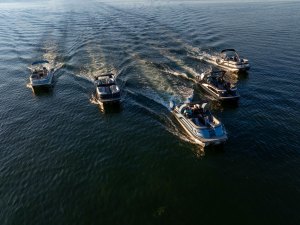
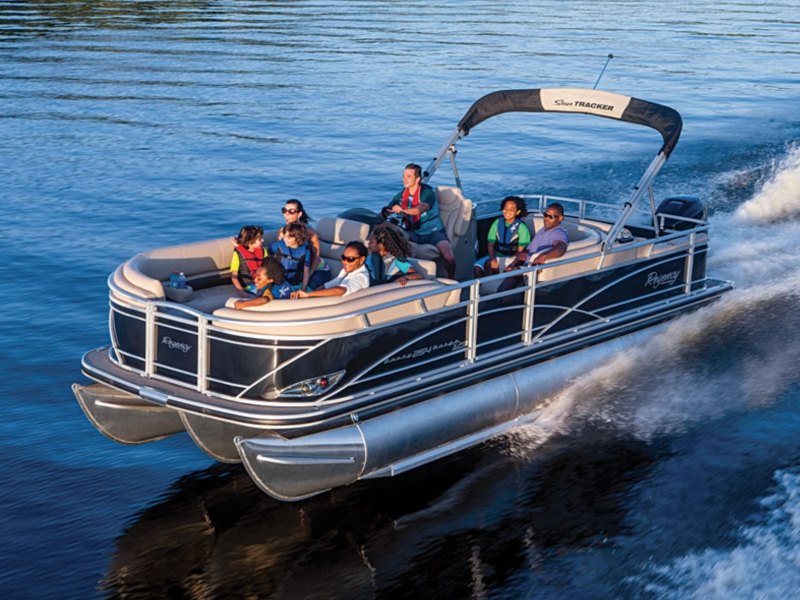
Pontoon boats are everywhere today; they’re among the fastest-growing segments of new and used boat sales. As so many boaters age and learn that pontoons are actually not only great family platforms but also can be fast, fun, and double as fishing and sporting boats, it’s easy to see why they have gained in popularity.
While they are boats, pontoons are markedly different in construction and appearance than traditional single-hulled runabouts and cruisers. They require a different understanding of performance on the water—not to mention how they behave when towing, and how to maintain them.
Compared to typical boats, pontoons are typically larger, with a bigger and more imposing footprint on the water or trailer. They have a unique hull profile (two, and, increasingly, three, tubular aluminum pontoons), and a more rectangular overall shape. Those characteristics also dramatically affect how they are towed, docked, driven, and handled. This becomes more important when you’re towing down the highway, launching or docking, boating on crowded waters and in rough conditions, and especially with riders aboard.
Slow Speed Maneuvering and Driving
A pontoon boat’s high windage and shallow draft make it subject to being blown around more by the wind than V-hull boats. Single-engine pontoons can be particularly challenging to dock or load on a trailer if the day is blustery. Twin-engine ‘toons offer better close-quarters maneuverability.
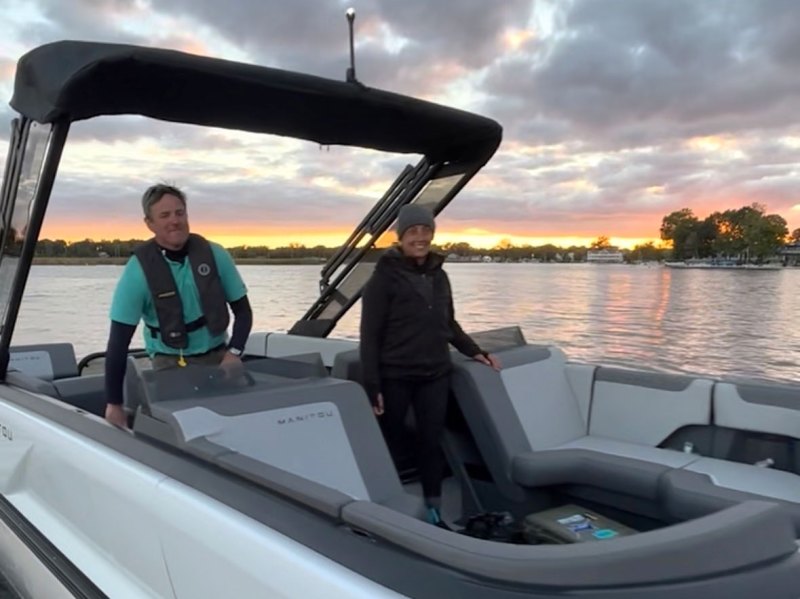
In any event, making time to practice docking your pontoon is essential. Practice around-the-docks maneuvering on slow days, when you’re less likely to be intimidated and nervous by other boaters. Bring a buddy to help guide you when docking and pulling out of the marina. When approaching the dock, have that buddy help you to bring the boat alongside the pier by advising how close you are to the dock and other boats; often, the perimeter enclosure of many pontoon boats can block your vision of the dock and pilings. This makes it a good idea to stand up—or kneel on the seat—in order to see better when docking a pontoon boat. When applying steering and throttle/shift movements, do so gingerly, with a light touch. Learn the technique of shifting alternately between neutral and idle-in-gear, as opposed to motoring all the way in and suddenly hitting reverse.
Your approach should be at a very slow speed, so if corrections such as hard-over steering or hard-throttle reversing are needed, your forward momentum will be easier to control.
Naturally, just as when docking any boat, learn to use the wind and/or current as an aid, when possible. Coming into the wind or current, learn to use the wind or current as a brake. With wind or current behind you, learn how your boat will drift-in, engine in neutral, on the force of the wind or current alone. In short, pay attention to your ‘toon to learn how your boat reacts, but also pay attention to wind and current and how they affect your boat’s handling.
Accelerating, Turning and Driving
When you’re ready to hit the open water, now is the time to feel out your new pontoon; take careful note of how it planes, how much the bow rises when accelerating, how it feels and reacts to steering wheel inputs, and how the engine power trim affects the ride attitude when trimming up and down.
A key is to remember that when you trim out the engine, you lift the bow. You want the bow—front of the pontoons—clear of the water in “normal” cruising. You’ll know you’ve trimmed too high if you feel the bow starting to “porpoise,” which is when it cycles up and down. If that happens, trim the engine(s) down just until that stops, and you will have a good trim to run on most days.
Turning? Try making turns at cruising speed with various engine trim positions to find out how your boat handles. Become familiar with how speed affects turning capability. Move weight around in the boat to see how it affects the center of gravity and the boat’s ability to accelerate, turn, and react. Your family and friends won’t always stay put or sit in the same place. Your boat will handle differently, depending on how it is loaded. Observe and apply what you learn.
Operating a pontoon boat is a dynamic experience. There are no patent techniques or steps that will serve best in every situation. Instead, you need to become familiar with how your boat will react to input at the wheel and shifter in a variety of scenarios. Pay close attention to how your boat reacts every time you shift, accelerate, or turn the wheel. At first, this will take up much of your attention. With time, though, it will become second nature, and soon you will find yourself “tooning-in” to your boat automatically.
Rough Water, Crowded Waterways and Safety
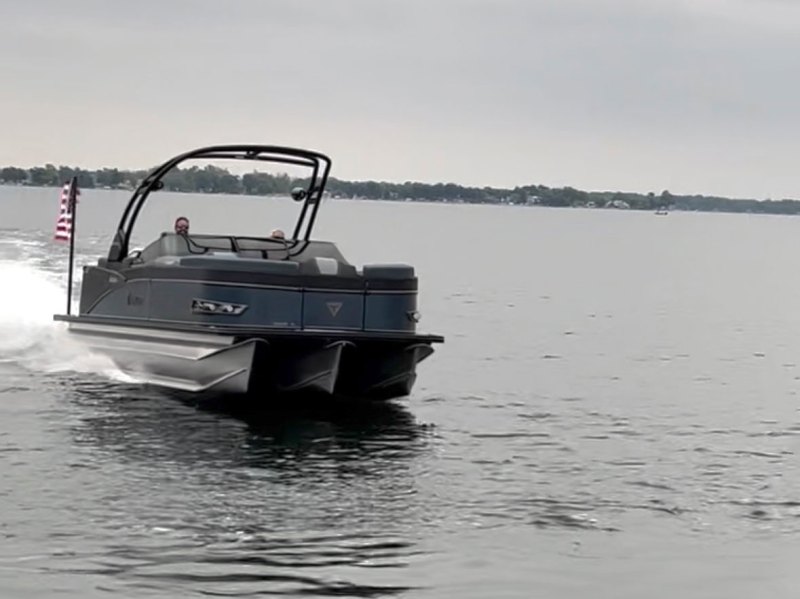
Situational awareness is literally having eyes in the back of your head and using all your senses to maximum capability. Your head should almost be on a swivel as you pay close attention to everything around you, several hundred yards ahead, and at least a dozen yards to the sides and stern. Anticipating several steps ahead, reading the water and weather conditions as well as the actions of other boaters around you, and being prepared to react in the safest, most decisive, and careful ways possible—that’s situational awareness.
In rougher water, drop speed and lower the trim so the boat rides level, slightly bow up, and stays on plane. This creates the smoothest and safest ride for everyone aboard and provides the pilot with more time to adapt to changing conditions with throttle, steering and trim adjustments.
When the water gets crowded with other craft, your approach should be very similar to rough water piloting; best results come from reduced speed and trim, keeping the boat level, and employing situational awareness to a maximum to keep surprises to a minimum. Driving in a crowded waterway is not like driving a car on a crowded freeway. There are no lanes, no turn signals or brake lights, and in many cases, those surrounding you didn’t pass a driver’s course or have a license. Anything can and will happen. For the safety of your guests aboard, keep speed down and maneuver carefully until the congestion clears.
Trailering, Launching and Retrieving
Trailering a pontoon boat can be challenging, arguably more so than typical boats. They’re larger in footprint, so are more prone to wind gusts and harsh reactions to sudden maneuvers (hard braking, turning and avoidance moves). The best advice is to get plenty of practice and do so at a slower rate of speed. Practice turning and parking in a large empty parking lot. Approach braking and turning deliberately and with caution. Lastly, if possible, launch with someone to help guide you, and do it on slow weekdays when the ramp is less congested.
Conclusion
It’s important to note that triple-toon “tri-toons” provide a much smoother rough water ride and easier handling. Pontoons powered by a waterjet offer enhanced maneuverability in close quarters.
Pontoon boats offer the unmatched ability to carry a large number of people for their length and do so with space to move around the boat. These qualities derive from the shape, which also happens to require special care when docking or when underway. The keys to becoming a competent pontoon boat captain are to practice and to “toon-in” to your boat’s reactions every time you hit the water.