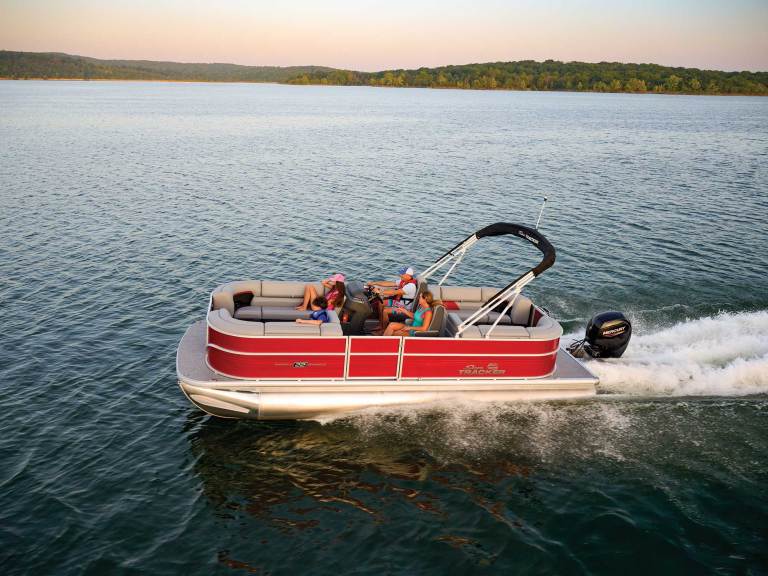
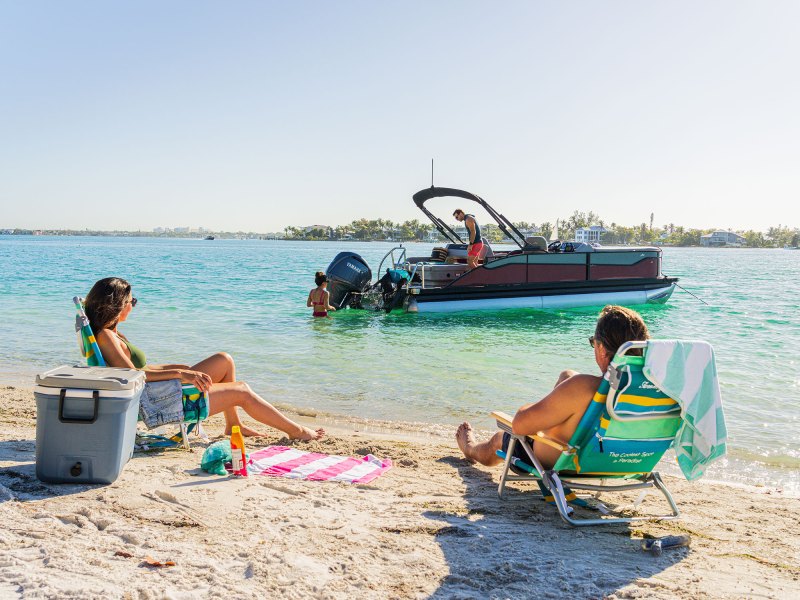
The average pontoon owner holds onto their boat for more than a decade. In that time, the sun does its work. UV breaks down vinyl, plywood bases soak up water through compromised seams, Bimini frames lose their tension, and ladders that were never great to begin with get worse. At some point, every owner faces a decision: buy new or breathe life into what they have.
New pontoons now routinely push into six-figure territory, and replacing worn components piecemeal from a patchwork of aftermarket brands has historically meant guessing at fitment and hoping the end result won’t feel like a downgrade from what came off the factory floor.
Lippert is looking to close that gap. The Elkhart, Indiana-based manufacturer already supplies most major boat builders in the industry. Now, through a suite of consumer-facing products, Lippert is translating that factory-floor expertise into aftermarket upgrades designed to bring aging pontoons back to current-model standards.
“We build upwards of 90% of all pontoon furniture in the OEM space,” said Jarod Lippert, Chief Marketing Officer at Lippert. “It just makes a lot of sense to supply pontoon furniture to the aftermarket space as well and offer consumers products that can make their old pontoon boat look like new.”
The Furniture That Built the Industry
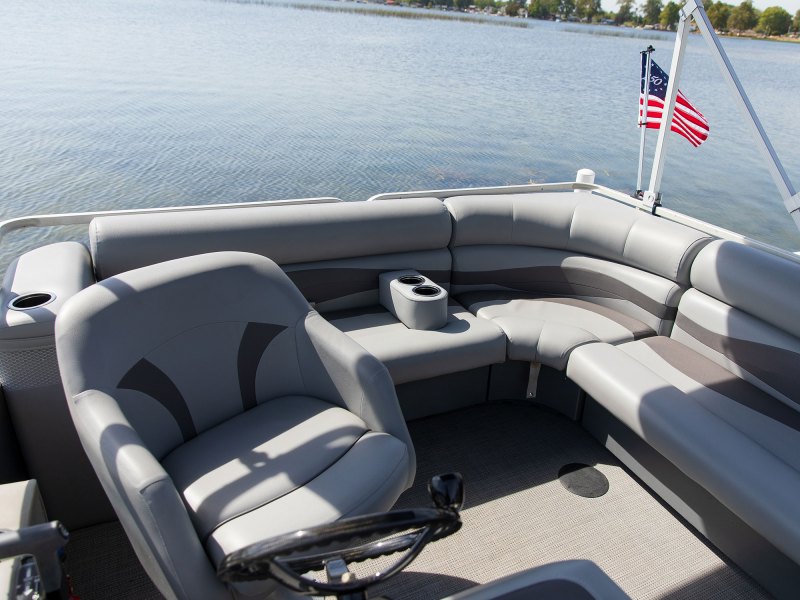
At the center of Lippert’s aftermarket push is the Rockport Series, a full line of replacement pontoon furniture built on rotationally molded polyethylene bases. For anyone who has pulled a soggy, delaminating plywood base out of a pontoon bench seat, the distinction matters. Rotomolded poly doesn’t absorb water, doesn’t swell and doesn’t rot. Marine-grade UV-resistant vinyl handles prolonged sun exposure without cracking or fading.
The line includes individual benches, flip-flop seats with 75-quart cooler compartments, corner seats, chaise lounges, and helm configurations. If you want to overhaul an entire deck, Lippert offers pre-configured kits (Cruiser, Lounger, and Voyager) sized to fit common pontoon floor plans. Lippert says the kits are increasingly popular as the program matures.
“The kits are designed to fit most major floor plans and spaces that are out there,” Lippert said. “We design and manufacture just about every floor plan in the industry, so we know which pieces combined will make for the best remodel.”
The same company designing custom layouts for the industry’s biggest builders is now packaging that knowledge into kits a pontoon owner can install themselves or by an expert at a factory service center.
“Pontoon OEMs trust us every year to imagine and reimagine what their furniture floor plan could possibly look like,” Lippert said. “We act as their innovation engine for new designs, materials, and functions. We have leaders in this industry who have a combined 300 plus years in the industry — that’s a lot of experience.”
Shade and Speed at the Same Time
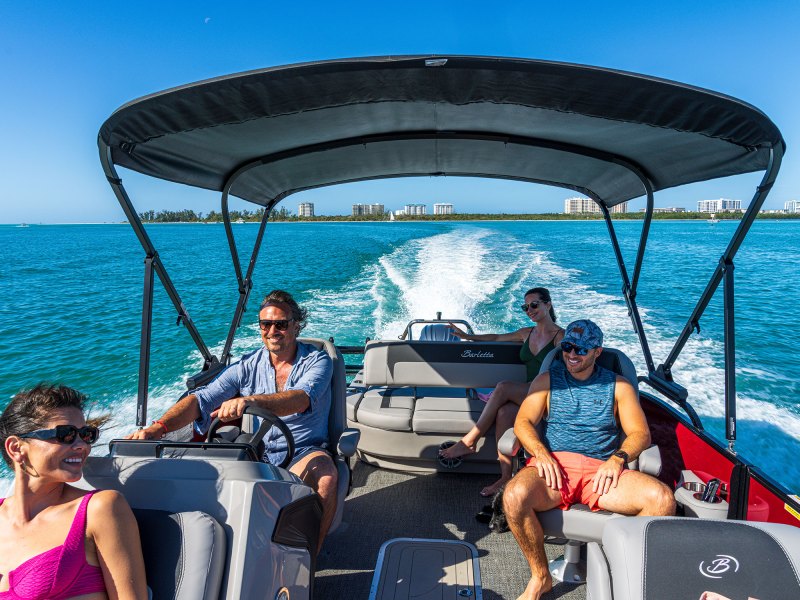
Lippert’s SureShade Power Bimini addresses another persistent complaint: manual bimini tops that are clumsy to deploy and limited in coverage. SureShade is a fully electric system that extends and retracts via a rail-mounted switch or keychain remote. It delivers 10 feet of shade (roughly 30% more than a standard bimini) on a telescoping aluminum frame that fits pontoons from 92 to 102 inches wide.
Two installation paths are available. A hardwired 12V option connects directly to the boat’s electrical system, while a rechargeable lithium-ion battery option eliminates the need for wiring and installs in about 90 minutes. Lippert says the battery option is gaining traction with DIY owners, while the hardwired version remains the better choice for professional installations.
What sets SureShade apart is the accessory ecosystem. Optional sport arms allow the bimini to stay fully extended at speeds up to 45 mph, and a Speed Top mesh canvas replacement handles up to 55 mph, well beyond the 20-to-25-mph ceiling that forces most bimini owners to retract before opening the throttle.
“As an owner of both, I can say that these statistics are very accurate,” Lippert said. “The sport arms do the job well, and the air flows through the speed top as designed so you can reach these higher speeds while leaving your bimini up. These products were designed for newer pontoons that can go higher speeds and pull skiers and tubers.”
Rethinking the Reboard
One of the most overlooked pain points in pontoon ownership is the ladder. Standard pontoon ladders often come with narrow rungs, steep vertical angles, and limited weight capacity. With a lot of older models, reboarding is uncomfortable at best and unsafe at worst.
“The pontoon ladder has not changed since, well, ever,” Lippert said. “Lifting yourself vertically out of the water onto the standard straight ladder is difficult, and I am an able-bodied healthy person.”
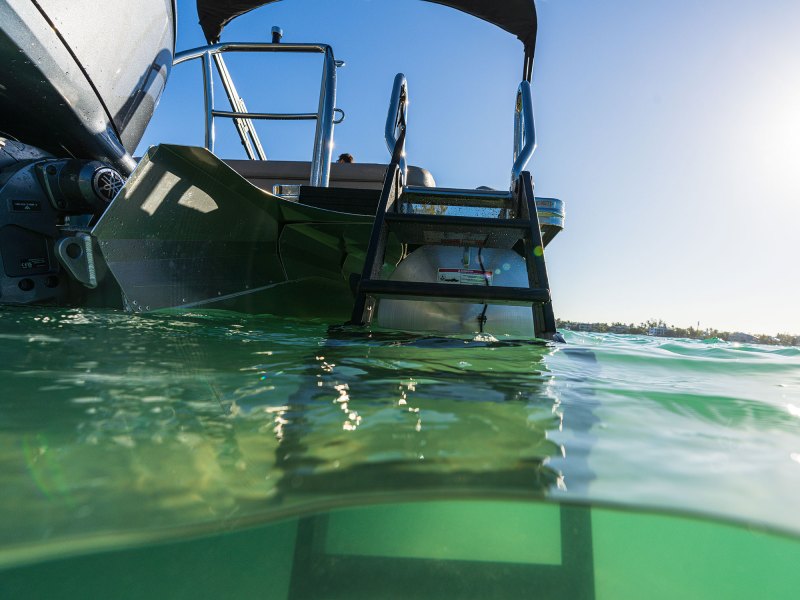
Lippert’s SureStep ladder replaces that paradigm with extra-wide, slip-resistant stair-style steps, a 400-pound weight rating that meets ABYC standards, and a one-step retraction system that deploys or stows without bending over.
“The SureStep’s design aims for an angled entry and exit level, making it easier for the user to climb in and out of the water,” Lipper explained.
The ladder is built from saltwater-rated stainless-steel rails and powder-coated aluminum steps, since many pontoons in coastal states regularly encounter salt or brackish water.
Anchoring Without the Headache
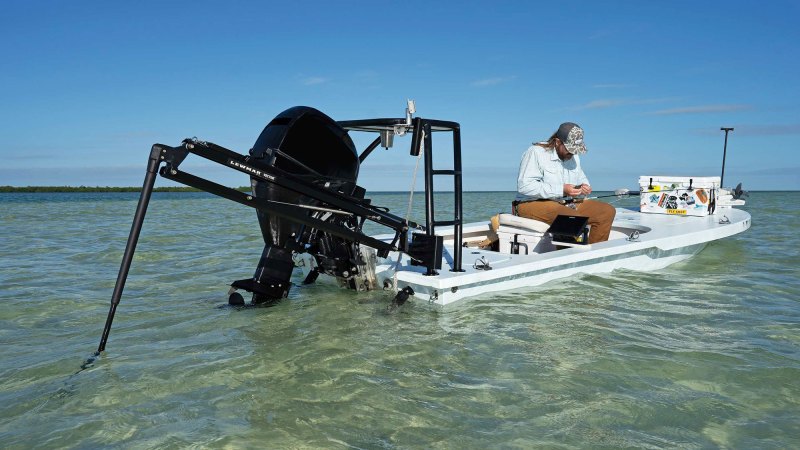
Rounding out Lippert’s pontoon upgrade portfolio is a product from Lewmar, the UK-based marine hardware manufacturer Lippert acquired in 2019. The Lewmar Axis and Vector shallow water anchors bring a different engineering philosophy to a category long dominated by hydraulic systems.
The Axis is a fully electric unit powered by a 12V linear actuator. It uses no hydraulic pumps and no hoses, and contains no seals to leak. It deploys in about eight seconds via remote control, works in up to seven feet of water, and handles boats up to 26 feet or 4,500 pounds. The Vector is its manual counterpart, a pull-rope-deployed anchor with a gas spring-secured fiberglass spike for smaller boats.
The electric approach has a reliability advantage.
“You do not want to deal with leaking seals and pumps,when you’re out fishing,” Lippert said.
The Lewmar shallow water anchor was developed entirely under the Lippert umbrella.
“We challenged the Lewmar team to come up with an industry-changing anchor and they delivered,” Lippert said.
Lewmar is constantly innovating new products for the American pontoon market. Previously, they had focused on their core market in the high-end yachts and sailboats.
“The acquisition has helped bring to life products for the most popular boats in the United States,” Lipper said.
Lippert recently celebrated 70 years in the RV manufacturing space and is applying the same playbook to boating: earn the trust of builders first, then bring that credibility directly to the owner.
If you’re a pontoon owner and you’re weighing whether to invest in your current boat, the value proposition in aftermarket upgrades makes the decision easy. The company that built the original furniture, designed the floor plan, and engineered the components is now offering the upgrade path, too.