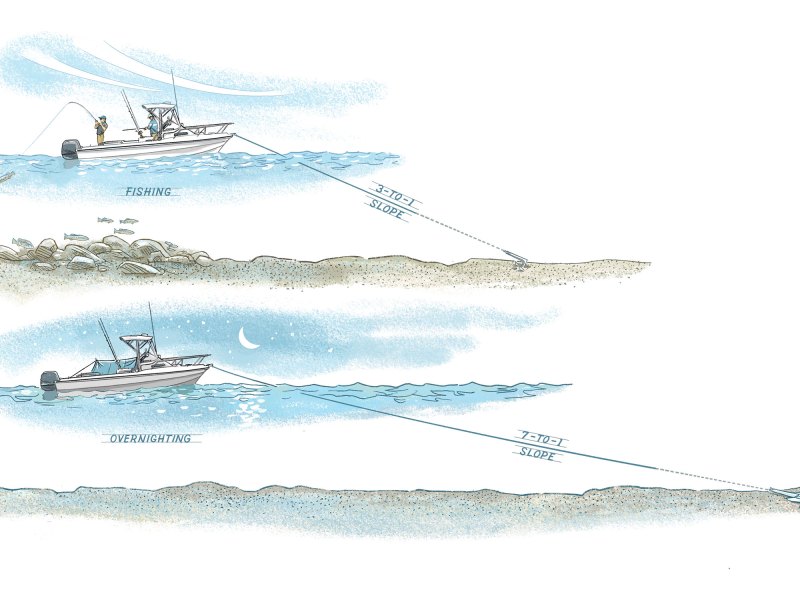
For my style of boating, there are two kinds of anchoring: anchoring to catch fish versus anchoring for a good night’s rest. I do both in coastal waters. Not only do the methods vary, so does the ground tackle I employ for each.
Why should there be difference? There are different objectives. Fishing is a relatively short-term anchoring proposition, and in many cases requires precise positioning over a wreck or rockpile. You might pull the anchor and re-anchor time and again to fish a number of spots during a day of ocean fishing. Of course, while fishing the crew is largely awake and on-deck.
Overnighting, on the other hand, is a longer-term proposition. You want to set the anchor with the idea of not needing to weigh anchor and reset until the next day, or perhaps even longer. An anchor dragging, especially in the dark, ranks as a much greater safety concern than if you’re fishing. It is the difference between sliding off of a fishing hotspot or sliding into harm’s way. Consider these tips as you decide on ground tackle and how to deploy it for your particular anchoring needs.
Anchoring to Fish
Precision is the name of the game when I anchor to fish a wreck, ledge, rockpile or reef. Each combination of seafloor, depth, wind conditions and current calls for adaptive tactics, but generally speaking, the shorter the distance that I motor upcurrent or upwind from the spot to drop the anchor, the more accurately I can position the boat.
The greater the scope (the amount of anchor rode laid out), the more difficult it becomes to place the boat exactly where I want it to sit at anchor. In addition, greater scope means a wider swing—the tendency for the boat yaw back and forth on anchor, especially on breezy days. This can decrease time over the target as the boat alternately swings off and back over the desired structure.
To minimize the scope while fishing, I used a 16.5-pound Lewmar Claw anchor, which is oversized for my 21-foot center-console. Lewmar recommends something in range 4.4 to 11 pounds. The Claw also sets quickly and holds well in the muddy seafloor of the coastal flats off Southern California. I enhance the effectiveness of this anchor with 20 feet of 5/8-inch galvanized chain. As result, I can anchor for fishing on a nominally breezy day with as little as 3-to-1 scope in water as deep as 75 feet without dragging the anchor.
Read Next: Ultimate Boat Anchor Winch Buyers’ Guide
Anchoring to Overnight
The anchoring objective changes to safety when it comes to overnighting. Again, much depends on bottom composition, depth, wind strength and current. Most of my overnighting takes place around Southern California’s offshore islands such as Santa Catalina, where the seafloor is largely composed of course sand.
I keep the same 20 feet of chain, but change the anchor to a Fortress FX-11 fluke-style 7-pound anchor, which is preferable for this type of bottom. It digs deeply in to the seafloor to stay put for the long term. In addition, it resets quickly as the current or wind shifts.
The Fortress is lightweight aluminum, making it easy to carry onboard at all times to also serve as a backup anchor when not otherwise in use. As with the Claw, this model is oversized for my boat—Fortress recommends the FX-7 4-pound anchor for a 21-footer—but I would rather have too much anchor than not enough.
Very importantly, I also increase the scope for overnighting (as opposed to fishing) to 7-to-1, a safety parameter than allows me to solidly anchor using my 500 feet of anchor line in depths as great as 70 feet. When possible, I try to anchor in shallower depths of around 50 to 60 feet, but take in account the potential to swing into the island’s shallow water, should the wind or current shift, in choosing an anchorage. We still post an anchor watch, no matter what.