Many skippers reach a point in life where they no longer want to catch the most fish. If they’re like me, they take far more delight in putting their crew in a position to catch the most fish. That’s what skippering a fishing boat—and life in general—is ultimately all about.
It takes years of fish-finding and boat-handling experience to reach such a level of enlightenment, but once you do, the tricks of the trade become second nature. Don’t get me wrong. Just when you think you have the fish figured out, they have a habit of making fools of even the most seasoned skippers.
But good captains figure out a way to catch fish, and there are few boat handling secrets that help tip the fishing odds in their favor. Here are tactics that I often use when structure fishing in salt water aboard my boat.
Leading the Spot
I love to take family and friends bottom fishing around reefs and wrecks. It is one of the most consistent types of fishing, and it requires relatively little angling skill for crew members to succeed. They just drop baited lines straight down to the structure where fish live and eat. They usually catch fish and have fun.
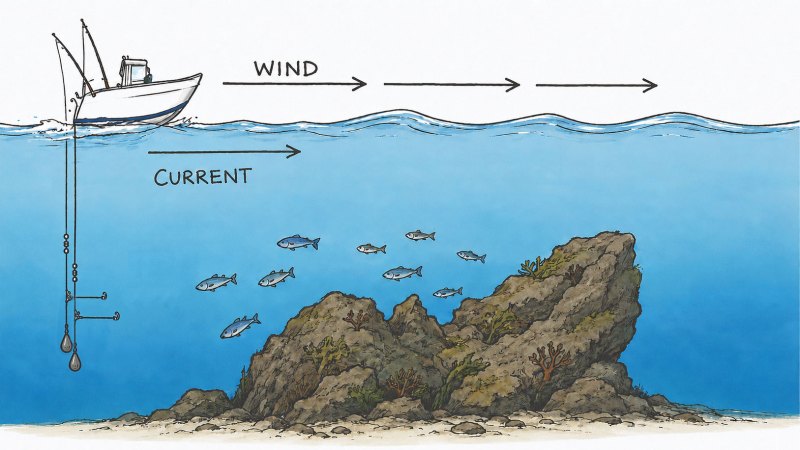
However, for your crew to drop vertically to the structure, it sometimes requires that you “lead” the spot to compensate for the drift. As illustrated above, this means positioning upwind or up-current before they drop baits. Time it right, and the baits will land in the strike zone and provide plenty of time to interest hungry fish as you drift along the structure zone.
By what distance should you lead the spot? It depends on two factors: bottom depth and the speed of the drift. There’s a third factor that has nothing to do with boat control—the weight of the sinker. The greater the depth and the faster the drift, the more weight is needed to keep the lines as vertical as possible over the bottom structure.
Trial and error will help you figure out how far upwind or up-current you need to position the boat to allow your crew’s baits to fish the productive structure.
Power-Drifting
Sometimes, wind and current make the drift too fast to keep lines vertical, no matter how heavy the sinker. The boat just sails by, lines scope out and snag the structure or never reach it. Rather than give up, try power-drifting. That is, using the propulsion system to slow the boat’s drift. This is often done in reverse, backing up against the current or wind to hold position or at least slow the boat drift over the spot and extend the time in the strike zone.
This requires acute attention at the wheel and throttle, and care must be taken not to back into heavy seas that can break over the transom and swamp the boat. Also, anglers must pay strict attention to their lines to prevent them from wrapping up in the running gear. When done properly and safely, it is proven way to stay on the spot and catch fish.
Read Next: The Differences Between Anchoring to Fish Versus Overnighting
Spot Lock
Depending on the depth, some skippers might also opt to anchor up to fish a structure in a stiff wind or current. However, today’s advanced technology offers skippers another, more convenient choice—electric GPS-guided bow-mounted trolling motors with a feature known generically as Spot Lock.
Trolling motors from brands such as Garmin, Minn Kota, Power Pole, Rhodan and Simrad are now powerful enough to “anchor” a 30-foot fishing machine in position, even in moderate wind or current. Saltwater trolling-motor shaft lengths as tall as 9 feet mean that big boats with high bows can take advantage of this technology, as can low-profile bay boats. Just drive to where you want to position the boat and press a button to “spot-up” and start fishing.
Whether you drift, power-drift, anchor-up or spot-up, there is no greater sense of fulfillment than putting your boat in a position for your crew to catch fish.