
An improperly loaded boat is inherently unsafe. Whether you prefer to be called captain, skipper, helmsman or driver, it is one of your many responsibilities to make sure your boat is loaded properly at all times. The life of your crew—and your own life—depends upon it.
I say “at all times” because loads can shift during the day, particularly that most mobile of recreational boat loads—the crew. A whale is spotted. “Ooooo! Ahhh!” Everyone moves to that side. Some spray comes over the windward gunwale. People move to the other side. Johnny wants to talk privately with Janey, or Jimmy doesn’t want to sit next to Jesse anymore. And so it goes. You know what I’m talking about. People move around the boat, which is OK within limits and depending upon the boat and the conditions.
People moving around affects smaller boats more than larger boats, and a larger number of people moving around has a bigger effect on the balance of any boat. We at the wheel need to be aware of crew movement and, when necessary, direct them to either move or stay put. I’ll offer examples from my own boating to illustrate.
My two college-age girls regularly invite friends aboard my center-console. They invariably all want to congregate in the bow where the view is great. The boat can readily handle eight or ten people, but only if they are spread out properly.
With six people in the bow, as skinny as they are, the boat is slower to rise to oncoming waves. Additionally, with this weight forward, the self-bailing cockpit drains much slower. I’ve tested this using the washdown hose to compare drainage rates. Also, my prop and outboard are now a few inches higher than they are when the boat is properly loaded and sitting on its lines. As such, there is less lift from the prop and less “rudder” in the water to provide optimal turning ability.
While running at cruising speed, and headed in a more or less straight line, the dynamic stability that a planing hull achieves delivers a false sense of security. The boat feels OK. Should I encounter a wave train or wake, the boat won’t rise to them readily; should I need to swerve to avoid some emergency, the boat will turn slower; should solid water come aboard, it will drain slower. For all of these reasons, I do not allow all of the guests aboard Breakaway to sit up front. Some are asked to sit aft. (Pro tip: Asking “Hey, wanna drive?“ is a great incentive for many to move.)
Read Next: Calculating Your Boat’s Power-to-Weight Ratio
When I take a moment to explain in a friendly manner that the boat is a good one, and safe, but isn’t a cruise ship, so we need to balance the load, the reception is always good, whether it’s the kids, neighbors, or whoever. Using “we” is key. That word gives the crew some of the responsibility and lets them know that they are not just passengers, but active participants in the day’s adventure.
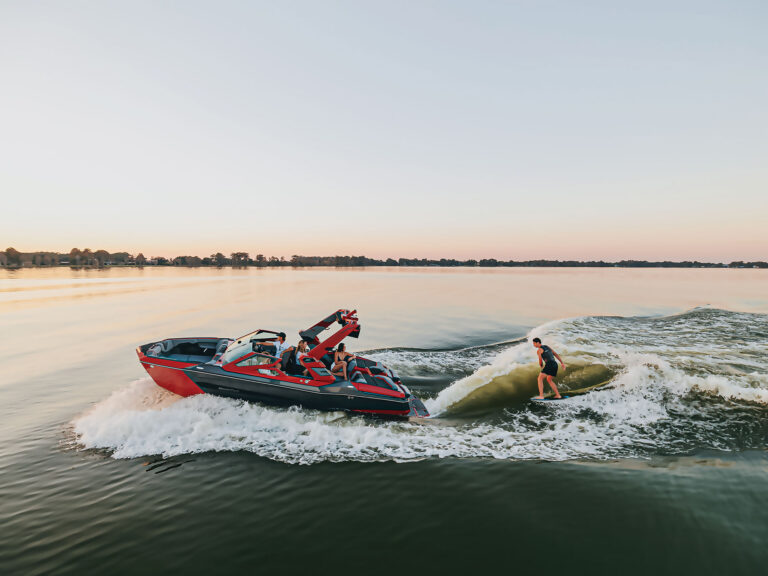
It is dangerous to run a boat with too much load on one side, in the stern, as well as in the bow. Boats are designed to run balanced and on their lines. With the popularity of open boats such as bowriders, dual consoles, center-consoles and pontoons, I see many boats overloaded by the bow. The US Coast Guard’s reports—as well as social media—are unfortunately chock-full of the bad results.
Don’t be or create a statistic. Load your boat evenly, properly and within the limits of its rating.